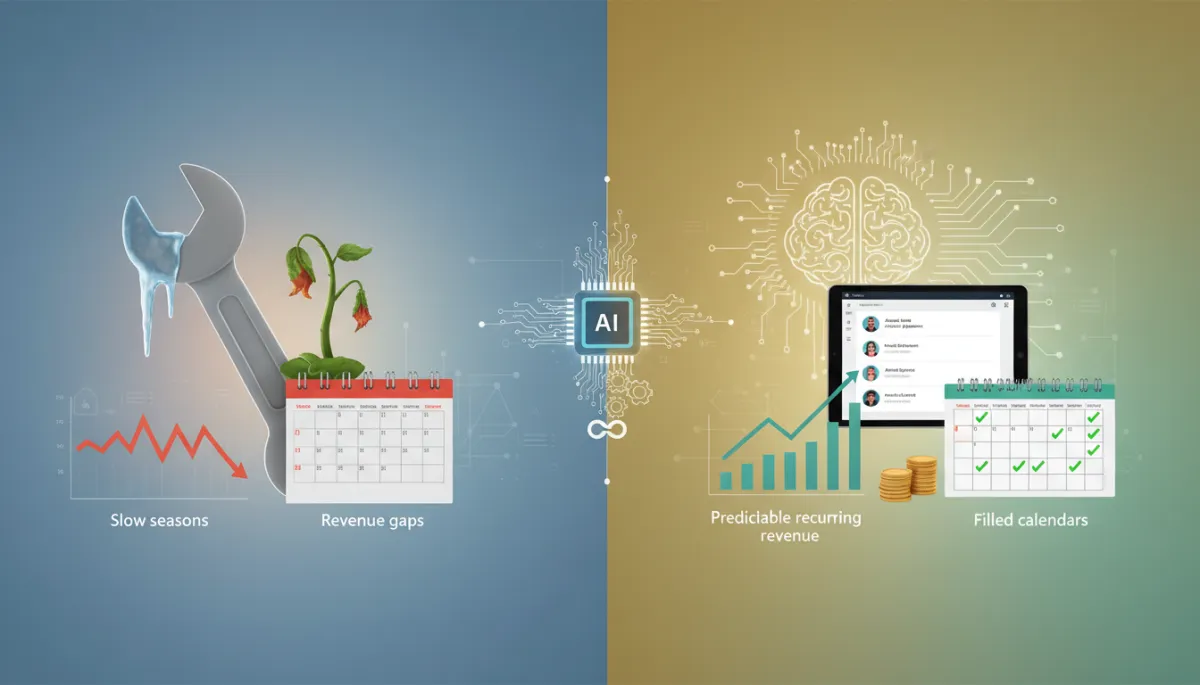
AI in HVAC: Boost Recurring Revenue with Maintenance Plans
HVAC, HVAC maintenance plan marketing, AI automation, Recurring Revenue
AI in HVAC: Boost Recurring Revenue with Maintenance Plans
In this article, we’ll walk through how AI-driven HVAC maintenance plan marketing can pre-sell annual service agreements, create predictable recurring revenue, and smooth out the slow seasons—using practical examples, simple math, and real-world workflows you can deploy with platforms like Instant Business Pro (IBP) for HVAC.
Why Is HVAC Revenue So Seasonal, and Why Does It Hurt Your Valuation?
Most HVAC contractors don’t have a marketing problem; they have a seasonality problem. Summer brings AC emergencies, winter brings no-heat calls, and then spring and fall go quiet. Trucks sit. Techs get sent home early. Cash flow tightens just when you’d like to invest in training or another vehicle.
Industry data shows that repair and maintenance services already contribute about 32% of total HVAC revenue, and average repair ticket values have climbed sharply since 2022. Yet most of that revenue is still reactive—you only earn when something breaks. This leaves tremendous upside on the table in the form of proactively sold maintenance agreements that lock in future work and stabilize your calendar.
💡 Key idea: Every service call is a chance to convert a one-time repair into a multi-year maintenance relationship. AI simply makes that conversion process automatic and consistent.
How Much Revenue Are You Leaving on the Table Without Maintenance Plan Pre-Sell?
Let’s connect the seasonality problem to real dollars. Consider a company doing around $1.5M/year in primarily reactive service and change-outs. That volume often represents several thousand past customers sitting in your database—most of whom do not have an active maintenance agreement with you.
In 2026, residential HVAC maintenance plans commonly run between $199 and $329 per year per system. To stay conservative, assume an average of $200/year per agreement. If your base has 1,000+ past customers and you could convert just 20–30% of them into plans, you’re looking at potential yields of $50,000 ARR, or roughly $4,167 MRR. Scale that to 400–600 agreements and you’re easily in the $80,000–$120,000/year range—enough to fund a full-time tech and a truck, even in the slow shoulder seasons. For many $1.5M shops, that’s $200,000–$400,000 in predictable revenue that is currently uncaptured.
How Can AI-Powered HVAC Maintenance Plan Marketing Pre-Sell Agreements Automatically?
Traditionally, selling service agreements has relied on techs making the pitch at the kitchen table or CSRs trying to upsell during booking. The problem is consistency: some techs are great at it, some hate selling, and everyone is busy during peak season. AI-powered marketing changes this by running always-on, personalized outreach in the background.
1. Segment and score your past customers
AI-driven platforms like IBP for HVAC can ingest your existing customer list—names, phone numbers, service history, equipment age, and location—and automatically segment it into high-probability maintenance plan candidates. For example:
Homeowners with systems 3–10 years old and no maintenance agreement on file.
Customers who had a repair last season but no tune-up this year.
High-value zip codes with more than one system per home.
The AI can assign a simple score (e.g., 0–100) indicating who is most likely to respond to a maintenance plan offer, ensuring your campaigns start where the likelihood of success is highest.
2. Launch AI-powered text and email campaigns that feel human
Once you know who to contact, AI can run multi-touch campaigns across SMS, email, and even voicemail drops. The messaging is personalized by equipment type, local weather, and service history.
Under the hood, a platform like IBP uses trained language models to generate variations of the offer message, test subject lines, and optimize send times based on when your list tends to respond. As a contractor, you see the results in a simple dashboard rather than managing all the logic yourself.
3. Use AI to handle objections and close via text, without manual calls
The real power comes when AI doesn’t just send a blast, but also holds the conversation. Modern AI follow-up tools, like the lead nurturing engine in IBP, can respond to common objections over SMS or web chat:
“What’s included in the plan?”
“Can I cancel anytime?”
“We’re at 6,000 feet in Colorado—does altitude change what we need?”
You can think of it as a virtual CSR that runs 24/7. In implementation, we often configure a simple state machine: once the customer replies with a keyword like “YES” or completes a short link form, the AI updates their status to Plan-Sold and triggers a scheduling workflow for their first tune-up.
4. Capture missed calls and convert them into maintenance plan members
A surprising amount of maintenance plan opportunity comes from people who tried to reach you but never connected. With tools like IBP’s missed-call text-back system, every missed call automatically receives a text within seconds:
“Sorry we missed your call! This is Rocky Peak Heating & Air. Are you calling about a repair, tune-up, or our annual maintenance plan?”
The AI then routes the conversation appropriately and can offer a discounted first-year service agreement to callers who would otherwise have hung up and dialed a competitor. This is low-hanging fruit that most shops ignore.
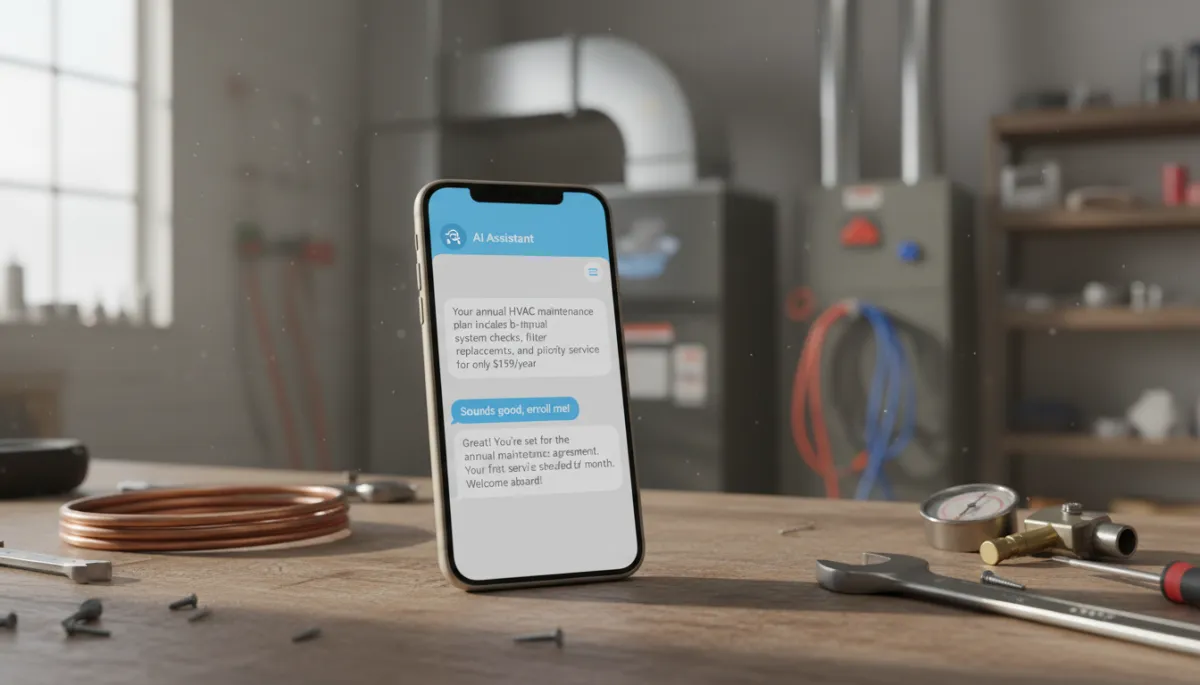
AI text follow-up turns missed calls and past jobs into recurring maintenance plan revenue.
What Does the ROI of HVAC Maintenance Plan Automation Actually Look Like?
Let’s break down the ROI with realistic numbers that many contractors can hit within 6–12 months of launching AI-powered HVAC maintenance plan automation:
Base case: 200 customers × $200/year = $40,000 ARR.
Moderate case: 400 customers × $220/year = $88,000 ARR.
Aggressive case: 600 customers × $250/year = $150,000 ARR.
That top scenario alone can cover:
One full-time tech’s salary and benefits.
A fully equipped truck and tools.
A significant portion of your AI platform and marketing stack.
And that’s before factoring in:
Higher customer lifetime value (LTV): plan members buy more replacements and accessories over time.
Fewer emergency discounts: you’re not discounting panicked same-day jobs as often because systems are maintained.
Improved company valuation: private equity and buyers pay higher multiples for businesses with 40%+ recurring revenue from agreements.
📌 Key takeaway: AI doesn’t just save admin time; it unlocks a recurring revenue stream that can add 2–6× EBITDA to your eventual exit value.
How Does This Help Fill the Calendar During Slow Seasons?
The real operational win isn’t just extra revenue; it’s calendar control. With a critical mass of maintenance agreements, your AI system can auto-schedule tune-ups into your slow weeks instead of trying to cram them into peak season when everyone is already slammed.
For example, IBP’s AI follow-up tools can:
Identify members whose spring or fall visit is due within 30–60 days.
Automatically send SMS and email nudges with links to your booking page.
Offer priority scheduling on historically slow days (e.g., Tuesdays in April).
Over time, this flattens the peaks and fills the valleys. Your techs stay busy and billable in March, April, September, and October—when they would otherwise be waiting for the phone to ring.
Colorado HVAC Use Case: Altitude, Climate, and AI-Driven Maintenance Plans
To make this concrete, consider a mid-sized HVAC contractor along Colorado’s Front Range—serving Denver, Boulder, and nearby foothill communities at 5,000–6,000 feet. The climate swings from hot, dry summers to freezing winters, with shoulder seasons that can feel dead from a dispatch perspective.
At altitude, systems work harder: thinner air changes heat transfer characteristics, and large temperature swings stress equipment. That makes preventive maintenance even more critical, but homeowners rarely connect those dots on their own. An AI-powered campaign can:
Reference local weather patterns (“Before the first big Front Range cold snap…”).
Educate on altitude-related wear (“At 5,280 feet, your system runs longer and harder each season…”).
Offer a maintenance plan that includes both AC and furnace tune-ups timed around Colorado’s shoulder seasons.
In practice, I’ve seen Colorado contractors use AI-driven lifecycle automation (similar to what Summit Mechanical did with equipment replacement campaigns) to achieve double-digit percentage lifts in both maintenance plan enrollments and renewals. The same logic that identifies aging systems for replacement can flag customers due for tune-ups and push them into automated outreach sequences.
How Do IBP Tiers Support HVAC Maintenance Plan Automation Without Overcomplicating Your Stack?
From a software engineering standpoint, the goal is to keep your workflow simple while the AI does the heavy lifting. Instant Business Pro offers multiple tiers—ranging from a core automation tier focused on lead capture and follow-up, to more advanced tiers that add multi-location support, deeper analytics, and custom AI models. At a high level:
The entry tier can handle basic lead capture, missed-call text-back, and simple maintenance plan campaigns.
Mid-tier offerings add robust AI lead nurturing, multi-step workflows, and more advanced reporting on conversion rates by campaign.
Top tiers support larger organizations, with multi-brand setups, API integrations, and custom behavior tuned to your specific service area and customer base.
The important thing is that you do not need to become a programmer to benefit. The underlying logic—like the for-loops and conditionals you saw earlier—is abstracted into visual workflows. You define your offer, approve the messaging, and the AI takes care of contacting the right customers at the right time and following up until they say “yes” or “no.”
What Are the First Practical Steps to Launch HVAC Maintenance Plan Automation?
Clean and import your customer list. Export from your CRM or invoicing tool, remove obvious duplicates, and ensure you have phone numbers and emails where possible.
Define a simple, compelling maintenance plan. For example: two visits per year, priority scheduling, no diagnostic fee, and 15% off repairs for $200–$250/year.
Set up AI campaigns in a platform like IBP. Use the built-in HVAC templates, then localize them to your city, climate, and brand voice. Configure missed-call text-back and web chat to mention your maintenance plan as an option on all new inquiries.
Track key metrics. Monitor how many contacts are reached, how many conversations start, and how many plans are sold each week. Use that data to refine your offers and scripts.
Within 60–90 days, most contractors see a clear pattern: maintenance agreements begin to stack, recurring revenue grows, and the fear of slow seasons starts to fade as your calendar fills with pre-scheduled tune-ups rather than last-minute scrambles.
Final Thoughts: Turn AI Into a Maintenance Plan Sales Tech Who Never Sleeps
HVAC maintenance plan marketing doesn’t have to mean more pressure on your techs or CSRs. With AI-powered outreach, objection handling, and enrollment workflows, you can pre-sell HVAC service agreements at scale, build stable HVAC recurring revenue, and keep your crews productive all year—even in markets with extreme seasonality like Colorado’s Front Range.
If you’re currently doing $1.5M or more in reactive service, the numbers strongly suggest you’re leaving hundreds of thousands of dollars in predictable maintenance plan revenue on the table. AI gives you a practical, low-friction way to capture that opportunity without hiring an army of salespeople or spending your evenings manually following up on quotes.
To explore how AI lead nurturing, follow-up, and missed-call text-back could work in your specific market, you can review the HVAC-focused capabilities at IBP for HVAC and the dedicated missed-call text-back solution. Even a small pilot—targeting a few hundred past customers—can validate the ROI and give you a clear roadmap to scaling a profitable, agreement-driven service department.
You don’t have to accept feast-or-famine as “just how HVAC works.” With the right AI-powered HVAC maintenance plan automation in place, you can turn your existing customer base into a steady, growing stream of recurring revenue—and give your team the stability and predictability they deserve.
