
Boost Contractor Business with AI Reactivation
Home Services, Customer Reactivation, AI Automation
How Colorado Contractors Recover $8K–$15K from Dead Leads Using a 3-Step AI Reactivation Sequence
As a senior software engineer who has helped home service contractors implement automation, I see the same pattern everywhere: you are paying to generate leads, doing great work in the field, then leaving tens or hundreds of thousands of dollars on the table by never systematically re-engaging past customers and cold leads. AI-powered customer reactivation campaigns change that by turning your old database into a predictable, low-cost source of booked jobs.
Why do contractors leave so many past customers and leads on the table?
Most home service contractors I talk to have the same story: years of invoices in QuickBooks, a CRM full of old leads, and call logs stacked with people who never booked. Once the job is done or the lead goes cold, those contacts rarely hear from you again. From a technical perspective, your data is just sitting there—no workflows, no triggers, no systematic reactivation logic. From a business perspective, it is a silent leak in your revenue bucket.
For a typical HVAC, plumbing, roofing, or electrical company that has been operating for 3–5+ years, it is common to see:
1,000–5,000 past customers in various systems (CRM, invoicing, spreadsheets)
Hundreds of “never booked” estimates, web form submissions, and missed calls that were never followed up properly
Zero structured customer reactivation campaigns for contractors beyond the occasional seasonal email blast—if that
This is exactly the gap Instant Business Pro (IBP) is designed to close, with AI lead recovery, nurturing tools, and missed-call text-back automation that ensure no contact is left behind.
How much does it really cost to ignore lapsed customers and dormant leads?
When you look at the numbers, the cost is staggering. Every lapsed customer you never re-engage represents roughly $500–$5,000+ in lost repeat revenue per year, depending on your trade and average ticket size. For many contractors, that range is conservative.
Consider a simple example for an HVAC contractor:
Average service ticket: $450
Average replacement/installation ticket: $6,800
Reasonable expectation: one maintenance visit + one bigger job every 5–7 years for a satisfied customer
Spread across time, that easily falls into the $500–$5,000+ annualized opportunity range. Now multiply that by 500–2,000 lapsed customers and dormant leads in your system. You are looking at a potential seven-figure revenue hole. Research on AI in marketing from Forbes and Gartner consistently shows that reactivation and retention campaigns deliver some of the highest ROI because you are working with people who already know your brand ( Forbes Tech Council , Gartner ).
📌 Key Takeaway: If you are spending thousands per month on ads and lead services while ignoring your existing database, you are effectively paying a “silent tax” on every new job you book.
How do AI reactivation SMS and email sequences work for home service contractors?
AI reactivation sequences are structured workflows that automatically reach out to past customers and cold leads via SMS and email, using AI to personalize timing, message content, and follow-up logic. Instead of a one-off blast, you get a multi-touch, behavior-aware campaign that feels like a human office manager doing perfect follow-up at scale.
In tools like IBP’s AI lead recovery and nurturing engine, the high-level flow looks like this:
Import your historical contacts (customers, estimates, web leads, missed calls).
AI segments them (past customer, estimate not sold, missed call, stale web form, etc.).
For each segment, the system launches tailored SMS and email sequences with relevant offers and language.
AI monitors replies and engagement, adjusts follow-ups, and routes hot leads directly to your office or booking link.
Under the hood, this is driven by rules and models that look at last service date, job type, location, and historical behavior.
In practice, IBP’s AI reactivation sequences incorporate message variation, reply understanding, and time-of-day optimization, but the core idea is the same: every contact is automatically placed into the right re-engagement path.
How do AI-powered customer reactivation campaigns actually re-engage past clients?
The strength of AI reactivation sequences is personalization at scale. Instead of blasting “Hey, we miss you” to everyone, the system can reference specific services, timelines, and homeowner concerns that matter to each contact. For example, IBP can generate different copy for:
A water heater install from 3 years ago (“time for a check-up and flush”)
A roof repair after a hailstorm (“free inspection before the next storm season”)
A missed-call estimate that never got booked (“we tried to reach you earlier, still want help with your project?”)
IBP’s missed-call text-back feature closes the loop for new inbound opportunities, while the AI reactivation sequences sweep back through older contacts. Together, they form a full contractor lead recovery system that keeps your funnel warm.
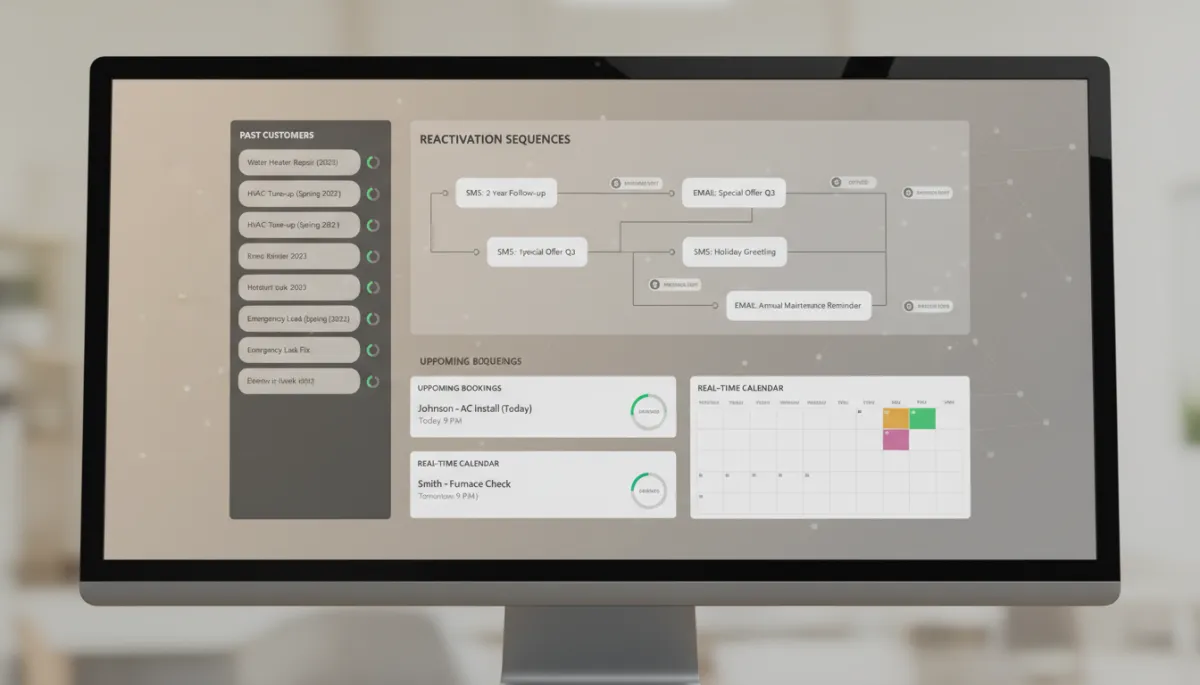
Automated AI reactivation sequences quietly convert old contacts into fresh booked jobs.
What ROI can contractors expect from AI reactivation sequences and lead recovery?
While exact ROI varies by market and trade, AI-driven reactivation campaigns consistently outperform cold advertising. Industry research on AI in marketing shows that reactivation and retention-focused campaigns often deliver some of the highest returns because acquisition costs are effectively near zero ( Marketing Dive ).
Let us walk through realistic numbers for a mid-size contractor using IBP’s AI reactivation sequences and contractor lead recovery tools.
Example ROI model (conservative)
2,000 contacts imported (past customers + cold leads)
25% valid and reachable via SMS/email → 500 contacts engaged in sequences
15% of engaged contacts respond meaningfully → 75 conversations
40% of conversations convert to booked jobs → 30 jobs
If your average job value is $750, that is $22,500 in recovered revenue from a single pass through your old database. For trades with higher average tickets (roofing, remodeling, solar), that number can easily climb into the six figures from the same 2,000 contacts.
Now compare that to your typical ad spend. Many contractors are spending $3,000–$15,000 per month on Google Ads, LSA, or lead marketplaces just to keep the phones ringing. AI reactivation campaigns for contractors let you generate similar or better revenue without the constant acquisition cost. That is why AI lifecycle automation case studies in home services, like Summit Mechanical in Colorado, are reporting ROI figures north of 2,000% on proactive outreach efforts ( US Tech Automations ).
💡 Pro Tip: Even a 3–5% reactivation rate on a large database can pay for a full year of AI automation tools in a single month.
How does a Colorado contractor use AI reactivation to fill their schedule?
To make this concrete, let us look at how a Colorado home service contractor could deploy AI reactivation sequences in the real world, drawing inspiration from local case studies.
Colorado HVAC & plumbing example
Imagine “Front Range Comfort,” a 10-truck HVAC and plumbing company in the Denver metro area. Over the last 6 years, they have built a database of 6,500 customers and 1,200 unsold estimates. Like Summit Mechanical in Colorado, they are starting to see that proactive lifecycle outreach can unlock significant replacement and maintenance revenue, especially given the region’s temperature swings and high-altitude equipment wear.
With IBP’s AI lead recovery and nurturing tools, they implement three core AI reactivation sequences:
Seasonal tune-up reactivation: Contacts who had installs or major repairs 18–36 months ago receive SMS and email offers for discounted tune-ups before winter or summer peaks.
Unsold estimate follow-up: All open estimates older than 30 days are placed into a gentle AI-driven follow-up series offering updated pricing, financing, or alternate options.
Missed call & web lead recovery: Using IBP’s missed-call text-back , anyone who calls but does not connect, or fills out a form without booking, gets an instant AI-powered SMS asking a few qualifying questions and guiding them to schedule.
Over 12 months, a scenario similar to the Summit Mechanical case is realistic:
30–40% more replacement sales driven by lifecycle and reactivation outreach
Contact response times reduced from days to minutes thanks to automated SMS flows
A pipeline of maintenance club members generated almost entirely from past customers re-engaged by AI
The result is a reactivated pipeline and a schedule filled with customers who already trust them—without outspending competitors on ads.
How does IBP structure AI reactivation tiers for contractors?
From an engineering standpoint, contractors do not need to design these workflows from scratch. IBP packages AI reactivation and lead recovery into clear tiers so you can start where you are and scale up as you see results. While specific pricing is not listed here, the tiers typically look like:
IBP Core: Foundational tools including CRM, basic automation, and essential follow-up for new leads and simple reactivation campaigns for contractors.
IBP Growth: Adds AI-powered SMS/email sequences, more advanced segmentation, and enhanced contractor lead recovery workflows for missed calls and stale estimates.
IBP Elite: Full AI orchestration, multi-channel nurturing, deeper integrations, and optimization across your entire customer lifecycle—from first call to long-term reactivation.
Each tier is designed so that a non-technical office manager can run the system day-to-day, while still giving you the kind of logic and automation a developer would build internally. If you want to see how the platform fits into your existing stack, you can explore more details on IBP’s main site and specific automation features like missed-call text-back and AI follow-up workflows.
What does implementation look like for a busy contractor team?
One concern I hear from owners and ops managers is, “This sounds great, but my team is already slammed. Who is going to set this up?” From a technical and operational standpoint, a typical implementation with IBP follows a straightforward path:
Data import & cleanup: Export contacts from your CRM, invoicing system, or spreadsheets and import them into IBP. The platform assists with deduplication and tagging (past customer, lead, estimate, missed call).
Segment definition: Decide which segments to target first (e.g., “no contact in 18 months,” “unsold estimates over $2,000,” “missed calls last 90 days”).
Sequence selection: Choose from pre-built AI reactivation sequences for your trade and customize the tone and offers to match your brand.
Go-live & monitoring: Turn on the campaigns, monitor initial responses, and adjust message timing and frequency based on your team’s capacity to handle new jobs.
As a developer, I appreciate that the heavy lifting—event scheduling, message templating, reply parsing—is abstracted away. Contractors get the benefits of a custom-built automation stack without writing a line of code or hiring an in-house engineering team.
How can you start re-engaging past clients and dormant leads today?
If you are a home service contractor, the fastest path to results is not another ad campaign—it is unlocking the value in the customer data you already own. AI reactivation sequences give you a way to systematically re-engage past clients, follow up with dormant leads who never booked, and recover missed-call opportunities before they go to a competitor.
With IBP’s AI lead recovery and nurturing tools, you can:
Launch targeted customer reactivation campaigns for contractors in days, not months.
Automatically re-engage past clients with relevant offers and reminders at the right time.
Turn missed calls and cold leads into booked jobs using AI-driven SMS and email sequences.
If you want to see how this could look for your business, a practical next step is to review how IBP’s missed-call text-back and AI reactivation features fit into your current lead flow. Even a single pilot campaign on a small segment of your database can demonstrate the impact: a reactivated pipeline, more booked jobs, and higher lifetime value from customers who already trust you.
You do not need to overhaul your entire operation overnight. Start with one reactivation sequence, measure the results, and let the numbers guide your next move. The data is already in your systems—AI just gives you a smarter way to put it back to work.
