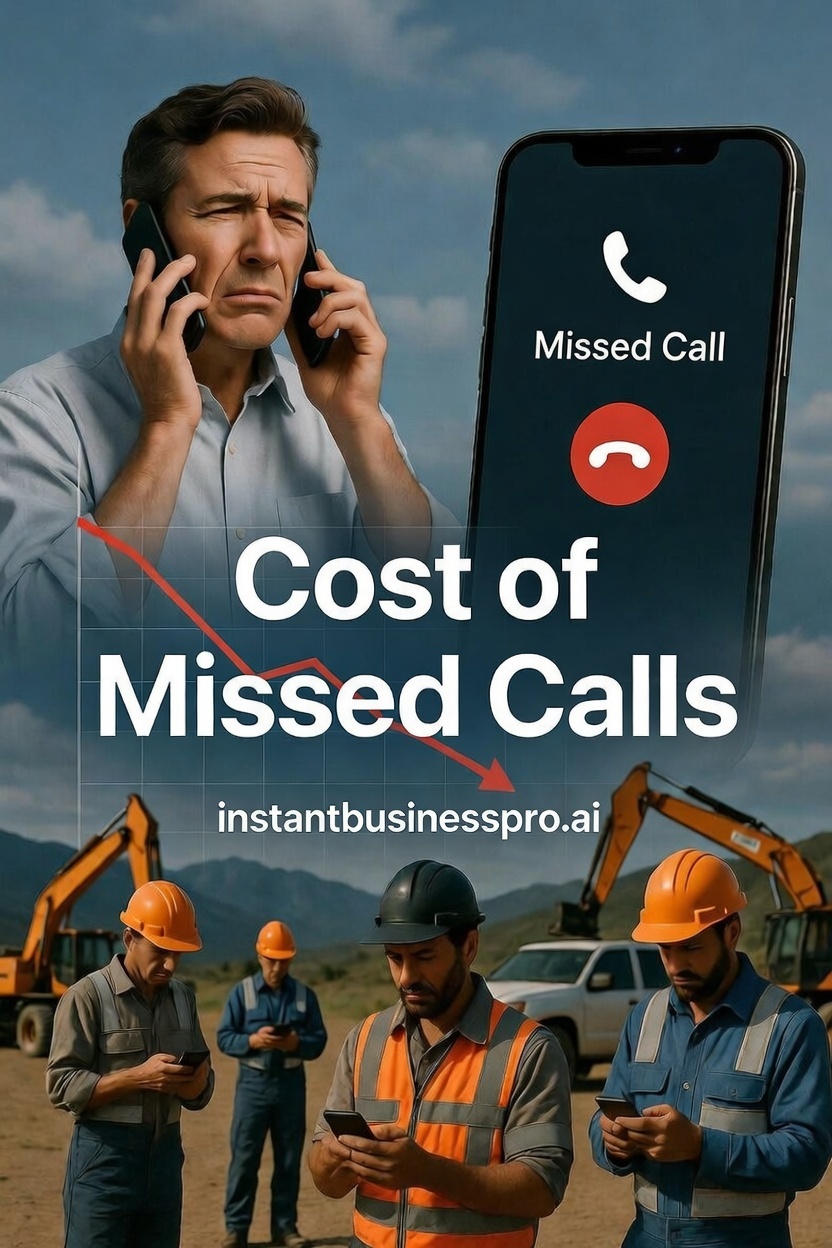
The Real Cost of Missed Calls for Contractors in 2026 – $45K–$120K Lost Annually
The Real Cost of Missed Calls for Contractors in 2026 – How to Stop Losing $45,000–$120,000 Per Year
Quick Answer: What You Need to Know
According to Invoca's research, 27% of calls to home service businesses go unanswered— the industry-wide baseline
Each missed call costs home service contractors an average of $1,200 in lost revenue (Invoca, 2025)
Less than 3% of callers leave a voicemail when sent to voicemail — the rest hang up and call your competitor (Invoca platform data)
85% of callers who don't reach a live answer won't call back (multiple home services studies, 2025)
Annual revenue loss for the average small contracting business:$45,000–$120,000, based on data from 1,200+ contractors across HVAC, plumbing, electrical, and general contracting
The fix: AI-powered missed call text-back that responds in under 30 seconds, 24/7 — no extra staff required
Picture this: It's 11:30 on a Tuesday night in January. A homeowner in Parker just realized their furnace isn't struggling — it's dead. Fourteen degrees outside, kids in bed, and they're on their phone searching "emergency HVAC Parker CO." They call the first number. It rings. Nobody answers.
They dial the second number. Same result.
By the time they reach the third contractor — one who responds within 30 seconds — the job is booked. The first two contractors will never even know they lost it.
That scenario plays out dozens of times every week across the Denver metro, Fort Collins, Colorado Springs, Castle Rock, Elizabeth, and the entire I-25 corridor. And if you're running a contracting business without a real answer to missed calls, there's a good chance you're one of those first two contractors more often than you realize.
1. The 2026 Data: How Many Calls Are Contractors Actually Missing?
The numbers here come from real research — not estimates pulled from thin air.
According to Invoca's call analytics data, 27% of calls to home services businesses go unanswered. That's the industry-wide average across HVAC, plumbing, roofing, electrical, and general contracting — roughly one in four calls hitting dead air before a single word is spoken.
A separate 30-day study by 411 Locals, monitoring 85 businesses across 58 industries, found that those businesses answered only 37.8% of incoming calls — meaning nearly two out of three potential customers never spoke to anyone.
The after-hours picture is worse. Estimates from contractor call analytics platforms suggest the miss rate climbs significantly during evenings, weekends, and holidays — the same windows when Colorado's weather emergencies tend to peak.
Here's what the data says about what happens after a missed call:
Less than 3% of callers leave a voicemail when sent to one, according to Invoca's platform data. That's not a typo. The vast majority hang up immediately. And according to research consistently cited across home services studies from 2025, 85% of callers who don't reach a live answer won't attempt a second call. They've already moved on to the next contractor in their search results.
For a typical Colorado contractor receiving 15–25 inbound calls per day — a realistic volume in active markets like the Denver metro — this translates to hundreds of missed opportunities annually that most owners never see on any report.
Colorado's weather patterns make the problem worse. Hail tears through the Front Range and roofing phones light up overnight. A January cold snap and HVAC contractors are fielding calls at 6 AM. A July heat wave hits Denver and every AC company in the metro is fielding calls simultaneously. These are your highest-value jobs — and they go to whoever responds first.
2. The Revenue Math: What Each Missed Call Is Costing You
According to Invoca's research, the average missed call costs a home services business $1,200 in lost revenue. That's not a one-time job value — that's what each unanswered ring costs when you account for close rates and job values across trades.
Here are conservative 2025–2026 averages by trade:
HVAC service calls and installs:$800–$3,500 (emergency no-heat or AC repairs often $1,500+; full system replacements higher)
Plumbing jobs:$500–$2,500 (burst pipe emergencies frequently $1,200+)
Roofing repairs and replacements:$5,000–$15,000+ (storm damage averages $8,000–$12,000)
Decking and general contracting:$2,000–$10,000+ (custom outdoor living or remodel work often higher)
Now run the math on what that actually costs annually. Data from 1,200+ contractors across plumbing, HVAC, electrical, and general contracting shows the average small contracting business loses $45,000–$120,000 per year to unanswered phone calls. In higher-ticket trades — roofing after a hail storm, HVAC during a freeze — the ceiling goes well past $200,000.
The real tragedy is that these aren't cold leads. They weren't browsing. They called because they needed help immediately. They were already qualified.
3. Why This Happens to Good, Hardworking Contractors
This isn't a people problem. It's a structural one.
You're in the field — on a roof in Parker, under a sink in Castle Rock, or driving between jobs in Fort Collins. The phone goes unanswered because you're doing the work that pays the bills. That's not negligence; that's just how the job works.
After-hours gaps are unavoidable without the right system. A significant portion of contractor inquiries — estimates from home services platforms suggest it's roughly half — arrive outside traditional business hours. Staffing those windows with a human receptionist costs $35,000–$45,000 per year in salary alone (not counting benefits or overtime), and still doesn't solve the 2 AM emergency call.
Traditional answering services fall short. They typically cost $200–$500 per month, often feel impersonal, and still don't provide the instant response that wins jobs in a competitive market. By the time a message is relayed and you call back, the homeowner has already booked someone else.
As research on home services consumer behavior confirms: in an emergency, speed is the deciding factor. The contractor who answers first captures the job — not necessarily the one with the best reviews or the lowest price.
4. The 2026 Fix: AI-Powered Instant Response
The solution isn't more staff. It's a smarter system that responds instantly whether you're on a job site, asleep, or driving between calls.
Instant Business Pro — a Colorado-based AI automation platform built specifically for contractors — delivers a genuine zero-loss response system:
Missed call detection and response in under 30 seconds. The moment a call goes unanswered, the system fires a personalized, professional text message — not a generic "thanks for calling" script, but a real, trade-specific message that reads like it came from you:
"Hey, this is [Your Business Name] — sorry we missed you. Are you dealing with a no-heat emergency or routine maintenance? We're dispatching today."
Trade-specific qualification built in. The AI asks the right follow-up questions for your trade: storm damage vs. full replacement for roofing, burst pipe vs. clog for plumbing, no-heat emergency vs. seasonal tune-up for HVAC. Leads are qualified before you ever pick up the phone.
Direct booking and dispatch. Calendar links sync with Jobber and QuickBooks. Emergency calls get immediate dispatch alerts. Non-urgent leads enter a nurture sequence. Nothing slips through.
Full CRM logging. Every interaction — every text exchange, every booked appointment — is recorded and pushed to your system automatically.
Contractors running this setup consistently reduce their missed call rate to under 10% and recover 30–50% more booked jobs from leads that previously went unanswered.
5. Real Results from Colorado Contractors
A Denver-area HVAC contractor was losing roughly 25% of summer surge calls before implementing AI text-back. Within 60 days:
Response time dropped from hours to under a minute
Booked appointments increased 42%
Recovered revenue in the first season: approximately $65,000
A roofing contractor along the I-25 corridor recovered multiple hail-season jobs by qualifying leads instantly — including one $12,000 roof replacement that would have gone to a competitor who answered faster.
A Colorado Springs plumbing company reduced their after-hours losses by 38%, turning weekend pipe-burst calls into dispatched emergency jobs instead of missed opportunities.
These aren't outliers. They're the predictable result of closing the speed-to-lead gap in a market where the first response wins.
6. Stop Funding Your Competitors' Growth
You've already done the hard part. You built a business people trust enough to call when something goes wrong. The only reason you're losing these jobs is a timing gap — calls arriving when you physically can't answer them.
That's fixable. And when you fix it, the revenue you recover isn't new marketing spend. It's money that was already yours — earned by the reputation you've spent years building.
Text AUDIT to (720) 973-1369 for your free missed call revenue projection. We'll analyze your call patterns and show you exactly what you're losing — and what recovering it looks like in real numbers.
See how AI handles HVAC emergencies →instantbusinesspro.ai/hvac
Full contractor marketing automation guide →instantbusinesspro.ai/post/the-complete-guide-to-contractor-marketing-automation-2026
Frequently Asked Questions
How many calls does the average contractor miss per day?
Based on Invoca's research showing a 27% industry-wide miss rate, a contractor receiving 15–25 inbound calls per day can expect to miss roughly 4–7 calls daily under normal conditions — more during surge windows like Colorado's hail season or winter freeze events.
What does a missed call actually cost an HVAC or plumbing contractor?
According to Invoca's 2025 data, the average missed call costs a home services business $1,200 in lost revenue. For emergency trades like HVAC and plumbing, where job values frequently exceed $1,500–$2,500, the per-call loss can be significantly higher.
How much revenue are contractors losing to missed calls annually?
Data from 1,200+ contractors across HVAC, plumbing, electrical, and general contracting shows the average small contracting business loses $45,000–$120,000 per year to unanswered calls. In high-ticket trades like roofing or in markets with high call volume, annual losses can exceed $200,000.
Do callers actually leave voicemails when they can't reach a contractor?
Almost never. Invoca's platform data shows that less than 3% of callers who are sent to voicemail actually leave a message. The overwhelming majority hang up immediately and call the next contractor in their search results.
Will a caller try back if they don't reach someone the first time?
Research consistently shows that 85% of callers who don't reach a live answer on the first attempt will not call back. In emergency situations — burst pipes, no-heat calls, storm damage — that number is effectively 100%. They need help now, not later.
Why do contractors miss so many calls even when they're working hard?
The causes are structural, not personal. Field work physically prevents answering the phone — you can't be on a roof and on a call simultaneously. After-hours and weekend gaps exist because most small teams can't staff 24/7 without burning out. It's a systems problem, not a work ethic problem.
What is AI text-back and how does it work for contractors?
AI text-back is an automated system that detects a missed call and sends a personalized text response in under 30 seconds. For contractors, the message is customized to your trade and business — asking qualifying questions, providing your business name and location, and directing the homeowner toward booking. The goal is to keep the lead engaged before they call a competitor.
How quickly does speed-to-lead actually matter for home services?
In competitive local search — especially during emergency situations — response time is often the deciding factor over price, reviews, or experience. Studies on home services consumer behavior confirm that the first contractor to respond wins the majority of emergency jobs. Even a 5–10 minute delay significantly reduces conversion rates compared to a 30-second response.
Does AI text-back work for after-hours and weekend calls in Colorado?
Yes — and that's where it matters most. Colorado's weather-driven demand creates sudden surges in after-hours call volume: winter furnace failures, spring hail damage, summer AC emergencies. AI text-back operates 24/7, meaning those high-value emergency calls get an immediate response even when your team is off the clock.
How long does it take to see ROI from AI missed call automation?
Based on contractor results using the Instant Business Pro system, most see measurable ROI within the first 30–60 days. At an average recovered job value of $1,200 and a 30–50% recovery rate on previously lost leads, the system typically pays for itself many times over within the first month of implementation
