Do contractors need a CRM?
CRM for contractors, home service businesses, automation
Do Colorado Contractors Actually Need a CRM in 2026? (The Honest Answer If You're Doing Under $500K/Year)
A CRM for contractors keeps every lead, customer conversation, estimate, job stage, and review request in one organized system so you respond faster, follow up automatically, and stop losing work because someone forgot to call or text back — and whether you need one comes down to how many leads you handle, how often follow-up slips, and how serious you are about growing a smooth, professional home service business in 2026.
If you run a plumbing, HVAC, roofing, electrical, or painting business in Colorado, you have probably heard the term CRM and wondered what it actually does. Maybe a marketer pitched you “contractor CRM software 2026” with a long feature list that did not feel connected to the real world of job sites, late-night emergencies, and customers who text instead of call.
What Is a CRM in Plain Contractor Language?
CRM stands for Customer Relationship Management. In simple terms, it is a central place where you store and manage everything about your leads and customers. Instead of juggling spreadsheets, sticky notes, call logs, and text messages across multiple phones, a CRM puts it all in one organized system that your team can see and update.
Think of it as a digital whiteboard plus notebook plus follow-up assistant. A good CRM for home service businesses shows you who just reached out, where each job sits in your pipeline, what was promised, and what needs to happen next so the work actually closes and the customer is taken care of.
What Does a CRM Do for Contractors Day to Day?
When you ask what does a CRM do, the real answer depends on your trade and how you work. For Colorado home service contractors, the most valuable functions fall into a few clear buckets.
1. Lead capture and tracking in a simple pipeline
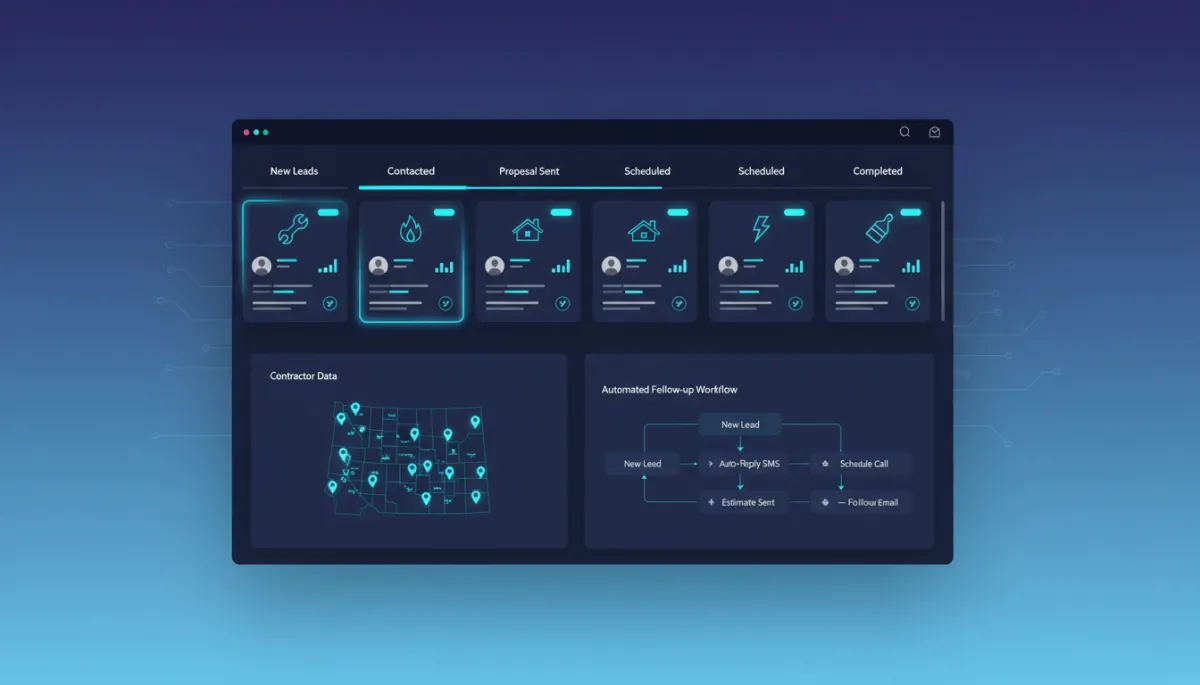
A CRM collects leads from your website forms, Google Local Services Ads, Facebook, call tracking numbers, and even manual entries from the phone. Each lead becomes a record with name, contact info, service requested, source, and notes. Those records move through stages such as New Lead, Estimate Scheduled, Estimate Sent, Job Won, and Job Lost so you always know your pipeline at a glance.
Research on contractor CRMs shows that fast response is critical — responding within five minutes can make a lead more than twenty times more likely to qualify. A clear pipeline helps you see which new leads still need a call or text right now rather than tomorrow.
2. Automated follow-up so you stop leaving money on the table
Most small contracting teams lose jobs not because they are too expensive, but because they never follow up. You send an estimate, get busy on another project, and the homeowner hires whoever checked back in. Modern contractor CRM software 2026 solves this with automated follow-up sequences by text and email that go out on day two, day five, and day ten, or on whatever schedule fits your sales cycle.
Instead of relying on memory, the system reminds prospects that you are still ready to help, answers common questions, and can even invite them to book online. This is where CRM for contractors overlaps with lead automation and AI — if you want a deeper plain-language breakdown, see the guide on what lead automation means for contractors .
3. Complete customer history in one place
A strong CRM for home service businesses keeps a full timeline for each customer. You can see every call, text, email, estimate, work order, invoice, and note in one record. That means anyone on your team can pick up the conversation without asking the homeowner to repeat the story or digging through old texts on a personal phone.
Over time this history becomes valuable data. You can see which neighborhoods generate the best jobs, which service lines are most profitable, and which repeat customers are worth proactive check-ins before busy seasons.
4. Automated review requests and reputation building
After a job wraps, your CRM can automatically send a text or email asking the customer to leave a Google review with a direct link. Consistent review requests matter — especially in competitive Colorado markets where homeowners compare dozens of contractors before calling. Automating this step keeps your reputation growing even when your crew is already on the next project.
Do You Actually Need a CRM for Your Contracting Business?
The honest answer to do I need a CRM for my contracting business is that not every single solo operator needs full-blown software, but most growing teams do. The decision should be based on clear indicators, not hype.
Signs you probably need a CRM now
You regularly forget to call or text back at least a few leads each week and only notice when they show up on a competitor’s reviews.
Your leads come from multiple places — phone, web forms, ads, referrals — and you have no single list that shows all open opportunities.
More than one person answers calls or handles estimates, and information gets lost between office, field, and after-hours coverage.
You cannot quickly answer basic questions like how many estimates you sent last month, or what close rate you have on roof replacements versus repairs.
You know your phone rings, but your booked calendar does not reflect the volume of inquiries you are getting.
If several of these feel familiar, a focused CRM for contractors will likely pay for itself through recovered jobs and better follow-up long before the year is out. When combined with AI tools like an AI receptionist that answers and qualifies calls , the gains can be even larger.
When a full CRM might be overkill for now
If you are a true one-person shop doing a small number of high-value projects, you return every call personally, and you can track all active work in a simple spreadsheet without missing anything, you might not need a full CRM yet. In that case, start by understanding what AI automation actually costs contractors in 2026 so you can time your investment wisely as you grow.
Home Service CRM versus Generic Business CRM
Many general CRMs were built for software companies or corporate sales teams, not for contractors driving between jobs in snow and summer heat. When you compare CRM for home service businesses with generic tools, the difference is in the workflow details.
What to look for in a contractor-focused CRM
Mobile-first design that works well on phones in the field, with quick access to customer info and notes before you walk up to the door.
Simple stage-based pipelines like New Lead, Estimate Scheduled, Estimate Sent, Job Won, rather than complex corporate sales terminology.
Built-in texting so you can communicate the way homeowners actually prefer, with all messages logged automatically in the customer record.
Easy integration with estimating, invoicing, and payment tools you already use, or at least simple export options for your bookkeeper.
Automation templates tuned for contractors — estimate follow-ups, maintenance reminders, seasonal tune-up campaigns, and review requests.
By contrast, a generic CRM might have powerful marketing automation but no concept of dispatch, on-site visits, or job stages that match how a plumber or roofer actually works. That often leads to paying for features you never use, which industry reports show is a common problem when teams adopt software designed for another industry.
How Instant Business Pro Works as a CRM and Lead Automation System for Colorado Contractors
Instant Business Pro is built specifically as a CRM for contractors and home service teams in Colorado. It focuses on one core mission — capture every lead, follow up automatically, and keep your pipeline organized without forcing you into a complicated enterprise platform.
Centralized lead inbox and pipeline
All calls, web form submissions, and messages flow into a single inbox. From there, Instant Business Pro creates or updates contact records and places each opportunity into a clear pipeline that mirrors how Colorado contractors actually sell and schedule work. You can see at a glance which leads are new, which have open estimates, and which are ready to be closed out as completed jobs.
AI-powered follow-up that feels personal, not robotic
Instant Business Pro uses AI to send timely, human-sounding responses and follow-ups by text and email. The system can acknowledge new leads instantly, answer basic questions, and nudge prospects who went quiet after receiving an estimate. For a deeper look at how contractors are using AI in 2026, you can review the five most common AI automation questions Colorado contractors ask .
Customer history, notes, and review requests built in
Every interaction is logged automatically, so your office staff and field techs can see the same customer history. After the job is done, Instant Business Pro triggers branded review request messages that link straight to your preferred review platforms, helping you steadily build a reputation that supports higher close rates and better pricing.
Designed to fit into your existing software stack
Instant Business Pro focuses on lead capture, follow-up, and CRM functions rather than trying to replace every operational tool you use. If you already have estimating or dispatch software — especially in trades like plumbing or HVAC — Instant Business Pro can sit alongside it as the brain that manages leads and communication. For a broader view of your tech stack, see the breakdown of what software a plumbing business actually needs and how CRM fits in.
Bringing It Together — Is a CRM Worth It for You in 2026?
In 2026, contractor CRM software is no longer a luxury only big franchises can justify. The real question is how much it costs you not to have one. Missed calls, slow follow-up, and scattered notes quietly drain revenue and create stress for owners and teams. A focused CRM for contractors helps you respond faster, follow up consistently, and present a more professional experience to every homeowner who contacts you.
If you are still unsure, start by mapping how leads move through your business today and compare that with the streamlined, automated workflows a system like Instant Business Pro can provide. As you consider your options, it may also help to understand the real costs and returns of AI automation for contractors so you can make a confident, numbers-backed decision.
For many Colorado plumbers, HVAC techs, roofers, electricians, and painters, the answer to what does a CRM do is simple — it protects every opportunity you earn, keeps your team organized, and gives your business the professional backbone it needs to grow without chaos.
Ready to see what this is costing your business?
IBP builds the complete AI lead response system for Colorado contractors — missed call recovery, automated follow-up, and review requests — in 14–21 days, fully managed. The IBP Revenue Calculator shows your exact opportunity in 60 seconds. Free, no sign-up needed.
