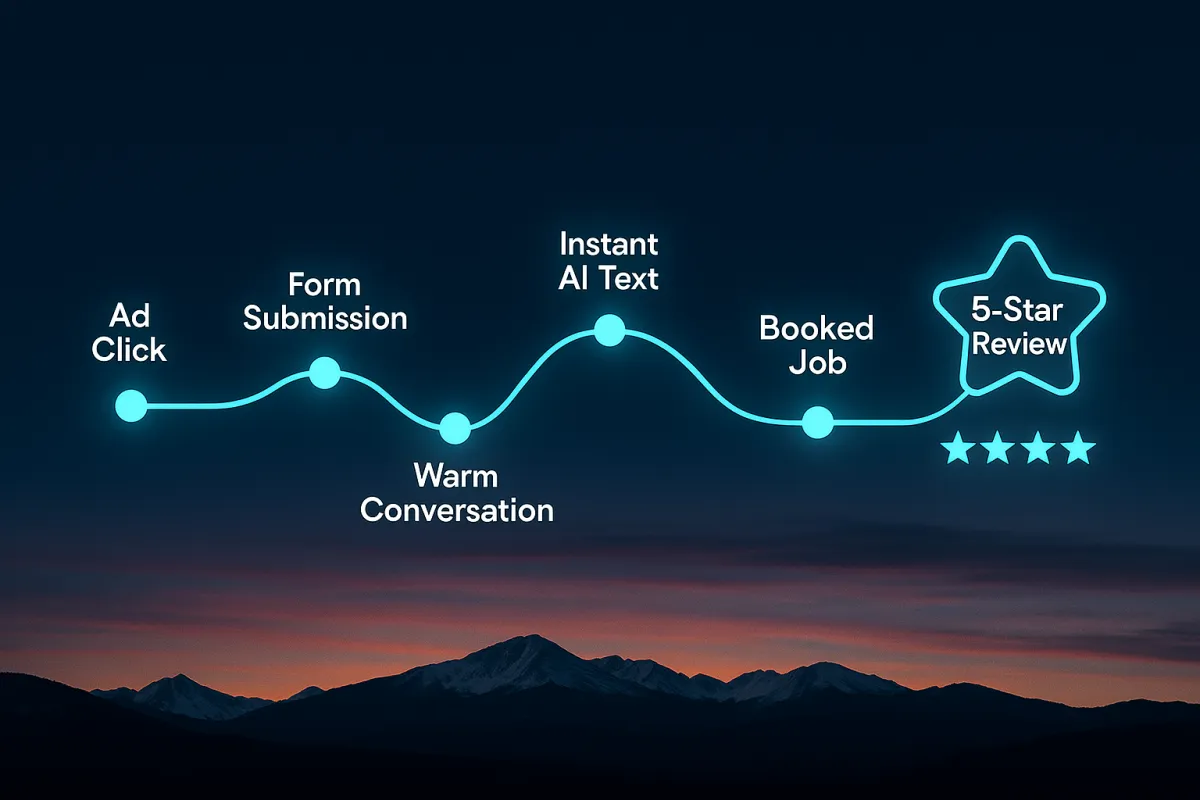
The Full Contractor Lead Journey Automated: Ad Click to Review
The Full Contractor Lead Journey Automated: From Ad Click to Five-Star Review
The conversation around AI and automation in contractor marketing tends to focus on one specific moment. The missed call. Text back instantly when you miss a call. Capture the lead before they call your competitor. It is a real problem and a real solution, and if you have been following this blog, you already know how significant that opportunity is.
But the missed call is just one point in a much longer journey.
For Colorado home service contractors who want to dominate their market, automating a single point is like fixing one leak in a bucket with seven holes. The real opportunity is automating the entire journey, from the moment a prospect first sees your ad to the moment they post a five-star Google review and tell their neighbor about you.
This post maps that full journey, stage by stage, and shows you exactly what automation can and should do at each point, backed by real data on what each stage costs when it breaks down.
What Is the Contractor Lead Journey?
The contractor lead journey is the complete path a prospect takes from first awareness of your business to a completed job and beyond. For Colorado home service contractors, this journey has seven distinct stages: ad click, form submission, first conversation, estimate, booked job, work delivery, and post-job follow-up.
Most contractors automate none of these stages. A few automate one. The contractors who dominate their local markets, in Denver, Colorado Springs, Fort Collins, Boulder, and across the Western Slope, have automated all seven.
Stage 1: The Ad Click — Intent Signals and First Impressions
The lead journey begins before any form is filled out or any call is made. It begins the moment a Colorado homeowner sees your Facebook ad, your Google search result, or your Local Services Ad and decides to click.
At this stage, the prospect is signaling intent. The strength of that signal varies significantly by platform. A Google search click for "emergency HVAC repair Denver" carries far higher intent than a Facebook Lead Ad scroll-and-tap. Understanding intent level helps calibrate your follow-up urgency and tone. For reference, the average cost per lead for home service contractors on Google Ads is $90.92 in 2025, while Facebook Lead Ads average $27 to $42 per lead depending on trade. Losing a lead after that investment happens long before the phone rings.
What automation does here: audience targeting rules, retargeting pixels, and ad platform algorithms work to serve ads to the highest-intent prospects at the right moment.
What matters most: the ad must be clear about who it is for, what problem it solves, and what the immediate next step is. Confusion at the ad stage means fewer clicks from your best prospects and more clicks from the wrong ones, driving up your cost per booked job before follow-up even begins.
We break down specifically why ad spend fails for most contractors in our post on why contractor ads are not booking the jobs they should.
Stage 2: The Form Submission — The Most Fragile Moment in the Entire Journey
The prospect has clicked your ad. They have seen your offer and decided it is worth their time. They fill out the lead form, on Facebook, on Google, or on your website, and hit submit.
This is the most fragile moment in the entire contractor lead journey.
The lead is real. The interest is real. But for passive ad leads who submitted in a scroll-and-tap moment, intention fades within minutes if no one reaches out. The industry average response time for leads is 47 hours. Contractors who respond within 5 minutes are 8 times more likely to win the job. After 30 minutes, the odds of conversion drop below 10%.
What automation does here: an automated trigger fires within 60 seconds of form submission, initiating your instant response sequence. A personalized SMS lands within one minute. A follow-up email arrives within two to three minutes. Your team receives a real-time notification with the lead's full details.
What matters most: speed and personalization. Use the lead's name from the form data. Reference their specific inquiry. Ask a simple, low-pressure question that invites a reply.
The full mechanics of this response window are covered in our post on the 5-minute rule for contractor ad form leads, and the complete system for building your automated sequence is in our post on automating your ad lead follow-up step by step.
Stage 3: The First Conversation — Warming the Lead
The lead has responded to your initial message. Maybe they replied to the text. Maybe they called back. Either way, you now have a warm two-way conversation in progress.
This is the transition from automated sequence to human relationship, and it is where bookings happen.
At this stage, your team has everything they need: the lead's name, contact information, the service they inquired about, and the full message thread from the automated sequence. They are not making a cold call. They are continuing a relationship that automation already started. That is a fundamentally different conversation, and it closes at a fundamentally different rate. Research shows that 37% of phone leads convert during the initial call when a real person engages immediately.
What automation does here: the lead transitions from sequence to active conversation in your CRM, creating a contact record, flagging the conversation as active, and routing it to the right team member. Real-time notifications ensure no warm lead waits for a human response.
What matters most: the human taking over needs to be warm, informed, and focused on getting to the estimate. Listen first. Ask what they need, confirm availability, and get a time on the calendar. Leads who engage and feel heard at this stage are dramatically more likely to move forward.
If your team is handling after-hours responses, our post on how AI can replace your after-hours answering service covers the coverage gap that costs Colorado contractors the most revenue overnight and on weekends.
Stage 4: The Estimate or Consultation — Building Trust Before You Arrive
The appointment is booked. The lead is now a prospect. The window between booking and the actual estimate appointment is one of the most overlooked trust-building opportunities in the entire contractor journey.
Prospects who schedule estimates often do so with multiple contractors at once. They have not made a decision yet. The contractor who communicates most professionally and consistently before the appointment already holds a trust advantage when they walk in the door, before a single word is spoken.
What automation does here: an automated appointment confirmation fires immediately after booking. Reminders go out 24 hours before and again one hour before the appointment. A rebooking link is included in case the prospect needs to reschedule. Data shows that automated SMS reminders reduce no-shows by 22%, which translates directly into fewer wasted drive times and more estimate conversions per week.
What matters most: confirmation and reminder messages should be warm and specific, not generic. Reference the service, the team member coming, and a brief note about what to expect. Prospects who feel prepared and considered before you arrive rate the experience more positively, even before the work begins.
Stage 5: The Estimate — Converting Prospects to Customers With Smart Follow-Up
The estimate is the moment of highest human importance in the entire journey. No automation replaces the quality of a professional, well-prepared, and trustworthy estimate. The contractor who shows up on time, explains clearly, listens carefully, and follows up promptly wins more jobs than the one who was cheaper or had more reviews.
But automation plays a critical supporting role in what happens after the estimate is delivered.
Most prospects who do not immediately accept an estimate are not rejecting you. They are thinking. The contractors who follow up systematically win a significant portion of those jobs back. A 5-touch follow-up sequence on unconverted estimates typically improves close rate by 8 to 12 percentage points. Contractors using automated follow-up systems report closing 20% more jobs from the same estimate volume.
What automation does here: if the prospect does not immediately accept, an automated sequence kicks in. A same-day message thanks them for their time. A day-two follow-up asks if they have any questions. A day-five gentle check-in keeps you top of mind during the consideration window without requiring manual outreach for every estimate delivered.
What matters most: when a prospect asks a question during the consideration period, the response time matters as much as it did at Stage 2. A prospect asking about your estimate at 8pm on a Tuesday is evaluating their options right now. An instant, helpful response can close the job before morning.
Stage 6: The Booked Job — Communication That Creates Five-Star Experiences
The customer has accepted. The job is on the schedule. Most contractors treat this stage as purely operational. It is also one of the highest-leverage marketing moments in the entire journey, because what happens during the job directly determines what happens after it.
What automation does here: pre-job confirmation messages sent 24 hours before work begins. Day-of messages with arrival time windows. Mid-job check-ins for projects spanning multiple days. These touchpoints reduce customer anxiety, increase satisfaction scores, and make your business feel more organized than competitors who simply show up and get to work without communicating.
What matters most: research consistently shows that homeowners who feel informed and considered during the job rate contractors higher, even when the technical quality of work is comparable to a competitor who did not communicate. Proactive communication during the job is one of the most direct drivers of five-star reviews. Automation makes that communication consistent across every single job, regardless of how busy your team is.
Stage 7: After the Job — Reviews, Referrals, and Repeat Business
The job is done. For most contracting businesses, this is where the relationship quietly ends, until the customer needs something else or happens to mention you to a friend.
This is the most automation-solvable gap in the entire contractor journey, and it holds the highest long-term revenue potential of any stage.
Review requests: 81% of consumers use Google reviews to evaluate local businesses, and 88% read them before choosing a contractor. Review requests made within 24 hours of job completion convert at 3 to 5 times higher rates than those sent days later. After 24 hours, response rates drop 40 to 60%. Local contractors who send post-job SMS review requests within 24 to 48 hours of service see 12 to 15% review conversion rates, compared to just 3 to 4% from email. SMS review requests have a 95% open rate and a conversion rate 14 times higher than email.
An automated SMS sent the next morning, while the positive experience is still fresh, is the single most effective review generation strategy available to Colorado contractors.
Referral triggers: referred customers have at least a 16% higher lifetime value than non-referred customers. Businesses with formal referral programs see 86% more revenue growth over two years. Yet only 30% of businesses have a systematic referral ask process. An automated follow-up one to two weeks after job completion, asking if the customer knows anyone who might benefit from your services, costs nothing and generates some of your highest-quality leads with zero ad spend.
Seasonal re-engagement: automated campaigns that reach back out to past customers at seasonally relevant moments, spring HVAC tune-up reminders before the first heat wave, pre-storm roofing inspection offers after a hail forecast, annual service reminders for maintenance plans, turn every completed job into an ongoing pipeline.
The data on why this matters: acquiring a new customer costs 5 to 10 times more than retaining an existing one. The success rate of selling to an existing customer is 60 to 70%, compared to just 5 to 20% for a new prospect. Contractors who neglect Stage 7 are spending their entire marketing budget trying to replace revenue that could have been retained automatically.
What Full Journey Automation Means for Your Business
When every stage of the lead journey is automated and optimized, something powerful happens. Your business becomes consistent. Not dependent on how busy you are, how attentive your team is, or whether a particular lead happened to arrive at a convenient time.
Consistent, professional, fast, and persistent at every stage, for every lead, every day.
That consistency compounds. More leads converted. More booked jobs. More five-star reviews. More referrals. More repeat business. The same lead volume generating significantly more revenue, because none of it is falling through the cracks anymore.
This is not a theory. It is what the data shows and what the contractors doing it are experiencing right now.
If you are still thinking about whether automation is the right move for your business, our post on the honest answers to questions Colorado contractors ask before trying AI automation addresses the most common concerns clearly.
Frequently Asked Questions: Contractor Lead Journey Automation
What are the 7 stages of the contractor lead journey?
The full contractor lead journey includes: (1) Ad click, where the prospect signals intent; (2) Form submission, the most time-sensitive moment; (3) First conversation, where automation hands off to a human; (4) Estimate or consultation; (5) Job booking and confirmation; (6) Work delivery and job communication; and (7) Post-job review, referral, and re-engagement. Automating all seven stages creates consistent, compounding revenue growth.
At which stage does automation have the highest individual impact?
Speed of follow-up at Stage 2, the form submission, has the highest single-stage impact on conversion rates. Responding within 5 minutes makes a contractor 8 times more likely to win the job. However, automating all seven stages creates a compounding effect where the cumulative value far exceeds any one stage alone.
What is the best time to send a Google review request after a job?
For home service contractors, the next morning after job completion is the optimal window. Review requests sent within 24 hours of service convert at 3 to 5 times higher rates than those sent days later. After 24 hours, response rates drop 40 to 60%. SMS consistently outperforms email, with a 95% open rate and a conversion rate 14 times higher.
How does automated estimate follow-up improve close rates?
A systematic multi-touch follow-up sequence on unconverted estimates typically improves close rate by 8 to 12 percentage points. Automated confirmation, reminders, and post-estimate messages keep the contractor visible during the consideration period and ensure that follow-up questions are answered quickly, even if they arrive after business hours.
Why does referral automation matter for Colorado contractors?
Referred customers have at least a 16% higher lifetime value than non-referred ones. Acquiring a new customer costs 5 to 10 times more than retaining an existing one. Businesses with systematic referral programs see 86% more revenue growth over two years. Yet most contractors never formally ask for referrals because the process is not built into their system.
Does automating job communication really affect review scores?
Yes. Research consistently shows that homeowners who feel informed and considered during the work process rate contractors higher even when the technical quality is comparable to a less communicative competitor. Proactive communication during the job is one of the most direct drivers of five-star reviews.
Can one platform automate all 7 stages of the contractor lead journey?
Yes. A full-journey automation platform integrates with your lead sources, such as Facebook Lead Ads, Google Lead Form Extensions, website forms, and your phone system, and manages automated sequences at every stage: instant follow-up on inquiry, appointment confirmation and reminders, estimate follow-up, job communication, and post-completion review and referral requests. All from one system with complete visibility into every lead at every stage.
Build the System. Let It Run. Watch Your Business Grow.
The contractors who dominate their markets across Colorado are not working harder than everyone else. They have systems that handle the lead journey automatically, consistently, and professionally at every stage.
At Instant Business Pro, we help Colorado home service contractors build those systems, from the Denver Metro to Colorado Springs, Fort Collins to the Western Slope. If you are ready to stop managing leads manually and start running a system that works at every stage of the journey, reach out today for a free discovery consultation.
