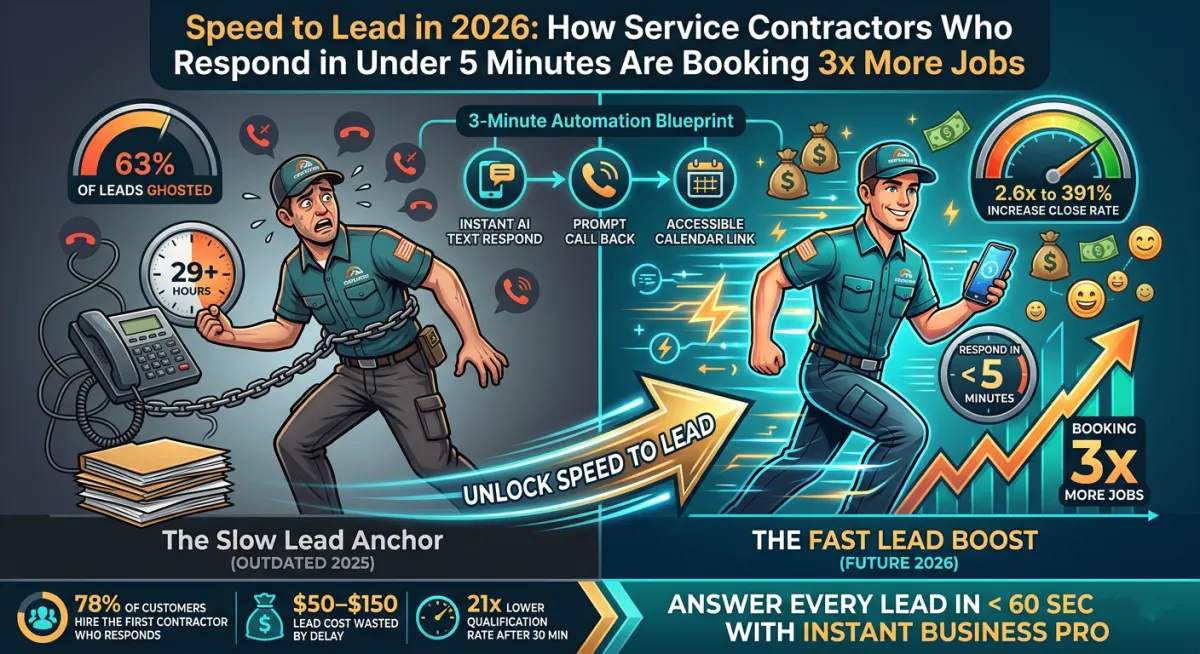
Speed to Lead in 2026: Contractors Booking 3x More Jobs with Instant Response
Speed to Lead in 2026: How Contractors Are Booking Significantly More Jobs with Instant Response
Quick Answer: What You Need to Know
Responding to a lead within one minuteboosts conversion rates by391%— a Velocify study confirmed by Kixie, Teamgate, and Voiso (2025)
Leads contacted within five minutesare21 times more likely to qualify than those reached after 30 minutes
78% of customers hire the first company to respond— not the cheapest, not the most reviewed
The average business takes47+ hoursto respond to leads; over 63% of businesses never respond to some leads at all
For Colorado contractors dealing with hail surges, winter freezes, and summer heat waves, every hour of response delay is a measurable revenue loss
AI text-back systems deliver sub-30-second first responses — meeting the response window that drives the highest conversion rates without adding staff
You're on a roof in Castle Rock. Your phone rings — an unknown number. You're four sheets into a hail job, can't safely take a call, and let it go to voicemail. You figure you'll call back in an hour.
That hour costs you the job.
Not because the homeowner was impatient. Because they needed help urgently, called three contractors, and hired the one that responded first. That's not a guess — it's how 78% of home services customers make their decision. They don't comparison shop once they get a fast, competent response. They commit.
Speed to lead — the time between a prospect's first contact and your first reply — has always mattered in contracting. In 2026, it matters more than almost anything else in your marketing operation. This guide breaks down the verified data behind that claim, why Colorado's market makes it especially urgent, what the best-performing contractors are doing differently, and how to build a system that captures leads while you're doing the actual work that pays your bills.
1. The 2026 Data: What Response Time Actually Does to Your Revenue
The research on this is among the most consistent in sales and marketing. Multiple independent studies across different industries and time periods reach the same conclusion: the faster you respond, the dramatically more likely you are to win the job.
Here's what the verified data shows.
The one-minute threshold is where the biggest lift happens. Research by Velocify — confirmed across multiple 2025 analyses by Kixie, Teamgate, and Voiso — found that responding within the first minute of an inquiry boosts conversion rates by 391%. Waiting just one more minute for a two-minute response time cuts that conversion lift by more than half. This is the number contractors need to understand: the jump isn't from slow to fast. It's from fast to instant.
Five minutes is the outer edge of the high-conversion window. Leads reached within five minutes are 21 times more likely to qualify than those reached after 30 minutes — and 100 times more likely to be connected with at all in the first five minutes versus waiting just half an hour. After the five-minute mark, qualification odds drop by 80%. That's not a gradual decline — it's a cliff.
78% of customers hire the first company to respond. Not the most experienced. Not the most reviewed. Not the cheapest. The first to respond. In a competitive local market where homeowners are searching "emergency HVAC Fort Collins" or "plumber Denver after hours" and calling multiple contractors simultaneously, the speed gap between you and your competition is the deciding factor on a majority of jobs.
The average business takes 47+ hours to respond to leads. A RevenueHero study of over 1,000 businesses found that 63.5% never responded to some leads at all. The industry average response time — across all channels — sits at over 47 hours. In a market where the five-minute window drives 21x higher qualification rates, that 47-hour average represents an enormous, systematic revenue leak across the entire contracting industry.
For a contractor in the Denver metro, Fort Collins, Colorado Springs, or anywhere along the I-25 corridor, these aren't abstract industry statistics. They're the math behind every job that went to a competitor while you were on a roof, under a sink, or driving between sites.
2. Why Speed Matters More Than Price, Reviews, or Experience in Colorado's Market
Most contractors compete on quality of work, reputation, and price. All three matter — but none of them matter if you don't respond first. Here's why Colorado's specific market conditions make speed-to-lead the highest-leverage variable in your business:
Home services emergencies don't allow for deliberation. A homeowner with a burst pipe at 11 PM, a dead furnace during a January freeze in Fort Collins, or an active roof leak after a spring hail storm isn't comparison shopping. They're in triage mode. They need someone — anyone qualified — to respond and tell them help is coming. The first contractor to do that wins the job before the second contractor even sees the missed call.
Colorado's weather patterns create predictable but intense demand spikes. Hail season along the Front Range — typically May through July — generates sudden roofing call surges that can triple a contractor's inbound volume overnight. Winter freezes spike no-heat calls and pipe bursts simultaneously. Summer heat waves flood HVAC lines. These aren't slow, gradual increases; they're rapid spikes where the contractors who respond in seconds capture the high-value emergency jobs while everyone else gets the callbacks nobody answers.
Homeowners call multiple contractors simultaneously. Research on home services search behavior consistently shows that callers in urgent situations contact three to five businesses during the same search session. The first to reply locks in the appointment. The rest receive a politely worded cancellation — or no response at all.
Mobile search behavior has shortened the patience window dramatically. Homeowners searching on their phones expect a response experience that mirrors what they get from Amazon, Uber, or DoorDash — near-instant acknowledgment that their request was received and action is being taken. A response that arrives two hours later doesn't feel like a real business responded; it feels like a voicemail that someone eventually got around to.
The cost of slow response compounds beyond the individual missed job. Leads that go cold require more follow-up effort and close at lower rates. Marketing spend that generated the call goes to waste. And the homeowner who went with a competitor — who may have done fine but not exceptional work — becomes a referral source for that competitor instead of you.
3. What the Best-Performing Colorado Contractors Are Doing Differently
The contractors consistently booking more jobs from the same call volume aren't necessarily working more hours, spending more on ads, or undercutting competitors on price. They've built a system that handles the first response — the most time-sensitive part of the sales process — automatically.
Here's how it works in practice:
Missed call detection in real time. The system integrates with your existing phone line via telephony connection and identifies unanswered calls the moment they happen. No batching, no delays, no "we'll send you a summary at the end of the day."
Personalized text response in under 30 seconds. The instant a call goes unanswered, the system fires a personalized SMS — not a generic auto-reply, but a message that references your business name, your location, and asks a relevant qualifying question:
"Hey, this is [Business Name] in Fort Collins — sorry we missed your call. Is this a no-heat emergency or a routine service request? We're dispatching emergencies today."
That 30-second response time puts you firmly inside the one-minute window where Velocify's research shows the 391% conversion boost. It's humanly impossible to hit that window manually while you're on a job site. Automation makes it the default.
Trade-specific qualification that actually gathers useful information. The AI doesn't just acknowledge the call — it asks the right follow-up questions for your specific trade:
For HVAC: "Is the heat completely out or just struggling? What type of system do you have — gas furnace, heat pump, or electric?"
For plumbing: "Is there active water? Can you send a photo of the area if it's safe to do so?"
For roofing: "Is this hail damage, an ongoing leak, or an estimate for replacement? Do you have photos of the damage?"
For decking and general contracting: "What's the project scope — deck replacement, addition, or full outdoor build? HOA restrictions in your area?"
By the time the lead is ready to book — or you step in for the final conversation — the AI has already gathered the details you need to give an accurate quote, dispatch the right crew, or triage the urgency level.
Direct booking into your calendar. For leads ready to commit, the system provides a direct booking link synced to your Jobber or QuickBooks calendar. For emergencies, it triggers an immediate dispatch alert to your on-call team. Non-urgent leads enter an automated nurture sequence — seasonal reminders, follow-up prompts, and reactivation messages timed to when they're most likely to be ready to book.
Complete CRM logging. Every interaction is recorded and pushed to your system automatically. You never have to manually enter a lead, reconstruct a conversation from memory, or wonder if a follow-up was sent.
The result of this system: response time drops from hours to seconds, leads that would have gone cold get qualified and booked, and you spend your human attention on the jobs that are already confirmed rather than chasing leads that slipped away while you were working.
4. Real Results from Colorado Contractors
Roofing Contractor — I-25 Corridor (Denver, Castle Rock, Colorado Springs)
Was missing roughly 35% of storm-season calls due to on-site work during active jobs. Hail events in May through July created sudden surges the team couldn't manually handle.
After implementing AI text-back:
Response time dropped from hours to under 30 seconds
Booked site visits increased significantly in the first 90 days
Recovered multiple high-ticket storm jobs — at $8,000–$12,000 average per job — that would have gone to competitors
Estimated recovered revenue in the first hail season: $85,000+
HVAC Contractor — Fort Collins
Was losing no-heat calls during winter surge periods when technicians were already dispatched and couldn't answer inbound calls. Emergency jobs — the highest-margin work in the trade — were going to whoever picked up.
After implementing AI text-back:
Booked appointments increased 42% during the winter surge window
Estimated annual recovered revenue: $65,000 at an average job value of $1,200+
Response time: hours → under 30 seconds on every missed call
Plumbing Contractor — Colorado Springs
Weekend and after-hours pipe-burst calls — among the most valuable emergency jobs in the trade — were consistently going to competitors. Manual follow-up systems couldn't bridge the after-hours gap.
After implementing AI:
After-hours losses reduced by 38%
Weekend emergency calls converted from lost leads to booked jobs
The system paid for itself within the first month
These results share a common thread: the revenue wasn't generated by new marketing spend or lower prices. It came from capturing leads that were already calling — calls the business was generating but not answering in the window that wins jobs.
5. How to Implement Speed-to-Lead Systems in Colorado's Market
Getting this working doesn't require a technical team or a major process overhaul. Here's the straightforward path most Colorado contractors follow:
Start with your phone system and CRM. The AI text-back layer integrates with your existing setup — Jobber, Housecall Pro, or QuickBooks — without requiring you to change how you operate. You're adding a response layer on top of what you already have, not rebuilding your workflow.
Customize the qualification scripts for your trade. Generic responses don't qualify leads effectively. Work with your automation provider to build scripts that reflect your specific services, emergency protocols, and service area. For Colorado contractors, this means weather-event specific language — storm damage triage for roofing, freeze response for HVAC and plumbing — that makes your first response feel like it came from someone who knows your market.
Set up emergency routing separately from routine scheduling. Not every call needs the same response. A burst pipe at midnight is a dispatch situation; a deck inquiry on a Tuesday morning is a booking situation. Your system should distinguish between them automatically and route accordingly — emergency alerts to your on-call team, routine requests to your booking calendar.
Monitor and refine based on real conversations. Review AI interaction logs weekly for the first 30 days. Look for: calls where qualification didn't capture what you needed, edge cases the system mishandled, and language that could be more specific to your trade. Most contractors make a few adjustments in the first two weeks and then very little after that.
Track the metric that matters most. Your speed-to-lead response time should become a number you know and monitor — ideally, sub-60 seconds on every missed call. Pair that with booking rate from AI-assisted leads versus manual follow-up leads, and you'll have clear data on what the system is worth every month.
In Colorado's market — where weather events create sudden, high-stakes demand windows that reward the fastest responders — building this system before hail season or the next winter freeze is the difference between capturing that surge and watching it go to whoever answered first.
Text DEMO to (720) 973-1369 for a free speed-to-lead audit — we'll assess your current response times, calculate your estimated revenue loss from delayed follow-up, and show you what an AI response system looks like in practice for your specific trade.
Roofing storm response examples →instantbusinesspro.ai/roofing
Full contractor automation guide →instantbusinesspro.ai/post/the-complete-guide-to-contractor-marketing-automation-2026
Frequently Asked Questions
What is "speed to lead" and why does it matter for contractors in 2026?
Speed to lead is the time between when a prospect first contacts your business — by call, form, or message — and when you first respond. It matters for contractors because 78% of customers hire the first company to respond, and leads contacted within five minutes are 21 times more likely to convert than those reached after 30 minutes. In emergency-driven trades like HVAC, plumbing, and roofing, the first response frequently determines who gets the job — regardless of price or reviews.
Does responding in one minute really make that much of a difference?
Yes — and the research is specific about it. A study by Velocify found that responding within one minute of an inquiry boosts conversion rates by 391%. Waiting just one more minute cuts that lift by more than half. The five-minute mark is the outer edge of the high-conversion window, where leads are still 21 times more likely to convert than after 30 minutes. After five minutes, qualification odds drop by 80%. These numbers hold across multiple independent analyses from 2025.
Why do contractors struggle with fast response times if it matters this much?
The causes are structural, not motivational. Contractors are on job sites, operating equipment, driving between calls, or managing active crews — all situations where answering an inbound call is physically impossible or dangerous. After hours, on weekends, and during Colorado's demand surge windows, the gap grows worse. Manual follow-up systems simply can't deliver the sub-60-second response that research shows drives the highest conversion rates.
What is AI text-back and how does it solve the speed-to-lead problem?
AI text-back is an automated system that detects a missed call and sends a personalized, trade-specific SMS within 30 seconds — regardless of whether you're on a job site, driving, or asleep. The message references your business name and location, asks a qualifying question, and keeps the lead engaged until you or your team can follow up. It bridges the gap between when a call comes in and when a human can realistically respond, without requiring you to be available 24/7.
How does Colorado's weather-driven market affect speed-to-lead?
Colorado's seasonal weather patterns — spring hail events, January freeze windows, summer heat waves — create predictable but intense demand spikes across roofing, HVAC, and plumbing. During these windows, call volume can spike dramatically in short timeframes. Contractors who can respond instantly during a hail surge capture the high-value emergency jobs; those who respond hours later find the homeowner already booked with a competitor. The urgency of weather-driven emergencies compresses the decision window even further than normal service inquiries.
What does a 391% conversion boost actually mean in revenue terms for a typical contractor?
Using Invoca's confirmed figure of $1,200 average revenue per home services lead, the difference between a one-minute response and a delayed response can represent hundreds of thousands of dollars annually across a contractor's full lead volume. For a contractor receiving 15–25 calls per day with a 27% miss rate, recovering even a portion of those leads through instant AI response translates to $45,000–$120,000+ in additional annual revenue — without spending a dollar more on marketing.
Do I need to replace my current CRM or phone system to implement AI text-back?
No. AI text-back systems are designed to layer on top of existing setups. They integrate with common contractor platforms — Jobber, QuickBooks, Housecall Pro — and work with your existing phone numbers. You don't rebuild your workflow; you add an intelligent response layer that handles the first contact window while you're focused on the work in front of you.
What should I track to know if my speed-to-lead system is working?
Three metrics matter most: first response time (target: under 60 seconds on all missed calls), booking rate from AI-assisted leads versus unassisted leads, and weekly recovered revenue from leads that previously would have gone unanswered. Most contractors who implement AI text-back see measurable improvement in booking rate within the first 30 days and full ROI within 60 days.
How do I customize AI responses for my specific trade?
The qualification questions and messaging should reflect your specific services, emergency protocols, and service area. For roofing in Colorado's hail corridor, that means storm damage triage language. For HVAC in Fort Collins winters, it means no-heat urgency detection and immediate dispatch routing. For plumbing, it means active leak triage and photo requests. Your automation provider should configure these scripts in advance based on your trade — generic responses don't qualify leads effectively and can undermine the trust the fast response built.
Is speed to lead really more important than price or reviews?
For emergency and urgent home services calls — which represent the majority of high-value contractor inquiries — yes. When a homeowner has a flooded basement or a failed furnace during a freeze, they're not comparison shopping. They're hiring whoever responds with competence and speed. Research consistently shows that 78% of customers choose the first responder. Price and reviews matter at the consideration stage; speed determines whether you reach the consideration stage at all.
Data sources: Velocify speed-to-lead research (via Kixie, Teamgate, Voiso, 2025); RevenueHero lead response study (1,000+ businesses, via Convoso, 2025); Invoca home services call analytics (2025); Lead Response Management research (via multiple 2025 analyses); Scorpion home services response time study (2025); CallBird AI contractor data (1,200+ contractors, 2025).
