
Automate Plumbing Plans for Steady Revenue Growth
Plumbing Business, Recurring Revenue, AI Automation
Automate Plumbing Plans for Steady Revenue Growth
If your plumbing revenue in Colorado spikes when pipes burst and drops when the weather’s calm, you don’t have a plumbing problem—you have a revenue system problem. The good news: you can fix it without adding more trucks or burning out your team. You do it by putting automated maintenance plans in place that run like clockwork and pay you every single year.
The real problem: your revenue is chained to emergencies
You already know the pattern. First freeze in Colorado? Phone blows up. Spring thaw? Water heaters start dying. Then July hits, phones slow down, and you’re staring at the board wondering how you’re going to keep techs busy without slashing prices or burning more cash on ads.
When your business is built on emergency calls only, you’re letting the weather and Google decide your paycheck. That’s not a business system—that’s gambling with payroll, fuel, and material costs that only go one direction: up.
📌 Key Takeaway: As long as your revenue depends on burst pipes and panicked homeowners, your slow seasons will keep hurting more each year.
The hidden cost of churn on a 500-customer book of business
Let’s talk numbers. Say you’ve built a decent book of business over the years—about 500 past customers in your CRM or on a spreadsheet. You paid for those calls already: ads, LSAs, yard signs, referral discounts, all of it. That list is an asset, just like your trucks and tools. But if you’re not running a maintenance plan, you’re quietly bleeding out that asset every month.
In 2026, typical plumbing websites convert only about 1–3% of visitors into leads if they’re not dialed in, while well-optimized operations see 20–40% lead-to-customer conversion when they respond fast and stay on top of follow-up. You already did the hard part—you turned those people into paying customers once. If you let them drift, they’ll Google “plumber near me” the next time something breaks and call whoever answers first. That’s churn. And it’s expensive.
Run a simple scenario on your 500 customers:
Assume each household is worth a conservative $400 every 3–4 years in reactive work (water heater, leaks, clogs, small projects).
That’s roughly $100–$130 per customer per year in “natural” demand if you keep them.
Lose just 20% of that 500-customer base per year because you’re not staying in front of them, and you’re walking away from $10,000+ in jobs annually. Not because the work doesn’t exist—but because your name isn’t the one they remember or see first when something goes wrong.
📌 Key Takeaway: Churn on a 500-customer list is a five-figure leak in your business every single year. You’d never ignore a slab leak in a customer’s house—stop ignoring the one in your revenue.
Maintenance plans: simple services, serious recurring revenue
The fix isn’t complicated. You don’t need a fancy “platinum elite” membership with 40 bullet points. You need a straightforward plumbing maintenance plan that homeowners in Colorado actually understand and value, built around services you already do every week:
Annual water heater flush (tank or tankless, within clear limits)
Whole-home drain inspection (visual checks, basic camera on main if you choose)
Main shutoff valve and critical fixture shutoff checks (make sure they actually turn)
Quick whole-home plumbing walk-through to catch leaks, corrosion, and code issues before they explode into emergencies.
Across the U.S. in 2026, standard plumbing plans commonly sit around $179–$199/year. Pricing your plan at $149/year in Colorado keeps you attractive, leaves room for upsell work, and still gives you strong recurring revenue with very predictable labor requirements.
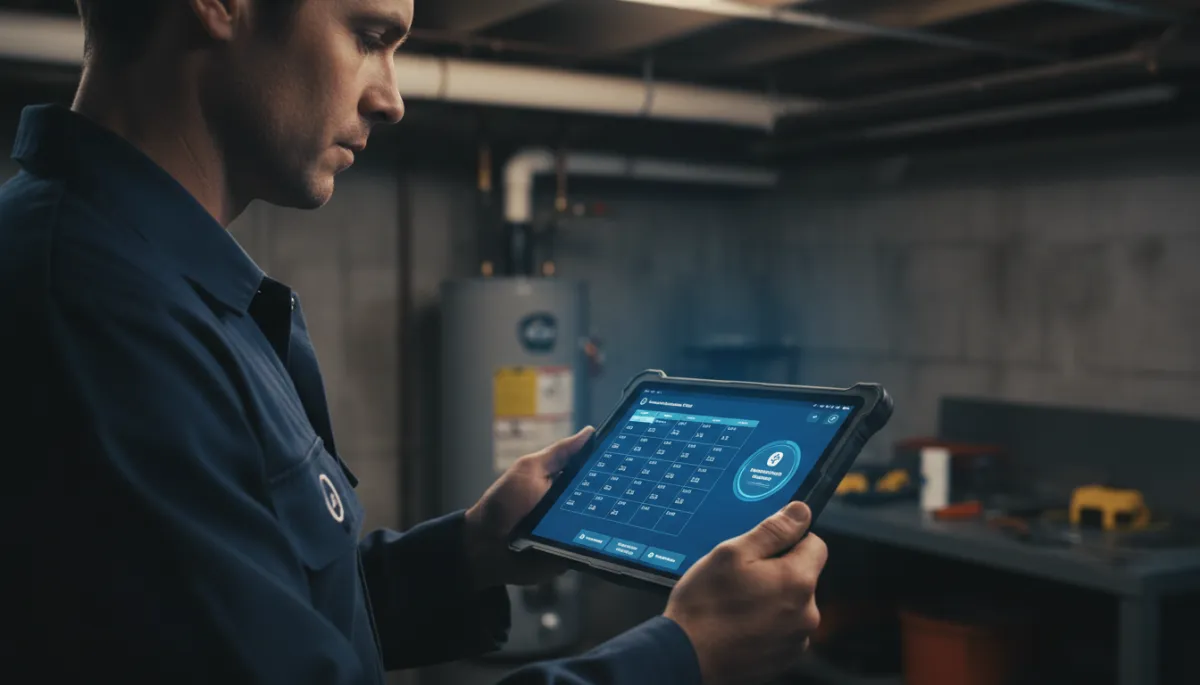
Simple annual services lock in repeat business and open the door to higher-margin jobs.
💡 Pro Tip: Keep your plan tight and easy to explain. One page, clear bullet points, and a single price beat a complicated “club” every time.
The part that kills most plans: manual enrollment and follow-up
Here’s why a lot of contractors “try” maintenance plans and then quietly drop them: the office can’t keep up. Techs forget to pitch it. CSRs don’t have a script. No one tracks renewals. Cards expire. Suddenly you’ve got a half-broken spreadsheet and three different “membership” lists that don’t match.
That’s exactly the problem Instant Business Pro is built to solve. Instead of asking your office to become a call center and a marketing agency, you let AI outreach and CRM workflows handle the heavy lifting while you and your techs stay on the tools.
“If a plan depends on someone remembering to make a call, it will die. If it’s automated, it will grow.”
How AI outreach automates maintenance plan enrollment
1. CRM workflows that never forget a customer
Step one is simple: import your customer list into a CRM that can actually do something with it. With Instant Business Pro, you tag your past jobs (water heater, drain, whole-house repipe, etc.) and drop them into an automated workflow. The system handles the timing and follow-up—for example:
30 days after a water heater install → send an educational email about protecting their warranty and extending heater life.
11 months after a drain cleaning → send a reminder that Colorado soils and older sewer lines benefit from annual checks.
Every one of those touchpoints invites them into a simple $149/year maintenance plan with clear benefits and an easy payment link. No one on your team has to remember who to call or when to send a reminder—the workflow drives it.
💡 Pro Tip: Tag customers by job type and location. That lets you send hyper-relevant messages like “Denver homes built before 1980” or “recent water heater installs.”
2. SMS and email campaigns that sound like a real person
Your customers are busy. Most of them would rather tap a link on their phone than sit on hold. AI-written SMS and email campaigns keep the tone conversational, answer common questions, and push them to a simple “Yes, I want in” button that kicks off enrollment and payment.
💡 Pro Tip: Short, plain-language texts like “Hey, this is Mike with Front Range Plumbing. Want us to handle your annual water heater flush and shutoff check for $149/year?” outperform long, marketing-heavy messages by a wide margin.
3. Missed-call text-back so you don’t leak leads
Colorado emergency leads are brutal—if you miss the call, they dial the next plumber. With missed-call text-back automation, every missed call instantly gets a text like:
Hey, this is {{company_name}}. We saw your missed call.
Are you dealing with an emergency or just have a question?

Reply 1 for emergency, 2 for non-urgent, or tell us what's going on.
From there, AI can triage, book the job, and—if it’s not an emergency—offer the maintenance plan as a way to get priority scheduling next time. That’s how you turn “sorry we missed you” into “here’s another $149/year member.”
4. Voice AI that handles the after-hours grind
If you’re not staffed 24/7, you’re either paying an answering service that doesn’t know your business, or you’re letting valuable calls ring out. With Voice AI, an AI “CSR” can answer, qualify, book, and even explain the maintenance plan at 11:30 p.m. when you’re finally off the road.
You don’t need to write code like this yourself—platforms like Instant Business Pro handle the logic under the hood. But this is the mindset: if the customer is a fit, the system automatically offers and enrolls them. No extra brain cycles from you or your office.
📌 Key Takeaway: AI doesn’t replace your team—it fills in the gaps at night, on weekends, and when the phones are slammed, so plan enrollment never pauses.
ROI math: what 500 customers and a 15% conversion actually mean
Let’s run the exact numbers the way a software engineer would: no fluff, just inputs and outputs.
Customer base: 500 past customers in your system.
Conversion rate to plan: 15% (well below what you see on high-intent emergency calls, which often close at 70–85%).
Plan price: $149/year.
500 customers × 15% = 75 members.
75 members × $149/year = $11,175 in predictable annual revenue.
That’s before counting the extra work from those members—priority scheduling, repairs you catch during inspections, replacements you quote before something fails. The recurring revenue alone likely covers a truck payment, insurance, or a big chunk of your marketing budget. And once the workflows are built, that $11,175 renews every year with far less effort than chasing new leads.
📌 Key Takeaway: You don’t need 5,000 customers to make this work. A modest 500-customer list and a 15% conversion rate already give you a five-figure recurring base you can count on.
FAQ: Automating plumbing maintenance plans in your shop
1. How does plumbing maintenance plan automation actually work?
You load your past customers into a CRM, define your plan (services, price, terms), and then turn on AI-powered outreach. The system sends texts and emails, answers common questions, handles “yes” responses, processes payments, and adds the visit to your schedule. Platforms like Instant Business Pro also layer in missed-call text-back and Voice AI so enrollment opportunities aren’t lost when the phone is busy or you’re on a job.
2. What should I include in a basic plumbing maintenance plan?
For most Colorado homes, a solid starter plan includes an annual water heater flush, drain inspection, shutoff valve check, and quick whole-home walk-through. You can add priority scheduling and a small discount on repairs if you want, but don’t overcomplicate it. The goal is predictable, easy-to-deliver visits that keep you in the home and in the customer’s mind.
3. How much recurring revenue can a plan realistically generate for my shop?
Using the conservative example above, a 500-customer list with a 15% conversion rate into a $149/year plan yields $11,175 in predictable annual revenue. If you build your list to 1,000 customers or push conversion closer to 20–25%, the numbers climb quickly—without increasing your ad spend at the same pace.
4. Do I need custom software or a developer to set this up?
No. As a senior software engineer, I can tell you: you could build this yourself, but you shouldn’t. Instant Business Pro gives you pre-built workflows, AI messaging, and integrations so you can import your list, configure your offer, and go live without writing a single line of code. You focus on plumbing; the platform handles the logic and automation.
5. How fast can I launch a maintenance plan campaign?
If your customer data is even halfway organized, you can realistically launch in a single business day. Import the list, define your plan, review the AI-written messages, and hit “start.” From there, the system starts contacting your customers, fielding responses, and enrolling members while you’re out running calls.
Turn Colorado’s seasons into a revenue system, not a roller coaster
You already know Colorado’s rhythm: freeze, thaw, dry spells, sudden storms. You can’t change the weather, but you can decide whether your revenue swings with it. A simple, automated maintenance plan turns one-time jobs into recurring, predictable income and keeps your trucks rolling even when Google is quiet.
If you’re tired of starting every year at zero and hoping the phone rings, it’s time to put a real system behind the customer base you’ve already earned. Let AI handle the follow-up, enrollment, and reminders so you can stay in the field and still build a book of recurring revenue that grows every year.
Ready to make your slow seasons smaller and your revenue steadier? See how Instant Business Pro’s AI can run seasonal and maintenance outreach for you.
Take the next step here: AI Seasonal Outreach for Plumbing Contractors. Turn your 500 past customers into a predictable revenue engine instead of a list that quietly leaks money to the next plumber down the road.
