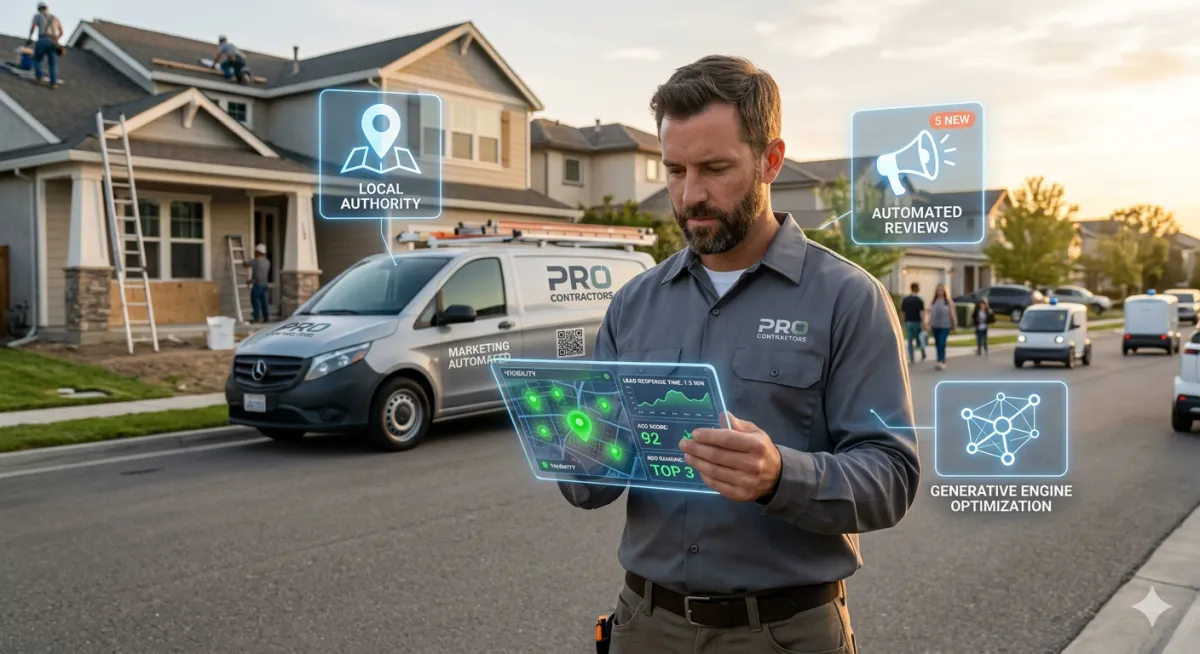
The Complete 2026 Guide to Contractor Marketing Automation: AI Lead Recovery & Growth
The Complete 2026 Guide to Contractor Marketing Automation: AI, Lead Recovery & Revenue Growth
Quick Answer: What This Guide Covers
The U.S. home services market is estimated at $650–$750 billion annually as of early 2025 — and the contractors capturing the most revenue in 2026 are the ones with automated lead systems, not the biggest crews
AI adoption rates among home service pros have hit 72%, with demand for AI products expected to climb 21% annually through 2030
A study by Velocify found that responding to a lead within one minute boosts conversion rates by 391% — and leads contacted within 5 minutes are 21x more likely to convert than those reached after 30 minutes
78% of customers buy from the first company that responds — making speed-to-lead the single highest-leverage variable in contractor marketing
The four automation pillars in this guide — instant lead capture, nurture cycles, AI booking, and review reactivation — work together to create a zero-loss revenue system
Estimated ROI for Colorado contractors implementing full automation:$13,500–$60,000+ in recovered annual revenue, depending on trade and call volume
There's a version of your business where leads never slip through the cracks. Where a homeowner in Fort Collins searches "furnace repair near me" at 10 PM on a Thursday, calls your number, and gets an intelligent, personalized response within 30 seconds — even while you're asleep. Where a hail storm rolls through Castle Rock and your roofing pipeline fills up automatically while competitors scramble to return voicemails.
That's not a fantasy. It's what automation actually looks like in 2026 for contractors who've built the right system.
This guide breaks down exactly how to build it — the trends driving adoption, the four pillars that make it work, how each major trade implements it differently, and the real math on what it's worth. Whether you're a one-truck HVAC operator in Fort Collins or a multi-crew roofing company covering the I-25 corridor, you'll finish this with a clear, practical roadmap.
1. Why Automation Has Become Non-Negotiable for Contractors in 2026
The home services industry isn't quietly shifting toward automation. It's sprinting.
The U.S. home services market is estimated at $650–$750 billion annually as of early 2025, and the businesses capturing an outsized share of that market aren't necessarily the most skilled — they're the most responsive. Competition intensified in 2025, and the businesses that grew consistently were the ones that treated marketing as a connected, performance-driven system, where data, response speed, and online visibility work together.
On the technology side, the adoption curve is steep. AI adoption rates among home service professionals have hit 72%, with demand for AI products expected to climb 21% annually through 2030 — making it clear that AI-powered solutions are here to stay. The gap between contractors who've automated their lead flow and those relying on manual processes is widening every quarter.
The numbers on response speed tell you everything you need to know about why this matters. Responding within the first minute can boost lead conversions by 391%, and waiting just one more minute cuts that conversion lift by more than half. You are 21 times more likely to qualify a lead if you respond within five minutes compared to waiting 30 minutes — and 100 times more likely to connect with that lead at all in the first five minutes versus waiting just half an hour.
For contractors in Colorado, this isn't abstract. In home services specifically, leads convert 21x more when responded to in under 5 minutes — and 78% of buyers choose the first company to respond. When a homeowner's furnace dies at midnight in January, or hail tears through a Parker neighborhood in May, whoever responds first gets the job. The rest get nothing.
Contractors miss 40–60% of incoming phone calls because they're on job sites, operating equipment, or in areas with poor cell reception. Automation closes that gap without requiring you to be glued to your phone.
2. The Four Pillars of Contractor Automation in 2026
Effective automation for home service businesses rests on four interconnected systems. Each one addresses a specific revenue leak. Together, they build what we call a zero-loss lead system — where no inbound opportunity escapes uncontacted, unqualified, or unbooked.
Pillar 1: Fast Five Response — Instant Lead Capture & Qualification
This is the foundation everything else builds on. The moment a call goes unanswered or a form gets submitted, the clock starts ticking. The drop-off after the five-minute mark is not a gentle slope; it's a cliff. After just five minutes, the odds of qualifying a lead plummet by 80%.
AI text-back solves this. The system detects a missed call, fires a personalized SMS within 30 seconds, asks a trade-specific qualifying question, and routes the lead to booking or dispatch — all before you finish the conversation you're already on.
For HVAC: "Hey, this is [Business Name] — sorry we missed you. Are you dealing with a no-heat emergency or a routine service call? We're dispatching today."
For roofing: "Got your call — is this about storm damage, a leak, or a full replacement estimate? Send photos if you have them and we'll get you scheduled."
78% of customers buy from the first company that responds. In Colorado's emergency-driven market — winter freezes, summer heat waves, spring hail — being first isn't just an advantage. It's the whole game.
Pillar 2: Nurture Cycles — Seasonal & Long-Term Lead Warming
Not every lead is ready to buy today. A homeowner who calls about a deck in February might be ready to sign in April. An HVAC customer who asked about a new system but couldn't afford it in November might be ready in March after tax season.
Automated nurture sequences keep you in front of those leads without requiring you to manually follow up:
Seasonal maintenance reminders— HVAC tune-up prompts in spring and fall, plumbing inspection reminders before Colorado winters
Reactivation campaignsfor dormant leads ("It's been 12 months since your last service — want to get ahead of this season?")
Educational drip contentbased on past interactions (a roofing customer who got an inspection gets a post-storm checklist during hail season)
The key is that these sequences run automatically. They don't require your team to remember who to follow up with or when — the system handles it, and you show up in the homeowner's inbox or phone at exactly the right moment.
Pillar 3: AI Appointment Setting & Booking
Once a lead is qualified, getting them on the calendar should be frictionless. AI booking handles the logistics that used to require phone tag:
Collects job details and urgency level
Checks availability in real time against your Jobber or QuickBooks calendar
Sends a direct booking link or confirms an appointment automatically
Fires reminder sequences to reduce no-shows
Routes emergency calls immediately to dispatch while scheduling non-urgent jobs for the right time slot
The result: leads move from first contact to confirmed appointment without you lifting a finger. Your team shows up to jobs that are already booked, already qualified, and already briefed.
Pillar 4: Review & Reactivation Harvesting
Post-job automation turns satisfied customers into your marketing engine.
Within 24–48 hours of job completion, an automated sequence triggers a review request via SMS or email. Most satisfied customers are happy to leave a review — they just don't think to do it unless prompted at exactly the right moment. Automated timing nails that window every time.
The same system re-engages past customers for follow-on services: "Your HVAC is due for its spring tune-up — want to get on the schedule before the rush?" or "We replaced your roof two years ago — has everything been holding up? We're offering free post-storm inspections this month."
This is how automated contractors build a flywheel — every job generates reviews, every review brings new leads, every past customer becomes a repeat revenue source.
3. Trade-Specific Implementation: How Automation Works by Trade
Automation isn't one-size-fits-all. Here's how the four pillars adapt to the specific demands of each major trade in Colorado's market.
HVAC Contractors
Colorado's climate creates predictable but intense demand spikes. January freezes generate emergency no-heat calls. July heat waves drive AC failures. Spring and fall are natural tune-up windows.
Automation handles:
AI text-back for emergencies— detects urgency instantly, routes to on-call dispatch for no-heat and AC failures
Seasonal nurture sequences— spring AC prep reminders, fall furnace check prompts, delivered automatically based on past service dates
Predictive scheduling— systems that forecast demand based on weather patterns and past call data, allowing you to staff ahead of surges instead of scrambling during them
Real result: A Denver-area HVAC contractor implemented AI text-back before the 2024–2025 winter season. Booked appointments increased 42% in the first 60 days, with response times dropping from hours to under a minute.
Plumbing Contractors
Plumbing emergencies — burst pipes, major leaks, sudden clogs — require immediate triage. Callers are stressed, the damage is active, and they'll hire whoever responds first without hesitation.
Automation handles:
Instant AI qualification— "Is this an active leak or burst pipe? Send us a photo of the area if you can." Routes emergencies to immediate dispatch and non-emergencies to scheduled booking
After-hours coverage— the calls that come in at 11 PM on a Saturday get an intelligent response and get booked, not lost to voicemail
Preventive maintenance nurture— pre-winter pipe inspection reminders, water heater service prompts
Real result: A Colorado Springs plumbing company reduced after-hours losses by 38% after implementing AI text-back, converting weekend emergency calls that previously went to competitors.
Roofing Contractors
Storm season along the Front Range creates sudden, high-volume, high-ticket lead surges. A single hail event can generate dozens of calls in a 48-hour window — far more than any manual system can handle cleanly.
Automation handles:
Instant storm lead qualification— "Hail damage or an active leak? Send photos and we'll get an inspection on the calendar."
Site visit scheduling and insurance note collection— automated intake gathers the details your crew needs before they arrive
Post-storm reactivation— proactively reaching out to past customers after major weather events ("We're doing free post-hail inspections in your area this week — want to get on the schedule?")
Real result: An I-25 corridor roofing contractor recovered multiple $10,000+ jobs during the 2025 hail season by qualifying leads instantly — including one $12,000 replacement that would have gone to a competitor who answered faster.
Decking & General Contractors
Longer sales cycles mean nurturing matters more here than in emergency trades. A homeowner who wants a new deck in June starts thinking about it in February. The contractor who stays in front of them through that window wins the job.
Automation handles:
Project intake— photo collection for scope, HOA restriction questions, budget range gathering before your first real conversation
Seasonal drip campaigns— spring deck build prompts, fall project reminders before Colorado winters
Review harvesting— outdoor living projects generate strong reviews and referrals when prompted at the right moment
4. Tools, Integrations & Real ROI Math
The technology stack that powers contractor automation in 2026 is more affordable and more contractor-specific than it's ever been.
Core integrations:
Jobber / QuickBooks sync— seamless calendar, invoicing, and CRM data flow so your automation talks to your operations system in real time
AI text-back and voice platforms(like Instant Business Pro) — handle missed call response, lead qualification, and booking without human intervention
TCPA/10DLC compliance— built-in SMS compliance so your automated outreach stays legal and deliverable
The ROI math — conservative example:
Starting from the confirmed industry data:
Average contractor receiving 15–25 calls per day
27% of calls to home services businesses go unanswered — that's 4–7 missed calls daily at minimum
Home service businesses miss out on an average of $1,200 per missed call
At 8 missed calls per week, that's roughly $9,600 in weekly lost potential — annualized at a 30–50% recovery rate:$15,000–$60,000+ in recovered annual revenue
Automation platforms in this space run $197–$1,997 per month depending on features and call volume. Even capturing half of those missed calls would add tens of thousands to annual revenue — far exceeding the cost of any AI solution.
Most Colorado contractors using this system see full ROI within the first 30–60 days.
5. Future-Proofing: What's Coming in 2026 and Beyond
Search is no longer just about ranking for keywords — it's about being understood and recommended by AI systems that interpret context, intent, and relevance. This shift has direct implications for how contractors get found.
A homeowner in Denver asking ChatGPT or Google's AI Overview "best emergency HVAC company near me" isn't getting a list of links — they're getting a synthesized answer that cites specific businesses. GEO (Generative Engine Optimization) is the practice of making your brand discoverable in AI-generated search results — unlike traditional SEO where you compete for position 1–10 on a results page, GEO is about being the source AI engines cite, reference, or recommend when answering questions.
For contractors, this means:
Your Google Business Profile, reviews, and citations need to be current and complete
Your website content needs to answer specific questions homeowners ask AI tools
Consistent trade-specific content — HVAC seasonal guides, roofing storm prep, plumbing winterization — signals topical authority that AI engines pull from
Original research, proprietary data, and expert commentary attract citations — if you publish something no one else has, AI engines have a reason to cite you over a dozen lookalike alternatives
The contractors who build this foundation now will have a compounding advantage as AI-driven discovery becomes the primary way homeowners find local service providers.
6. Your 30-Day Automation Roadmap
You don't need to implement everything at once. Here's a phased approach that delivers ROI from day one:
Week 1 — Audit your current lead flow
Pull your call records for the last 30 days. Count how many calls went unanswered. Estimate the revenue impact using the $1,200 per missed call baseline from Invoca's research. That number is your baseline — it's what the system needs to beat to pay for itself.
Week 2 — Implement AI text-back
Get the missed call response system running with trade-specific qualification messaging for your primary service. This is the highest-impact, fastest-payback piece of the entire stack.
Week 3 — Build your first nurture sequence
Set up a seasonal maintenance sequence for your most common repeat service. For HVAC: a spring tune-up campaign. For plumbing: a pre-winter pipe inspection drip. For roofing: a post-storm inspection offer.
Week 4 — Activate review harvesting
Connect post-job review requests to your existing workflow. This compounds over time — more reviews mean higher local search rankings, which means more inbound calls, which your new text-back system captures automatically.
Ongoing — Track and optimize
Monthly: review booking rate from text-back responses, nurture sequence open rates, review volume, and revenue recovered from previously missed leads. The system gets smarter as you refine the qualification questions and timing.
Text DEMO to (720) 973-1369 for your free 2026 contractor automation roadmap — we'll map the specific workflow for your trade, your call volume, and your market.
Speed-to-lead blueprint for contractors →instantbusinesspro.ai/post/how-service-contractors-are-booking-3x-more-jobs
Calculate your missed call losses →instantbusinesspro.ai
Frequently Asked Questions
What is contractor marketing automation and why does it matter in 2026?
Contractor marketing automation is the use of AI-powered tools to handle lead capture, qualification, appointment booking, follow-up, and review generation automatically — without requiring you to be available 24/7. In 2026, it matters because homeowners expect instant responses, 78% of customers buy from the first company that responds, and manual processes simply can't compete with that speed at scale.
What is "speed-to-lead" and why is it the most important metric for contractors?
Speed-to-lead is the time between when a lead contacts you and when you first respond. It's the most important metric in contractor marketing because you are 21 times more likely to qualify a lead if you respond within five minutes compared to waiting 30 minutes — and 100 times more likely to connect with that lead at all in the first five minutes versus waiting just 30 minutes. In emergency trades like HVAC and plumbing, the first contractor to respond almost always wins the job.
Does responding in under one minute really make that big a difference?
Yes — and the research is specific. A study by Velocify found that responding within one minute increases conversion rates by 391%. Waiting just one more minute for a two-minute response time cuts that conversion lift by more than half. For contractors, AI text-back achieves sub-60-second response times automatically, which is humanly impossible during field work.
How large is the U.S. home services market and is it still growing?
The home services market size in the United States is estimated at $650–$750 billion annually as of early 2025, with the potential to surpass $1 trillion annually by 2029. In Colorado specifically, population growth, aging housing stock, and extreme weather patterns continue to drive strong demand for HVAC, plumbing, roofing, and general contracting services.
How widely are home service contractors adopting AI in 2026?
AI adoption rates among home service professionals have hit 72%, with demand for AI products expected to climb 21% annually through 2030. The contractors who adopt automation now are building a meaningful lead-time advantage over those who wait — the gap in response speed and lead recovery between automated and manual operations is already measurable in real revenue.
What trades benefit most from marketing automation?
All home service trades benefit, but the highest immediate ROI tends to come from trades with emergency demand: HVAC, plumbing, and storm roofing. Contractors miss 40–60% of incoming calls because they're on job sites, operating equipment, or in areas with poor cell reception — and in emergency trades, those are the highest-value calls. Decking and general contracting benefit more from long-cycle nurture automation than emergency response.
What does the ROI math actually look like for a typical Colorado contractor?
Starting from Invoca's research showing that 27% of home service calls go unanswered and an average loss of $1,200 per missed call, a contractor receiving 15–25 calls per day is losing roughly $9,600 per week in potential revenue from unanswered calls alone. Recovering even 30–50% of those leads through AI text-back translates to $15,000–$60,000+ in added annual revenue — typically within 30–60 days of implementation.
What is the difference between SEO, AEO, and GEO for contractors in 2026?
SEO (Search Engine Optimization) helps you rank in traditional Google search results. AEO (Answer Engine Optimization) targets featured snippets and People Also Ask boxes — getting your content chosen as the direct answer to a query. GEO (Generative Engine Optimization) is the practice of making your brand discoverable in AI-generated search results — unlike traditional SEO where you compete for a list position, GEO is about being the source AI engines cite. SEO gets you found; GEO gets you trusted enough to be the answer. All three matter for contractor visibility in 2026.
How do I start with contractor automation without overwhelming my team?
Start with one thing: AI text-back for missed calls. It's the highest-impact, lowest-friction entry point — no workflow changes, no new staff, no complicated setup. Get that running for 30 days, track the bookings it generates, and use the recovered revenue to fund the next layer (nurture sequences, then review harvesting). You don't have to build the whole system at once; you build it one pillar at a time, and each one pays for the next.
What happens if a homeowner texts back with a complex question the AI can't handle?
Good AI text-back systems are designed to escalate gracefully. If a response falls outside the qualification script — a detailed question about permits, an unusual emergency, or a request to speak with someone directly — the system flags it for human follow-up and notifies you or your team immediately. The goal isn't to replace human judgment; it's to handle the initial response and qualification while you're unavailable, so the lead stays warm until you can take over.
Data sources: Invoca home services call analytics (2025); Velocify speed-to-lead research via Kixie, LeadAngel, Voiso, and Teamgate (2025); BDR home services market report (January 2026); ServiceTitan AI adoption data (2026); Convoso lead response research (2025); CallBird AI contractor database (1,200+ contractors, 2025); Scorpion home services response time study (2025).
