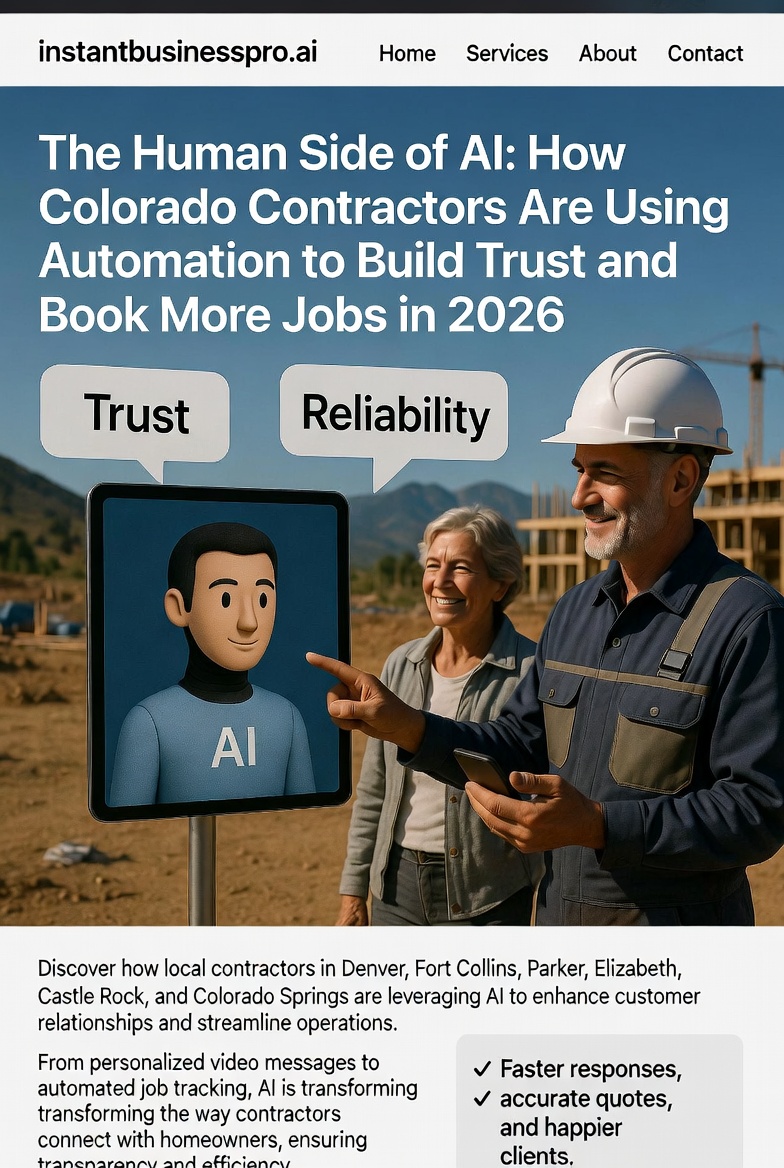
The Human Side of AI: How Colorado Contractors Are Using Automation to Build Trust and Book More Jobs in 2026
The Human Side of AI: How Colorado Contractors Are Using Automation to Build Trust and Book More Jobs in 2026
Quick Answer: What This Article Covers
90% of customers rate an "immediate" response as important when they reach out — and in home services emergencies, that expectation is non-negotiable (HubSpot, via FusionCX)
Behavioral research referenced by Harvard Business Review confirms that responsiveness is directly linked to trust formation in service relationships — even a short delay negatively affects how customers perceive professionalism
78% of local mobile searches lead to a purchase within 24 hours(ComScore) — and mobile drives roughly 70% of home services search queries
AI doesn't replace the human element in contractor relationships — it amplifies it by handling the first 30 seconds so the human relationship starts faster
Customers are willing to spend 17% more with companies that provide excellent service experiences — and speed is a core component of that experience
The contractors winning in Colorado's competitive market aren't the ones with the best reviews or lowest prices — they're the ones who respond first and feel most responsive
Let me tell you the conversation I have with almost every Colorado contractor who asks about AI automation.
"If I hand my customers off to a robot, they're going to feel like I don't care."
It's a completely legitimate concern. Homeowners in Denver, Fort Collins, Parker, Castle Rock, and Colorado Springs aren't calling you because they want to interact with technology. They're calling because their basement is flooding, their furnace died at 3 AM during a January freeze, their roof is leaking after a hail storm, or their AC quit on a 100-degree July afternoon. They're stressed, they're worried, and they want to feel like someone — a real person who knows what they're doing — is going to take care of them.
Here's what I've seen in 2025 and 2026 that changes this conversation entirely: the contractors who protect the human element most effectively are the ones using AI. Not instead of showing up personally — but to make sure they show up faster.
They're using AI to handle the first 30 seconds so the homeowner feels responded to immediately. Then they — or the right technician — step in personally at exactly the moment when the job is being decided. The result is higher close rates, fewer lost leads, and homeowners who feel more cared for than they would have if the call had gone to a rushed voicemail or a generic answering service.
This post is about the psychology behind that — why speed is actually a trust signal, how Colorado homeowners make emergency decisions, and how smart contractors are using AI to win that trust battle without sacrificing what makes them good at their job.
1. What Actually Happens in the First 60 Seconds of a Homeowner's Emergency Call
Behavioral research referenced by Harvard Business Review confirms that responsiveness is directly linked to trust formation in service relationships — even a short delay can negatively affect how customers perceive a brand's professionalism. In home services, where the stakes feel personal and urgent, this dynamic is amplified.
When a homeowner calls about an emergency — no heat at midnight, water coming through the ceiling, a roof compromised by hail — they're not in a deliberate, rational purchasing mindset. They're in a reactive, stressful one. What they need in that moment isn't a perfect sales pitch or a comprehensive service menu. They need to feel like someone responded, someone understands the problem, and help is coming.
That's why the first response matters so disproportionately. Consider what happens in each scenario:
When the call goes to voicemail or no one answers: The homeowner's stress intensifies. They feel ignored at exactly the moment they needed someone most. According to Invoca's platform data, less than 3% of callers who reach voicemail actually leave a message — the rest hang up and call the next number. In Colorado emergencies, that number almost certainly skews even lower. The homeowner doesn't wait; they dial down the list.
When a person answers but sounds distracted or rushed: Trust is actually damaged rather than built. The homeowner picks up on the signal that they're not the priority right now. A contractor on a job site, fielding calls between cuts or mid-conversation with a customer, often creates exactly this impression — not out of carelessness, but because the situation is genuinely divided.
When AI responds within 30 seconds, uses the company name, and asks one relevant question: The homeowner's stress level drops. They feel acknowledged. They're still talking to something — but something that responded faster than any human answering service could, used the contractor's name, asked about their specific situation, and promised follow-through. According to HubSpot, 90% of customers rate an immediate response as important when they reach out. AI delivers that every time, without exception.
The lesson here isn't that AI is better than humans. It's that removing the response delay allows the human relationship to start sooner. The AI catches the call. The contractor shows up for the relationship.
2. The Psychology of the Colorado Homeowner in 2026
To understand why this works, it helps to understand who you're actually dealing with when these calls come in.
They're mobile-first and they move fast. Mobile drives approximately 70% of home services search queries, and 78% of local mobile searches lead to a purchase within 24 hours. When a homeowner's furnace fails on a January night in Fort Collins, they're not sitting at a desktop researching. They're on their phone, searching, and calling. The window between "I need this fixed" and "I've already hired someone" is measured in minutes, not hours.
They equate speed with trustworthiness. Customers now associate speed with competence, trustworthiness, and overall quality. This isn't irrational — it's actually a reasonable heuristic. A contractor who responds instantly signals that they're organized, that they value the customer, and that they run a professional operation. A contractor who responds four hours later — even with a perfectly composed message — has already lost the trust battle.
They're skeptical — and for good reason. Colorado homeowners have been through enough storm-chasing contractors, high-pressure sales tactics, and no-shows to have developed real skepticism. They look for legitimacy signals fast: local knowledge, fast response, clear communication. A response that comes in 30 seconds, references their city by name, and asks a specific question about their situation sends all three of those signals at once.
They remember which businesses made them feel cared for. Research consistently shows that customers are willing to spend 17% more with companies that provide excellent service experiences, and that businesses prioritizing retention are measurably more profitable. The contractor who responds instantly during a homeowner's worst moment — a freeze, a flood, a hail event — doesn't just win that job. They win the next one, and the referral after that.
Their emergencies are seasonal and predictable. Colorado's weather creates demand windows that reward the fastest responders exponentially. When hail hits the Front Range, roofing call volume spikes dramatically and every homeowner who can't reach a contractor immediately calls the next one. When a cold snap rolls through the Denver metro in January, HVAC phones ring simultaneously across the market. The contractors who respond instantly during those windows don't just win more jobs — they capture market share that's extremely difficult to win back later.
3. Real Results from Colorado Contractors Who Got the Human + AI Balance Right
These are anonymized patterns from contractors using AI text-back systems in 2025–2026. The numbers are illustrative of real results — not cherry-picked outliers.
HVAC Contractor — Denver Metro Winter Surge
This contractor was losing a significant portion of no-heat calls because he was on other jobs or asleep when calls came in. His team averaged four to six hours for callbacks on nights and weekends — by which time most emergency callers had already hired someone else.
After implementing AI text-back:
AI asked:"Is the heat completely out or just struggling to reach temperature? What type of system — gas furnace, heat pump, or electric?"
Emergency leads triggered an immediate text to the on-call tech plus a direct booking link
Non-urgent leads received a follow-up sequence:"We'll get you scheduled first thing tomorrow"
After-hours bookings increased significantly in the first winter season
Estimated recovered revenue: $90,000+ in emergency calls that previously went unanswered
What made this work wasn't the technology — it was that the homeowner's experience improved. They felt responded to, not processed.
Roofing Contractor — Colorado Springs Hail Season
Hail hit in June. Calls spiked dramatically. Crews were on roofs all day and couldn't answer inbound volume. High-value storm jobs — $10,000 to $15,000 each — were going to whoever picked up.
After AI implementation:
AI replied instantly:"Sorry we missed you — hail damage? Send a quick photo of the roof if you have it and we'll get an inspection scheduled."
Qualified leads booked within 24 hours automatically
The contractor captured substantially more storm jobs than the previous hail season
One recovered job alone — a $13,000 full replacement — exceeded the annual cost of the AI system
The homeowners who called didn't care that the first response was automated. They cared that someone responded, asked the right question, and got them scheduled before the next contractor did.
Plumbing Contractor — Fort Collins Weekends
Weekends were consistently the worst revenue window. Burst-pipe calls — high urgency, high margin — were going to competitors because there was no system to catch them.
AI triage changed the pattern:
Photo requests filtered genuine emergencies from calls that could wait until Monday
Real emergencies were booked for immediate dispatch without a human relay step
False emergency dispatches dropped significantly — saving wasted crew time
After-hours revenue improved measurably within the first 90 days
The contractor reported something else worth noting: he felt less stressed about his phone. He stopped worrying about every missed call because he knew the system had it. That mental shift — freed-up attention — made him better in the human interactions that actually required him.
4. How to Build the Human + AI Partnership Without Losing What Makes You Good
This is the practical part. Here's how the contractors getting this right are structuring the system:
Lead with speed — AI responds in under 30 seconds. The goal isn't to replace you in the conversation; it's to make sure no homeowner experiences silence when they reach out. The AI buys the time you need to finish the job you're on, drive to the next site, or get out from under the sink.
Qualify with language that shows you understand their problem. The difference between a generic "we'll call you back" message and a good AI response is specificity. "Is water coming through the ceiling right now or is this a roof inspection after the storm?" That question shows you've thought about their situation. It builds trust before a human has said a word.
Hand off with context already established. Before you pick up the conversation, the AI has already gathered the relevant details — what broke, where, when, what they've tried. You step in knowing who you're talking to and what they need. That informed first human conversation is often where the job gets won.
Stay human in the high-stakes moments. Use AI for triage, scheduling, and routine follow-up. Use people for estimates, site visits, walking a homeowner through their options, and any situation where empathy and judgment matter more than speed. As one marketing expert at Improve & Grow put it: "Automation doesn't mean impersonal. The best systems feel personal and helpful while removing the manual burden from your team."
Close the loop with a personal touch. After the job is done, an automated review request goes out — but consider following it with a brief personal text. "Hey, it's [Name] — appreciate you trusting us with the repair. Let me know if anything comes up." One message. Thirty seconds. It reinforces every trust signal the AI built in the first response.
5. The ROI Behind the Human Story
The business case for this approach is grounded in confirmed research:
Invoca's data shows each missed call costs home services businesses an average of $1,200 in lost revenue. With 27% of home service calls going unanswered industry-wide, a contractor receiving 20 calls per day is losing more than $2,400 per day in potential revenue — much of it during the after-hours and surge windows when AI's response advantage is greatest.
Businesses with 24/7 reception see customer retention rates improve by 24% or more. Customers who feel heard and responded to instantly become repeat customers and referral sources — a compounding benefit that goes well beyond the immediate job recovered.
Across the Colorado contractors using this system, the consistent pattern is: more booked jobs from the same call volume, fewer lost leads to competitors, and a business that feels less reactive and more in control — even during Colorado's most intense demand windows.
The payback period for most implementations is 30–60 days. Most contractors who implement it don't go back.
Text DEMO to (720) 973-1369 for your free trust and speed audit — we'll show you exactly where leads are slipping away between first contact and first response, and how to close that gap without sacrificing what makes your business feel personal.
Missed call cost breakdown →instantbusinesspro.ai/post/cost-of-missed-calls
Speed-to-lead blueprint →instantbusinesspro.ai/post/how-service-contractors-are-booking-3x-more-jobs
HVAC emergency examples →instantbusinesspro.ai/trades/hvac
Frequently Asked Questions
Won't homeowners feel put off by AI responding instead of a real person?
The research says otherwise. According to HubSpot, 90% of customers rate an immediate response as important when they reach out. In home services emergencies — no heat, burst pipes, storm damage — homeowners are evaluating whether someone responded quickly and competently, not who sent the message. A 30-second AI response that correctly identifies their problem and promises action builds more trust in that moment than a four-hour human callback ever can.
How does AI response actually build trust rather than erode it?
Behavioral research referenced by Harvard Business Review confirms that responsiveness is directly linked to trust formation in service relationships. When a company responds instantly, it satisfies the prospect's need for quick solutions, reinforcing trust and credibility. Customers now associate speed with competence — a fast, specific first response signals professionalism, organization, and that the customer is a priority.
What's the psychological reason speed matters so much in emergencies?
Behavioral economists describe this through the concept of primacy bias — first impressions shape expectations for the entire relationship that follows. When a homeowner is stressed about an emergency, their brain is prioritizing immediate responses. If your business is the first to satisfy that need, you set the frame for the entire interaction. If a competitor responds first, that frame is set by someone else — and it's very difficult to recover.
How does mobile search behavior affect the response time window for Colorado contractors?
Mobile drives approximately 70% of home services search queries, and 78% of local mobile searches lead to a purchase within 24 hours. This means the homeowner searching "emergency plumber Fort Collins" at 10 PM isn't doing preliminary research — they're making a same-night decision. The response window is measured in minutes, not hours. AI text-back closes that window automatically.
What does a good AI first response actually look like for a contractor?
A good first response does three things: it identifies your business by name, it acknowledges the specific situation, and it asks one relevant qualifying question. For HVAC: "Hi, this is [Business] in Fort Collins — sorry we missed your call. Is the heat completely out or struggling to reach temperature?" For roofing: "Hail damage or an active leak? Send a photo if you have one and we'll get you scheduled." The specificity is what makes it feel human — generic responses don't build trust.
Does AI work differently for different trades in Colorado?
Yes — and it should be configured that way. HVAC emergency triage in Colorado is about identifying no-heat severity and system type during freeze windows. Roofing qualification during hail season focuses on damage scope and insurance claim status. Plumbing after-hours response distinguishes active leaks from routine clogs. General contracting qualification gathers project scope and timeline. A well-configured AI system speaks the language of your specific trade, which is why it can feel like your team instead of a generic bot.
What happens when a homeowner asks something the AI can't handle?
The AI escalates gracefully. If a response falls outside the qualification script — a complex insurance question, a request for an on-site estimate, or a homeowner who explicitly asks to speak with someone — the system flags it for human follow-up and notifies you or your team immediately, along with a summary of everything the conversation has covered so far. You step in with context instead of starting from scratch.
How does AI affect the human relationships that actually build long-term contractor businesses?
By handling the repetitive, time-sensitive first-contact layer, AI frees your human capacity for the interactions that actually require you — estimates, site visits, walkthroughs, relationship conversations with repeat customers. Research shows that businesses prioritizing customer retention are significantly more profitable, and customers are willing to spend 17% more with companies that provide excellent service. AI makes excellent service possible at scale by ensuring no homeowner experiences silence when they reach out.
Is there a risk of the AI response feeling generic or impersonal?
Only if it's not configured properly. A generic "thanks for calling, we'll be in touch" is impersonal regardless of who sends it. A message that references your business name, your city, asks a trade-specific question, and promises a clear next step feels personal — because it's specific to the caller's situation. The difference between impersonal and personal AI is the quality of the configuration, not the technology itself.
How long does it take to see results after implementing AI text-back?
Based on Colorado contractor results, most see measurable improvement in after-hours booking rates within the first 30 days. Full ROI — measured against both reduced service fees and recovered lead revenue — typically arrives within 60 days. The system that took the most time to deliver results in the case studies we track was 90 days, during a slow-season implementation before the contractor's primary demand window opened.
Data sources: HubSpot customer response time research (via FusionCX and Agents Republic, 2025); Harvard Business Review behavioral research on responsiveness and trust formation; ComScore local mobile search data (via Invoca, 2025); Hook Agency home services search analytics (2025); Invoca home services call analytics (2025); Voiso lead response time analysis (2025); Contracting Business customer service spending data; Dialzara 24/7 reception retention data (2025); Improve & Grow lead management for home services (2025).
