
Boost Contractor Reputation: Get More 5-Star Reviews
Contractor Resources, Revenue Growth, Reputation Management
How Colorado Contractors Go From 3.8 to 4.8 Stars in 60 Days Using an Automated Post-Job Review System
Two HVAC companies in Denver. Both show 4.8 stars on Google, both have trucks on the road, both claim “family-owned, locally trusted.” One gets the call within 60 seconds of a homeowner searching “AC repair near me”—the other never even hears the phone ring. The difference isn’t the star rating; it’s the story the entire review profile tells to a Colorado homeowner who’s about to spend $8,000 on a system replacement, $2,500 on a roof repair, or $1,200 on an emergency plumbing call.
As a civil engineer and former project manager on $100K+ contractor jobs, I’ve seen the same pattern across HVAC, plumbing, electrical, roofing, and landscaping—most owners obsess over “getting more reviews,” while homeowners are quietly running a far more sophisticated filter. They’re not just glancing at the stars; they’re scoring your entire profile for recency, response behavior, how you handle problems, and whether your photos and keywords match the job they need done in their part of Colorado.
This post is not about how to collect more reviews—that’s covered in other Instant Business Pro guides. This is about the psychology of the homeowner review filter and what every element of your Google review profile is silently communicating before they ever tap “Call.”
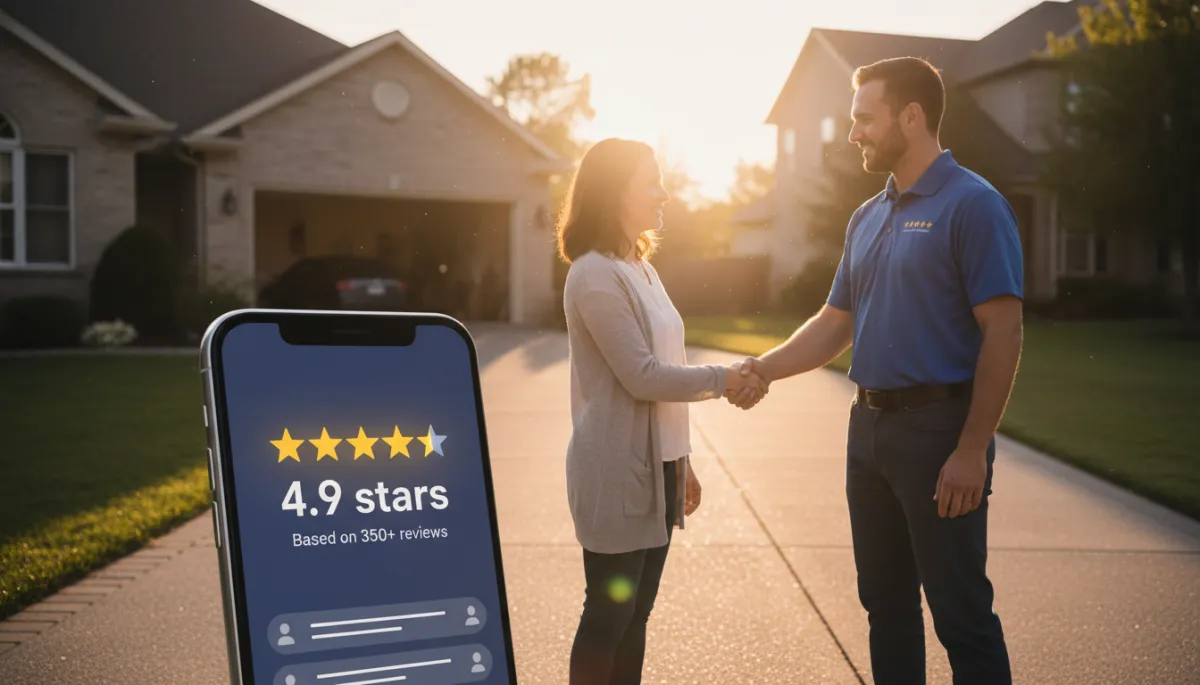
Meta description: Colorado homeowners don’t just look at your star rating—they read your entire Google review profile like a risk report. Learn how recency, responses, photos, and patterns shape trust, calls, and revenue.
The Real Problem: Same Star Rating, Completely Different Story
Across Colorado, from Fort Collins to Colorado Springs, most established contractors sit somewhere between 4.5 and 4.9 stars on Google. On paper, they look identical. But when a homeowner is staring at two 4.8-star profiles on their phone at 9:30 p.m. with a leaking water heater, they’re not making a decision based on the average rating—they’re reading the pattern behind the numbers.
Here’s what they’re actually thinking, whether they say it out loud or not:
- “Are these reviews recent—or did they stop caring two years ago?”
- “Do they respond when something goes wrong, or do they disappear?”
- “Has anyone mentioned my exact problem—frozen pipes in January, hail damage in Aurora, low water pressure in an older Denver bungalow?”
- “Do the photos look like real Colorado jobs—or generic stock images?”
In 2026, your review profile behaves like a pre-qualification file. It tells a detailed story about your operations, your culture, and your reliability—long before you ever step on-site. If that story is weak, inconsistent, or outdated, your phone stays quieter than it should, even if your crews do excellent work.
What Colorado Homeowners Actually Score in Your Review Profile
Let’s break down the main variables homeowners are scanning—consciously or subconsciously—when they open your Google reviews. These are the trust signals that decide whether a 4.8-star profile gets the call, or gets ignored.
1. Recency: Old 5-Star Reviews Feel Risky
A profile with 150 reviews and a 4.9-star average looks strong—until a homeowner notices the last review was posted 18 months ago. In a fast-moving market, that reads as:
- “Maybe ownership changed.”
- “Maybe they’re not doing much work anymore.”
- “Maybe quality dropped and nobody’s saying it out loud yet.”
Colorado homeowners know contractors churn. They’ve seen companies explode after a big storm season, then disappear. So they use recency as a risk filter. If your last 10 reviews are spread across the last 30–60 days, that feels like a live, active, stable operation. If your last 10 are spread across three years, your 4.8 stars start to look theoretical, not current.
2. Response Rate: Your Public Communication Log
Your review responses are a public log of how you communicate under pressure. Homeowners scroll and notice three patterns immediately:
- No responses at all: “If something goes wrong, I’m on my own.”
- Only responding to bad reviews: “They’re reactive and defensive, not proactive.”
- Consistent, professional responses to all reviews: “This team is organized, attentive, and accountable.”
Even simple responses—“Thanks for trusting us with your boiler replacement in Lakewood, John. We appreciate the review.”—send a strong signal. They show that you monitor feedback, you value customers, and you’re present in your own business. For many homeowners, that’s the deciding factor between two similar profiles.
3. Specific Problems Handled Well: Operational Reliability
Generic reviews—“Great job,” “Awesome team,” “Highly recommend”—are nice, but they don’t reduce risk. What really moves the needle is when homeowners see specific scenarios that mirror their own situation:
- “They got our heat back on the same day during a snowstorm in Littleton.”
- “They handled our insurance claim after hail damage in Thornton—no drama.”
- “They cleaned up thoroughly after trenching for a sewer line in an older Denver neighborhood.”
These details signal real-world reliability. They tell a homeowner, “This contractor has solved my exact problem for someone like me, in a house like mine, under Colorado conditions.” That’s far more powerful than another vague 5-star compliment.
4. Keyword Signals: Trade, Location, and Job Type
Homeowners don’t think in SEO terms—but they still scan for specific words and phrases:
- Trade: “HVAC,” “plumbing,” “electrical panel,” “roof replacement,” “sprinkler system.”
- Location: “Arvada,” “Parker,” “Colorado Springs,” “Boulder,” “Greeley.”
- Job type: “full system replacement,” “emergency call,” “annual maintenance,” “warranty work.”
When reviews naturally include these terms, they do two things at once:
- They reassure the homeowner that you’re experienced with their specific scenario.
- They feed Google’s local algorithm, helping you rank for those high-intent searches.
5. Photo Presence: Real Jobs vs. Stock-Photo Profiles
Colorado homeowners are highly visual. They’re used to judging properties, landscapes, and finishes. When they open your profile, they’re not just reading—they’re scanning photos for evidence:
- Real job-site photos in Colorado homes and neighborhoods.
- Before-and-after shots that show craftsmanship, not just equipment.
- Customer-uploaded photos attached to reviews, which feel more credible than polished marketing images.
A profile with only generic stock images and no customer photos reads as “manufactured.” A profile with messy, real-world, in-progress shots and finished work in recognizable Colorado settings reads as “legit.”
The Review Volume Trap: Why 47 Fresh Reviews Beat 312 Stale Ones
Many contractors fixate on big numbers—“Our competitor has 300+ reviews, we only have 80.” But homeowners are running a different calculation. They’re asking:
- “How many reviews are from the last 90 days?”
- “What’s the recent trend—stable, improving, or slipping?”
A profile with 47 reviews where 20+ are from the last quarter, all mentioning current staff, current processes, and current pricing, often feels safer than a profile with 312 reviews where everything recent is mixed or missing. Volume without freshness can actually raise suspicion—especially in markets like Denver and Boulder where homeowners are used to more sophisticated service providers.
The Red Flag List: Patterns That Make Homeowners Skip You Entirely
Just as important as your strengths are the patterns that quietly kill conversions. Here are the red flags I see Colorado homeowners react to again and again when we review call logs and lead data with clients:
- Clustered bad reviews with no resolution: Three 1–2 star reviews in a row about the same issue—“no-show,” “surprise fees,” “left a mess”—with no professional response from the owner. That reads as a systemic problem, not a one-off.
- Copy-paste responses: The same generic reply on every review—positive or negative—signals automation without care. Homeowners read that as “checkbox behavior,” not real accountability.
- Overly defensive replies: Long arguments, blaming customers, or revealing job details in public. Even if you’re technically right, you look volatile—and homeowners don’t want to invite volatility into their home or project.
- No reviews in key service categories: An HVAC company with tons of maintenance reviews but zero mentions of full system replacements. A roofer with only small repair mentions and nothing about full reroofs. For larger-ticket jobs, that gap is a red flag.
- All reviews from a single time period: 40 reviews in one month, then nothing for a year. That looks like a one-time push, not an ongoing standard.
Step 1: Check Your Current Review Gap
Before you change anything, you need a clear picture of where you stand. At Instant Business Pro, we call this your review gap—the difference between how your profile looks today and what top-performing Colorado contractors’ profiles look like in your trade and market size.
Use our free tool to check your review gap. In a few minutes, you’ll see:
- How your review volume compares to similar Colorado contractors.
- Whether your recency pattern looks healthy or stale.
- Gaps in job-type coverage (maintenance vs. installs vs. emergencies).
Once you see the gap, you can prioritize. Maybe you don’t need 200 more reviews—you need 20 new ones in the next 60 days that mention full replacements, financing, and specific Colorado cities.
Step 2: Remember—A Strong Profile Only Works If You Answer the Call
Here’s the part most owners miss. You can fix your review profile, tighten your responses, and dial in your photo strategy—but if you don’t answer the phone, all of that trust evaporates the second a homeowner hits “Call.”
In our data across Colorado contractors, 30–40% of first-time inbound calls go unanswered during peak seasons. That’s not a marketing problem—that’s an operations leak. To plug it, you need systems that catch every missed opportunity:
- A missed call text-back workflow that automatically sends a professional SMS within seconds when you can’t pick up. This keeps the conversation alive and reassures the homeowner you’re on it.
- An AI receptionist that can answer common questions, capture job details, and book appointments 24/7—so your review profile isn’t wasting its conversion power outside office hours.
-toned close-up of a contractor and homeowner standing in a finished kitchen remodel, contractor...
Step 3: Upgrade Your Review Profile from “Nice to Have” to Revenue Asset
When your review profile is dialed in, it doesn’t just look good—it reduces friction at every stage of the sales cycle. Contractors who treat their profile as a core asset consistently see four concrete payoffs:
- Higher map-pack visibility: Strong, fresh reviews help you rank higher in Google Maps, which leads to more qualified calls—especially for “near me” and emergency searches where homeowners pick from the top 3.
- Higher close rates: When prospects see dozens of detailed, local 5-star stories, your estimator doesn’t have to work as hard to justify your pricing. The review profile has already done half the selling.
- Less price pressure: A strong profile with clear proof of quality and reliability lets you hold margin—even when low-bid competitors are circling the same job.
- Long-term brand equity: Reviews stack over time. They stabilize your reputation, protect you from the occasional bad review, and increase the value of your business if you ever sell or expand into new Colorado markets.
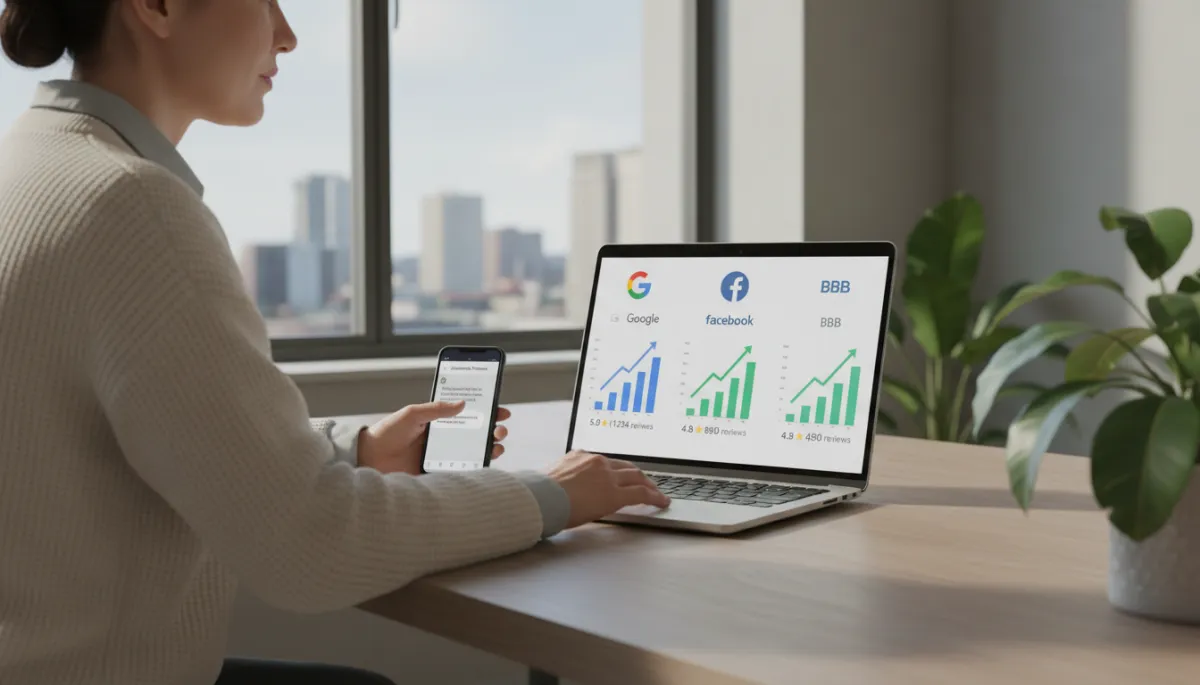
-toned office scene with a contractor business owner at a desk reviewing a laptop dashboard...
Step 4: Put It All Together with Instant Business Pro
The Colorado contractors winning in 2026 aren’t just the cheapest, or even the most technically skilled—they’re the ones who combine strong field operations with a disciplined, automated approach to reputation and response. In practice, a high-performing system looks like this:
- Every job is closed out with photos, payment, and a clear review request—so your profile stays fresh and relevant to the work you’re doing today in Colorado neighborhoods.
- Automated workflows send branded review requests and reminders at the right time—so your review velocity stays steady without your office staff chasing every customer manually.
- Reviews from Google, Facebook, BBB, and trade sites flow into a central dashboard, where your team uses AI-assisted templates to respond quickly, professionally, and consistently.
- Your best reviews—especially those that mention specific Colorado cities, job types, and outcomes—are repurposed into proposals, website sections, and social proof inside your sales process.
Instant Business Pro’s Growth Engine plan was built specifically for this. It combines review automation, centralized monitoring, missed call text-back, and an AI receptionist into one platform—so you’re not just collecting stars, you’re converting them into booked revenue.
Final Step: Check Your Review Gap and Book a Call
If you’re a Colorado contractor with a decent star rating but fewer calls than you should be getting, your review profile is almost certainly part of the problem—and one of the fastest levers you can pull to fix it.
Start by using our free tool to check your review gap. Then, if you want a direct, data-backed plan for tightening your profile, plugging missed-call leaks, and turning more searches into booked jobs, book a call with the Instant Business Pro team. We’ll walk your profile the same way a Colorado homeowner does—and show you exactly what to fix first.
When you treat your Google review profile like a core asset—not an afterthought—you stop competing on price alone and start winning on trust. In today’s Colorado market, that’s the edge that keeps your crews busy, your margins healthy, and your calendar full.
