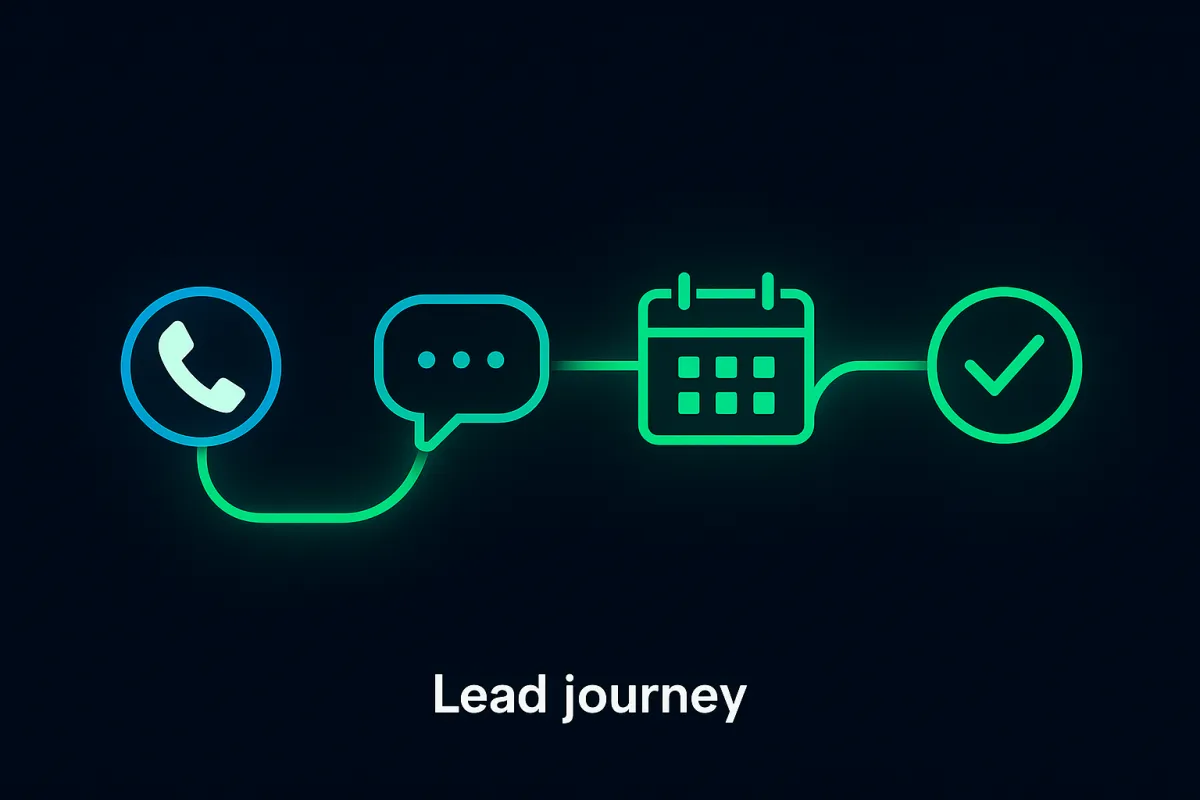
The Complete AI Lead Journey for Contractors: Call to Review
The Complete AI Lead Journey for Contractors: From First Call to Five-Star Review
Most conversations about AI automation for contractors focus on the missed call. That moment matters enormously, and we have written about it at length. But the full picture of what automation can do for a contracting business extends well beyond that first touchpoint.
The contractor AI lead journey is the complete path a phone lead travels from the moment they first call your number through a booked appointment, a completed job, and a Google review. Understanding what goes wrong at each stage — and how a well-designed AI system keeps leads moving forward — is what separates contractors who get incremental value from automation from those who unlock its full potential.
This post walks through every stage of that journey, what typically breaks down at each one, and exactly what a connected automation system does to fix it.
Stage 1: The Missed Call and Instant Text-Back
What happens without automation: A homeowner calls your number and reaches voicemail. Less than 3% of callers leave a voicemail when sent to one, according to Invoca platform data. The other 97% hang up immediately. Of those, 85% will never call back. They move to the next contractor in their Google search results, and you will never know you were considered.
The typical contractor in 2026 answers just 25.9% of inbound calls during working hours. That is the average for active businesses, not outliers. Nearly three out of every four calls go unanswered because technicians are on rooftops, in crawl spaces, under sinks, or in the middle of conversations with existing customers.
What happens with automation: Within 60 seconds of a missed call, the caller receives a personalized text message from your business number. Not a generic "we missed your call" blast — a warm, professional message that acknowledges their inquiry, identifies your business, and invites them to share what they need by text. The response time alone communicates something important about how your business operates.
This first moment accomplishes two things simultaneously. It keeps the lead engaged before they call a competitor. And it sets an immediate tone of professionalism and responsiveness that primes the customer for a positive experience before any human interaction has occurred.
Responding within 5 minutes makes a contractor 8 times more likely to win the job compared to responding after 30 minutes. After 30 minutes, conversion odds drop below 10%. The industry average response time is 47 hours. The gap between where most contractors operate and where the standard needs to be is where leads are lost every single day.
For a deep breakdown of the mechanics and message content, our post on what missed call text back is and how it works for Colorado contractors covers the full setup. You can also see how our dedicated Missed Call Text Back service supports this first stage.
Stage 2: The Conversation and Lead Qualification
What happens without automation: A customer calls back after seeing your missed call return. You are still on the previous job. Voicemail again. Or the customer texts back to your automated message and the response falls into a general inbox that nobody monitors until the end of the day. The lead was engaged, you had momentum, and then the system lost it.
What happens with automation: Once the customer responds to the initial text, a conversational sequence gathers the information your business actually needs before a human enters the conversation. What type of service do they need? What is their service area or address? What is their timeline? Is this urgent?
By the time you or a dispatcher enters the conversation, you are not starting from zero. You know what the customer needs, where they are, and how urgent their situation is. The first five minutes of a callback stop being intake questions and start being relationship-building and scheduling.
For customers with genuinely urgent situations — a burst pipe, a heating system that stopped working overnight, a roof that is actively leaking — smart triage flags the conversation for immediate human attention. Not every lead needs the same urgency level, and the system routes them accordingly. A quote request for a spring deck project and an emergency HVAC call at 9pm should not be treated identically, and a well-configured automation platform makes sure they are not.
This differentiated response is particularly valuable for Colorado contractors during weather-driven surge periods. A January cold snap generates a fundamentally different inbound call profile than a normal weekday in March, and the system handles that volume intelligently without requiring additional staff.
Stage 3: Appointment Booking and Confirmation
What happens without automation: The customer is interested. They responded, they explained what they need, and they are ready to schedule. You call back but they do not answer. You leave a voicemail. They call back while you are on a job. Another voicemail. By the time you actually connect and schedule, 36 hours have passed.
In a competitive market, 36 hours is enough time for a motivated homeowner to research three contractors, get two quotes, and book a job. The lead that was yours to win 36 hours ago is now someone else's confirmed appointment.
Phone tag is one of the most common and most fixable revenue leaks in contracting businesses. The fix is not working harder at calling back faster. It is moving scheduling into a channel that does not require both parties to be simultaneously available.
What happens with automation: Once a lead is qualified and ready to schedule, an automated text asks for their availability and either provides a booking link or guides the scheduling conversation through text. The customer can respond when they have a moment. You can confirm when you have a moment. Scheduling happens asynchronously without either party having to stop what they are doing to be on a phone at the same time.
Appointment confirmation messages fire automatically once the booking is locked — a confirmation text immediately, a reminder 24 hours before, and a check-in message the morning of service. Research consistently shows that automated SMS reminders reduce appointment no-shows by 22%. For a contractor running 20 or more appointments per week, that difference compounds quickly into meaningful saved time and revenue.
Customers who receive a reminder feel attended to. Customers who need to reschedule have a simple path to do it promptly rather than simply not showing up. Both outcomes are better for your schedule than the alternative.
Stage 4: Pre-Visit and Day-of Communication
What happens without automation: The appointment is booked and confirmed. Then radio silence until the technician shows up — or does not show up quite when expected. The customer is home waiting, not sure if the tech is running late or coming at all. They call the office. The office tries to reach the tech. The tech is finishing up a previous job and cannot answer right away. The customer's confidence in your business starts to erode before the first wrench has been turned.
What happens with automation: The gap between booking and service delivery is one of the most underutilized trust-building windows in the entire lead journey. A pre-visit message sent the day before tells the customer the technician's name and confirms the arrival window. A day-of message when the technician is en route gives a real-time estimated arrival time.
These messages do something that technical competence alone cannot: they humanize the transaction. The customer is no longer waiting for a faceless contractor. They are expecting a specific person at a specific time. That specificity reduces anxiety, ensures someone is home and ready, and creates a warmer environment when the technician arrives.
For contractors in competitive Colorado markets — from the Denver metro to Colorado Springs to Fort Collins — the pre-visit and day-of communication experience is often what separates a four-star review from a five-star review, even when the technical quality of work is identical. Customers rate the full experience, not just the repair.
These touchpoints require no additional effort from your team once the automation is configured. They fire based on appointment data and technician status, consistently, across every single job. That consistency is what professional service looks like at scale.
Stage 5: Post-Job Follow-Up and Review Request
What happens without automation: The job is complete. The customer paid. The technician is already driving to the next call. The moment when the customer's satisfaction is at its highest — when the problem is solved, the stress is gone, and the gratitude is real — passes without any follow-up from your business. Days or weeks later, you might remember to reach out. By then, the emotional peak has faded. The customer has moved on. The review that would have taken them 90 seconds to write in that window now requires actively remembering your business, finding your listing, and mustering the motivation. Most do not.
What happens with automation: A few hours after job completion, while the positive experience is still fresh, the customer receives a message from your business. It thanks them for choosing you, invites them to reach out if anything comes up, and asks if they would be willing to share their experience on Google with a direct link to your review page.
Review requests sent within 24 hours of a positive service experience convert at 3 to 5 times higher rates than those sent later. After 24 hours, response rates drop 40 to 60% as the customer moves on to other priorities. Automated review requests, fired consistently after every completed job, build your Google review profile steadily over time without requiring anyone on your team to remember to send them.
The compounding effect of this consistency is significant. Contractors with 300 or more Google reviews generate 1,046% more Google Local Service Ad leads per month than contractors with fewer than 100 reviews at the same ad budget. That is not a marginal advantage. That is the difference between an LSA campaign that delivers meaningful volume and one that trickles.
We covered the full mechanics of a high-converting review request system in our post on how to get more 5-star reviews on autopilot, and the broader business case in our post on why Google reviews win or lose jobs for Colorado contractors. You can see how our Reputation Management service supports this review flywheel.
The Full System: Why Consistency Across Every Stage Is What Matters
Any one of these five stages, automated well, provides measurable value. An instant text-back after missed calls alone recovers a meaningful percentage of leads that would have otherwise gone to competitors. A well-timed review request alone generates more reviews than most contractors get in a year.
But the true leverage comes from running all five stages consistently, for every lead, without exception. Here is what that system produces over time.
More leads captured at Stage 1 because no call goes to a dead-end voicemail. More leads qualified efficiently at Stage 2 because intake happens systematically before any human has to be involved. More leads converted at Stage 3 because scheduling does not stall in phone tag. Fewer no-shows at Stage 4 because customers feel attended to and reminded. More five-star reviews at Stage 5 because the request arrives at the highest-value moment.
Each stage feeds the next. Each improvement compounds. The result is a business that responds professionally at every touchpoint without the owner or their team having to be present for every one of them.
We covered this flywheel effect across the full contractor lead journey, including ad-driven leads and multi-channel automation, in our post on automating the complete contractor lead journey from ad click to five-star review. And if you are still weighing the cost of building this system against alternatives like live answering services or additional staff, our post comparing AI automation versus an answering service versus hiring a receptionist lays out the full numbers.
For home service contractors in Colorado, whether you run HVAC calls across the Denver Front Range, roofing in Colorado Springs, plumbing in Fort Collins, or deck and remodel projects in Boulder — building this full system does not require a large team or a complex technology stack. It requires a clear process and the right platform to run it automatically. Explore how we support HVAC, plumbing, and other trades across Colorado.
At Instant Business Pro, we build these systems for Colorado contractors from the ground up, configured for your trade, your tone, and the way your customers communicate. The result is a business that operates professionally at every touchpoint, every time, whether you are on the phone, on a job, or on the weekend.
Frequently Asked Questions: The Complete Contractor AI Lead Journey
What are the five stages of the contractor AI lead journey?
The five stages are: (1) the missed call and instant text-back, where automation re-engages callers within 60 seconds before they dial a competitor; (2) the conversation and qualification, where automation gathers intake information so a human enters the conversation informed; (3) appointment booking and confirmation, where scheduling moves to text-based channels to eliminate phone tag; (4) pre-visit and day-of communication, where automated messages set arrival expectations and reduce no-shows by 22%; and (5) post-job follow-up and review request, where review requests sent within 24 hours of job completion convert at 3 to 5 times higher rates.
How much revenue do contractors lose by only automating one stage of the lead journey?
Significant ongoing revenue leaks from every unautomated stage. Phone tag at Stage 3 alone loses jobs that were ready to book. No-shows from unreminded appointments waste technician time at Stage 4. Missed review request windows at Stage 5 compound into lower Google rankings, fewer LSA leads, and a weaker competitive position over time. Each stage has its own revenue impact, and the cumulative cost of unaddressed friction across all five stages is substantial.
What is the most common place contractors lose leads after the first contact?
Phone tag during scheduling is one of the most frequently cited causes of lead drop-off after initial engagement. The customer is interested, the contractor is interested, but the scheduling process requires simultaneous phone availability that neither party can reliably guarantee. Moving scheduling into asynchronous text-based channels eliminates this friction entirely.
How do automated appointment reminders reduce contractor no-shows?
Automated SMS reminders sent 24 hours before and the morning of a scheduled service reduce no-shows by 22%, according to SMS marketing performance data. Customers who receive a reminder feel attended to and are more likely to either keep the appointment or notify you promptly if they need to reschedule, rather than simply not answering when the technician arrives.
Why is the post-job review request so time-sensitive for contractors?
The moment immediately after a successful service completion is the customer's satisfaction peak. The problem is solved, the stress is gone, and gratitude is at its highest. Review requests sent within 24 hours of this moment convert at 3 to 5 times higher rates than those sent later. After 24 hours, response rates drop 40 to 60%. Contractors who send review requests manually and inconsistently miss this window on most jobs. Automation fires the request at the optimal moment for every completed job without exception.
How long does it take to set up a full five-stage AI lead journey system?
Most Colorado contractors using a properly configured automation platform are fully operational across all five stages within one to two days of initial setup. Each stage is configured once and runs automatically from that point forward, requiring no ongoing manual management beyond periodic review of performance metrics.
Ready to run the complete AI lead journey in your contracting business?
IBP installs the full pipeline — from first missed call to booked job to Google review — in 14–21 days. Everything in this guide runs automatically under your brand. Start by seeing what your current lead gaps are costing you: IBP Revenue Calculator — 60 seconds, free.
Want Austin at IBP to walk you through what the full journey looks like for your specific trade? Reach out here and we'll map it out together.
