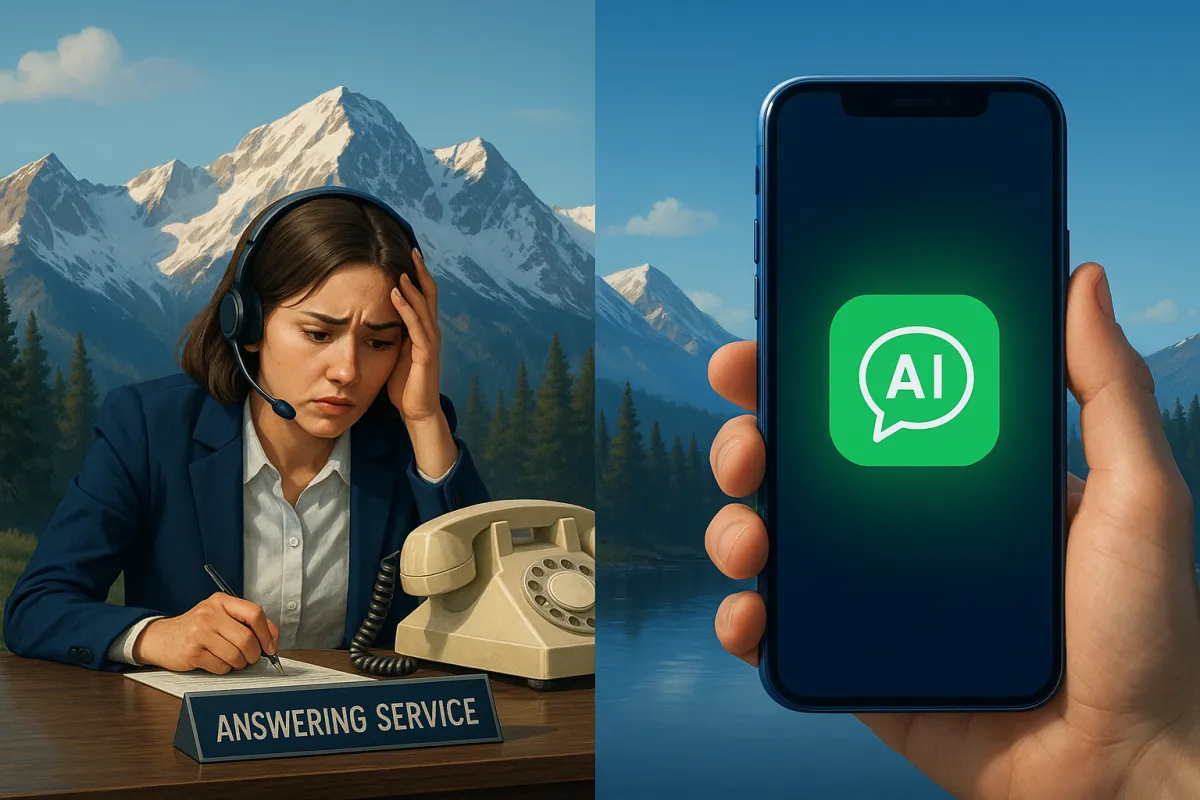
AI vs. Answering Service vs. Hiring a Receptionist: The Real Cost Comparison for Colorado Contractors in 2026
At some point, every growing contracting business in Colorado hits the same crossroads. The calls start coming in faster than you can handle them and you know something has to change. Maybe you've already missed a few jobs because you were on a roof or under a crawlspace and couldn't pick up. Maybe your voicemail is filling up and you're losing track of which messages you've returned and which ones are still sitting there.
The question most contractors start asking at that point is a pretty simple one: what do I do about this?
Three options come up again and again. Hire a traditional answering service, bring on a receptionist or admin, or try AI-powered automation. Each one sounds reasonable on the surface. Each one has real tradeoffs that don't always get spelled out before you sign up or write a check.
This post is a straight comparison. No upselling, no spin. Just an honest look at what each option actually costs, what it does well, and where it falls short, so you can make the right decision for where your business is right now.
Before we get into it, if you haven't seen the actual revenue numbers around what missed calls cost Colorado contractors each year, our post on The Real Cost of Missed Calls for Contractors in 2026 is worth reading first. The math is genuinely eye-opening.
Option 1: The Traditional Answering Service
Answering services have been around for decades and they've always sold themselves on one core promise: a live human voice picks up when you can't. For contractors who handle after-hours emergency calls, that pitch was compelling for a long time.
But there are limitations that don't always get mentioned upfront, and in 2026 most of the advantages answering services used to hold exclusively no longer belong to them alone.
The operators answering your calls don't know your business. They're working from a script you provided and they're fielding calls for dozens or hundreds of other companies at the same time. When a potential customer calls asking about hail damage inspection timelines, roofing material options, or what an HVAC tune-up typically includes, the rep can only say someone will call you back. That's better than voicemail, but it's not a conversation that builds confidence or moves anyone closer to booking.
Then there's cost. Most answering services charge per minute or per call, and those charges stack up quickly during busy season. Based on current 2026 industry pricing, traditional answering services for contractors typically run between $200 and $600 per month depending on call volume, and that's before add-on charges for appointment scheduling, call transfers, or bilingual support. A contractor fielding 80 to 100 calls a month can hit the high end of that range fast, paying for message-taking that still requires them to do all the actual follow-up themselves.
And then there's the speed problem. The answering service takes the message, but the lead still has to wait for your callback. Research consistently shows that 78% of buyers choose the first company that responds to them, and every 10-minute delay drops your conversion odds by 400%. An answering service doesn't close that gap. It just delays the moment you actually engage. By the time you call back, your competitor may already have the job.
Best for: Contractors who specifically want a fully human voice on every call and are less concerned with conversion speed. For everyone else, read on.
Option 2: Hiring a Receptionist or Admin
Bringing someone on full-time or part-time to handle incoming calls, schedule appointments, and manage follow-up feels like the natural move once your business reaches a certain volume. You get a real person who knows your trade, can answer questions in context, and represents your company in every interaction. It's the most human solution and there's real value in that.
It's also the most expensive option by a significant margin.
According to current 2026 data from Glassdoor and Salary.com, the average receptionist salary in Colorado runs between $38,000 and $46,000 per year in base pay. A full-time administrative assistant in the Denver metro averages over $55,000. Once you layer in employer payroll taxes, health benefits, paid time off, and the time it takes to hire and train someone, your real total cost lands closer to $55,000 to $70,000 per year for a single full-time hire. A part-time admin working 20 hours a week still runs $18,000 to $30,000 annually depending on experience.
Beyond the cost, there's the availability problem that rarely gets discussed honestly. HubSpot data shows that 52% of leads come in outside standard business hours. That homeowner who gets home from work at 6pm on a Wednesday and decides to finally call about a deck quote? Your receptionist is already off the clock. The call goes to voicemail. Research shows that 80% of callers who reach voicemail hang up without leaving a message. They don't try again later. They move on to the next contractor on Google.
There's also what you might call the single-point-of-failure problem. One employee calling in sick, going on vacation, or leaving the job creates an immediate hole in your lead capture system. Finding and training a replacement takes weeks. During that window, calls go unanswered and revenue quietly leaks out the door.
Best for: Established contracting businesses with consistent high call volume, complex customer interactions, and the revenue base to support full salary, benefits, and management overhead. Even then, most operations today are pairing a receptionist with AI to cover the gaps.
Option 3: AI-Powered Automation (The Future of Contractor Answering)
This is where the conversation is headed in 2026 and beyond, and this is where Instant Business Pro operates. We're going to give you the honest version.
AI-powered follow-up automation works by doing one thing exceptionally well: making sure every lead gets an immediate, professional response the moment they reach out. It doesn't matter what time it is, what day of the week it is, or how deep into a job you are.
When someone calls and you can't answer, the system sends a personalized text message within seconds. Not a generic response, but a message that reflects your business, your tone, and the nature of their inquiry. The customer can respond, share details about what they need, and feel heard before you ever pick up the phone. When you're ready to follow up, you step in with the full context already in hand.
And here's where most people get AI wrong: it handles emergencies too.
One of the biggest reasons contractors have held onto traditional answering services is the belief that emergency calls require a human. That used to be true. It isn't anymore. Modern AI systems are built to recognize emergency language in real time. When a caller says their pipe is flooding, their heat went out at midnight, or they smell something burning, the system doesn't take a message and wait. It detects the urgency, immediately pushes an emergency alert to your on-call tech or your phone, and simultaneously reassures the customer that help is on the way. No delay. No waiting for a human operator to decide if something qualifies as urgent. The same intelligent escalation that answering services have long promised, now built directly into the AI and running 24 hours a day.
Industry data backs this up. According to NextPhone's 2026 analysis, roughly 6.2% of contractor calls are true emergencies and another 15.9% contain urgency language. AI systems are now built to catch exactly those signals and route them immediately to the right person in real time, while handling the remaining 78% of routine inquiries, quote requests, and scheduling calls autonomously.
Think about what that means for a plumbing company at 11pm on a Saturday. A homeowner calls about a burst pipe. The AI picks up instantly, identifies the emergency from the caller's language, sends an immediate push alert to your on-call tech with the caller's name, number, and situation summary, and tells the homeowner help is being dispatched. Your competitor's answering service does the same thing with a human operator and a callback loop. Your AI does it in seconds, automatically, at a fraction of the cost.
That's not a limitation of AI. That's AI surpassing what traditional answering services were ever built to do.
The cost structure reinforces the case. AI automation doesn't charge per minute, doesn't call in sick, doesn't need benefits, and doesn't clock out at 5pm. It runs 24 hours a day, 7 days a week, at a flat monthly rate that's a fraction of what either a receptionist or a traditional answering service costs at scale. For a contractor getting 150 calls a month, a traditional answering service can run $300 to $500. AI automation typically delivers that same coverage, plus smarter emergency escalation and better lead capture, at significantly lower cost with no per-call overage surprises.
A lot of contractors worry this makes their business feel impersonal. The data actually says the opposite, and we wrote about it in depth in The Human Side of AI: How Colorado Contractors Are Using Automation to Build Trust and Book More Jobs in 2026. Speed of response builds trust in ways that slow callbacks simply don't.
If you're still in the thinking-about-it stage and have questions before committing, we put together 5 Questions Every Colorado Contractor Asks Before Trying AI Automation, answered honestly and without the tech hype.
Best for: Contractors of all sizes who want to stop losing leads to missed calls, handle emergencies without dropping the ball, compete on response speed, and recapture revenue without adding headcount. In short, this is the right move for most contractors operating in 2026.
The Side-by-Side Breakdown
Here is how the three options compare across the dimensions that matter most.
Speed of response: A traditional answering service provides a live pickup but still requires a callback from you before anything actually moves forward. A receptionist can engage more fully during business hours but is unavailable after 5pm and on weekends. AI automation responds within seconds, around the clock, every day of the year.
Emergency handling: Traditional answering services route emergency calls to a live operator who then contacts you. A receptionist handles emergencies only during business hours. AI automation detects emergency language in real time, immediately alerts your on-call tech with full caller context, and reassures the customer while the dispatch happens, all automatically.
Monthly cost: Traditional answering services typically range from $200 to $600 per month based on call volume, with per-minute overages that can push the bill higher during busy stretches. A part-time admin runs $1,500 to $2,500 per month when you include all employer costs. AI automation delivers consistent performance at a predictable flat rate that falls well below either alternative.
Availability: Answering services cover after-hours with limited engagement capability. Receptionists work business hours only. AI automation is always on.
Personalization: Answering service operators work from a script. A well-trained receptionist knows your business at a deeper level. AI automation is configured specifically for your company, your trade, your tone, and the types of questions your customers actually ask.
Scalability: As call volume grows, answering service costs increase proportionally. Adding an employee adds fixed cost and management overhead regardless of how busy you are. AI automation handles increased volume at no additional cost.
AI Answering Is Not a Trend. It's the New Standard.
The direction of the industry is not ambiguous. Gartner predicts 80% of customer service organizations will be using generative AI by the end of 2025. The AI receptionist market is currently projected to grow from $10.4 billion in 2024 to over $154 billion by 2034. Businesses that have already implemented AI customer service are seeing an average return of $3.50 for every $1 invested, with leading operations hitting 8x ROI or more. Companies using AI have cut their first response times by up to 74% within the first year.
The contractors who are winning the most jobs in Colorado right now are not the ones with the most experience or the lowest prices. They're the ones who respond first, professionally, every single time, whether it's 2pm on a Tuesday or 11pm on a Friday. AI is what makes that possible for a small or mid-sized contracting business without the overhead of a full staff.
The traditional answering service had its time. It solved a real problem in a world where the only alternative was a human picking up the phone. In 2026, that world doesn't exist anymore.
Which Option Is Right for Your Business?
The honest answer depends on where your business is today and where it's headed.
If you're a solo contractor or a small crew just starting to see consistent lead volume, AI automation offers the fastest path to capturing more of the business you're already generating, with no employee overhead, no per-minute charges, and no gaps in coverage when you're heads-down on a job.
If you're running a larger operation with high call volume and complex scheduling, a combination approach may make the most sense. AI handles the initial response, after-hours overflow, and emergency escalations. A receptionist manages deeper conversations during business hours. The two work well together and more Colorado contractors are running exactly this model.
If you're heading into spring and summer when call volume spikes and every missed inquiry feels more costly, our Spring Contractor Lead System Checklist walks through exactly how to prep your system before the busy season rush hits.
What very few contractors can afford in 2026 is doing nothing. Homeowners have more options and shorter patience than ever before. They're calling three or four contractors and the first one to respond clearly and professionally wins a disproportionate share of the work. The speed-to-lead data on this is clear: contractors responding in under five minutes are booking jobs at dramatically higher rates than those calling back an hour later.
If you run Facebook or Google ads and wonder why your lead cost is high and your close rate feels low, the issue is almost certainly response speed. We broke that down in detail in Why Your Facebook Lead Ads Are Generating Leads That Never Book.
For a deeper look at how all of this fits together as a complete lead and marketing system, The Complete 2026 Guide to Contractor Marketing Automation is a great next read.
At Instant Business Pro, we help Colorado contractors set up AI-powered follow-up systems that are fast to launch, easy to manage, built to handle both routine inquiries and emergency escalations, and designed around how your specific trade actually operates. If you're ready to stop losing leads to unanswered calls and start competing on speed and professionalism, we'd love to show you what that looks like for your business.
Ready to see the difference? Reach out today and experience firsthand what an instant response feels like.
Ready to see what this is costing your business?
IBP builds the complete AI lead response system for Colorado contractors — missed call recovery, automated follow-up, and review requests — in 14–21 days, fully managed. The IBP Revenue Calculator shows your exact opportunity in 60 seconds. Free, no sign-up needed.
