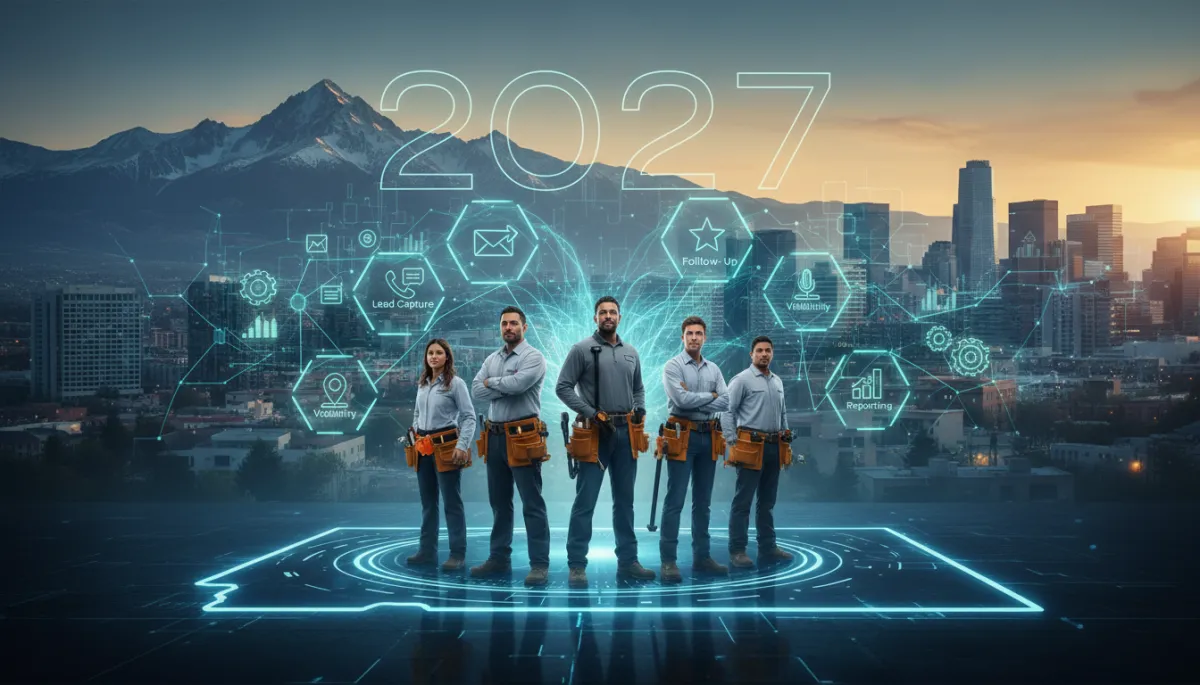
Is Your Colorado Contracting Business AI-Ready for 2027? The Full New Year Setup Guide
Colorado Contractors, AI Automation, 2027 AI Checklist Contractors
Is Your Colorado Contracting Business AI-Ready for 2027? The Full New Year Setup Guide
2027 is not “someday” anymore. It’s the next busy season on your calendar. By the time Denver and Colorado Springs hit their first 60-degree week next March, the Colorado contractors who already wired AI into their lead, follow-up, and scheduling systems will quietly pull ahead. The rest will wonder why the phone feels slower even though demand is still there.
Homeowners in Fort Collins, Pueblo, Boulder, Thornton, and Northglenn now expect instant answers, 24/7. AI voice agents and text workflows are already recovering 25–30% of leads that used to die in voicemail. Industry surveys in 2026 show measurable impact from AI more than doubling year over year, but only when tools are deeply built into daily operations—not bolted on as a gimmick. If you want to be a Colorado contractor AI ready 2027, you need systems, not scattered apps.
This guide walks through a practical 2027 AI checklist contractors can actually implement: seven core contractor systems Colorado businesses need in place before January—lead capture, qualification, follow-up, reputation, visibility, voice AI, and reporting. I’ll keep it concrete, with examples and even a few code-style snippets so you can see how the pieces fit together, even if you never touch the code yourself. The goal: a contractor AI setup Colorado teams can run with minimal extra admin and maximum impact on booked jobs.
Why 2027 Is a Turning Point for Colorado Contractors
In 2024 and 2025, “AI” for contractors mostly meant someone on the team occasionally pasting text into a chatbot. By late 2026, that changed. ServiceTitan’s 2026 State of AI in the Trades report shows 66% of contractors using AI are saving at least three hours a week in admin, and about 38–40% now report measurable business impact—double the prior year. The gap is no longer about who has AI. It’s about who has AI embedded in their workflows.
Colorado is feeling this shift harder than most states. Material volatility, rising tariffs, and labor shortages along the Front Range have already squeezed margins. At the same time, hail, freeze-thaw cycles, and wildfire seasons keep demand high for roofers, HVAC, plumbers, electricians, and general contractors. Contractors who build reliable AI automation for contractors 2027 into their office and field processes will capture that demand without burning out their teams. Those who don’t will lose leads silently to competitors who respond faster, follow up harder, and look better online—all powered by AI they set up once and let run.
📌 Key Point: This isn’t about replacing your office manager or dispatcher. It’s about giving them AI-powered systems so they stop chasing voicemails and spreadsheets, and start managing a pipeline that runs itself.
Section 1: Lead Capture Systems — Never Lose a Colorado Lead Again
1. Missed call text back — save every voicemail before it dies
Picture this: You’re on a roof in Northglenn, compressor running, phone buried in your pouch. A new lead calls, gets voicemail, and hangs up. Historically, that lead is gone. With a proper missed call text back system, AI sends a text within seconds: “Hey, this is [Your Company] in Thornton. We just missed your call—what do you need help with today?” That short message keeps the conversation alive until you or your office can jump in.
Trade data from 2025–2026 shows AI voice and text agents can recover 28–30% of leads that previously died in voicemail. For a Colorado HVAC or plumbing shop doing 60–100 calls a week in peak season, that’s not a rounding error—that’s payroll. If you want a deeper dive on how this works in the trades, look at resources like missed-call text-back contractors 2026, then bring it home into your own stack.
2. Web chat that actually books jobs
Generic chat widgets are glorified contact forms. An AI web chat tuned for contractors behaves like a competent office coordinator. It asks for name, phone, email, service address, and the issue. It answers basic questions (“Do you service Erie?” “Can you work with my insurance?”). When someone in Denver types, “My furnace is making a grinding noise,” the bot doesn’t just say “We’ll get back to you.” It offers available time windows and pushes the hot lead to your phone or dispatcher immediately.
The key is structure: every chat becomes a complete lead record, not just a random message in your inbox. That’s the difference between “we have a chat widget” and “our web chat books jobs while we’re on ladders.”
3. Smart form capture on every page
Most contractor sites still hide the only form on the “Contact” page. That’s wasted traffic. In a modern contractor systems Colorado setup, every key page—roof replacement, tankless water heaters, panel upgrades, basement finishing—has a short, clear form. AI tags the lead by service type and city, then routes it into the right follow-up sequence automatically. No one in the office is manually sorting Pueblo roof leads from Boulder electrical upgrades anymore.
When you can see “Boulder – EV chargers” or “Colorado Springs – emergency plumbing” as separate, live pipelines, you stop guessing which services in which cities are actually feeding your crews in 2027.
Section 2: Lead Qualification Systems — Separate Tire Kickers from Real Buyers
4. AI screening questions that run 24/7
Answering every inquiry personally sounds noble until you’re fielding 20 “just shopping around” messages a day while trying to close real work. AI screening questions solve that. Whether a lead comes in from web chat, text, or a missed call, the system automatically asks four things: location, project or problem type, timing, and budget range. It works the same way at 2 p.m. in July as it does at 2 a.m. in a January blizzard when a pipe bursts in Fort Collins
This isn’t overkill. It’s how you stop driving from Denver to Pueblo for a “maybe” while ignoring a “need it today” water heater in Thornton. The AI doesn’t decide who you serve; it just gives you clean data so you decide with your eyes open.
5. Hot/warm/cold routing — focus your time where it pays
Once you have structured answers, AI can route leads into hot, warm, and cold tracks. Hot: “Denver, main drain backed up, need someone today, budget $1k–$5k.” Warm: “Boulder, panel upgrade in the next month, still comparing quotes.” Cold: “Just planning a 2028 basement finish, no budget yet.” For hot leads, your phone buzzes immediately. Warm leads go into a nurture track. Cold leads get a light touch and stay tagged for future marketing. Resources like qualifying contractor leads with AI walk through this logic at a high level; here’s what it looks like in practice:
You tweak the numbers over time based on real close rates. By mid-2027, you’ll know exactly which lead profiles in which Colorado cities are worth a same-day drive and which ones can wait until tomorrow.
Section 3: Follow-Up Systems — Turn First Contact into Booked Jobs
6. A 7-day nurture sequence that works while you’re on the job
Most contractors lose deals not because they’re overpriced, but because they go quiet after the estimate. A 7-day AI-driven nurture sequence fixes that. Once a lead is qualified as warm or hot, the system sends structured texts and emails: confirm details, share proof, answer FAQs, and nudge just before a weather shift. For example, a Fort Collins roofing lead that came in during a mild spell gets a reminder right before the next snow system hits: “We can still get this roof buttoned up before the storm.”
You don’t need to write every message from scratch. You build a base sequence once, then let AI customize details per job type and city. If you want a primer on why this works so well in the trades, look at resources on lead nurture for contractors and then adapt them to your own voice.
7. Estimate follow-up automation — small changes, big close-rate gains
The cleanest money you’ll make in 2027 is from jobs you already estimated but never closed. AI estimate follow-up runs on a simple schedule—24 hours, 3 days, 7 days—referencing the exact project type so it doesn’t feel robotic. “Hey Sarah, this is Mike from Front Range Electric. Just checking if you had any questions about the panel upgrade estimate for your Boulder home.” Contractors who implement this kind of automation routinely add several percentage points to their close rates without chasing more leads.

Structured follow-up sequences quietly convert estimates into booked jobs while crews work.
Section 4: Reputation Systems — Reviews That Fuel Ranking and Referrals
8. Review automation after every completed job
In 2026, AI-driven review workflows became a top “Tier 1” use case because they’re cheap, reliable, and clearly tied to revenue. After every completed job—whether it’s a Pueblo sewer line or a Fort Collins mini-split installation—the system sends a text and email with a direct Google review link. If there’s no response in 48 hours, it sends a gentle reminder. No one on your team has to remember to ask; it just happens. Over a year, that can double or triple your review count, which directly affects ranking and click-through on your Google Business Profile.
For a deeper breakdown of how reviews feed search and referrals, look at resources around contractor online reputation. The bottom line: Colorado homeowners scroll reviews like they scroll social media. Your AI systems need to feed that habit in your favor.
9. Smart review response templates — stay human, save time
Responding to reviews matters almost as much as getting them. But no one wants to spend Sunday night typing “Thanks so much!” fifty different ways. AI can draft review responses—both positive and negative—that sound like you, not a robot. You skim, tweak if needed, and approve in seconds. For negative reviews, AI can propose a calm, factual response that de-escalates without admitting fault you don’t own, and prompts the customer to move the conversation offline.
You stay in control. AI just removes the blank-page problem and the time sink, so your online reputation keeps up with the quality of your field work.
Section 5: Visibility Systems — Be Everywhere Local Homeowners Look
10. A fully optimized Google Business Profile for Colorado conditions
If your Google Business Profile (GBP) is half-complete, you’re already losing. Colorado homeowners often never get past the map pack. Being AI-ready for 2027 means your GBP is not just claimed, but actively managed: accurate hours (including winter and holiday schedules), correct service areas, fresh project photos, seasonal posts, and city-specific service descriptions (“24/7 emergency furnace repair in Thornton,” “Hail damage roof inspections in Colorado Springs”).
AI can help here by drafting posts, pulling before/after language from your job notes, and keeping descriptions consistent across your CRM and listings. As you evaluate a CRM for contractors, make sure it can sync with GBP data or at least export clean business info that AI tools can reuse. The less manual copying and pasting your office staff does, the better.
11. Listings on 100+ directories with AI-powered sync
Consistent NAP (name, address, phone) data is still a ranking signal. But no one has time to log into Yelp, Nextdoor, Angi, and a dozen niche home service directories every time your hours change or you add a new service. Modern AI-enabled listing tools keep your core business profile in one place and then push updates out to 50–100+ directories automatically. When you update “24/7 emergency plumbing” to include Colorado Springs and Pueblo, that change propagates everywhere without another login.
The result: when someone in Thornton searches “furnace repair near me” at 10 p.m., your phone number and hours are correct everywhere, and your reviews and photos line up with what they see on Google.
Section 6: Voice AI Systems — Real Coverage After Hours and on Holidays
12. After-hours call handling with scheduling
In Colorado, real money moves after dark and on bad-weather days. Frozen pipes, dead furnaces, tripped main breakers—these don’t wait for office hours. Historically, you either paid a human answering service (who couldn’t qualify or schedule well) or you rolled the dice on voicemail. Modern voice AI changes that. An AI receptionist can answer after-hours calls, gather project details, and actually book appointments in your calendar for the next available slot. For emergency trades—heating, electrical, plumbing—during Colorado winters, that’s the difference between capturing the job or losing it to the first contractor who answers.
Well-implemented voice AI doesn’t guess. It follows strict rules you define. It knows which zip codes you serve, what counts as “emergency,” and which techs are on call. For a detailed breakdown focused on the Colorado market, resources like Colorado contractors AI call management are worth a look, but here’s the distilled logic:
13. Holiday weekend coverage that doesn’t burn out your team
Memorial Day, July 4th, Labor Day, Thanksgiving—Colorado homeowners love long weekends, and your crew deserves them too. Historically, that meant accepting that some emergency work would slip away while everyone was at the lake or in the mountains. With voice AI, you can capture and triage those leads without chaining a human to the phone. The system can:
Distinguish true emergencies from “can wait until Tuesday” jobs.
Book non-emergency work into next-week slots automatically.
Escalate only the urgent calls to the on-call tech via text.
The result is consistent monthly revenue regardless of holidays, without frying your staff. That’s what AI automation for contractors 2027 should look like: more booked work, less chaos.

Voice AI covers after-hours and holidays so your team can actually unplug.
Section 7: Reporting Systems — Know What’s Working Before 2027 Starts
14. Weekly lead summary by source and city
If you’re still guessing where your best leads come from, you’re flying blind into 2027. A proper contractor AI setup Colorado approach includes a simple, automated weekly email or dashboard that answers four questions:
How many leads did we get this week?
Where did they come from? (GBP, directories, website, referrals, ads)
Which Colorado cities are producing the most hot and warm leads?
What’s the hot/warm/cold split?
You shouldn’t have to log into five platforms to see this. AI can pull the data from your CRM, phone system, and web forms, then roll it up in a human-readable summary. Over a quarter, patterns emerge: maybe Northglenn Google leads close at 40%, while paid leads in Boulder barely break even. Once you see it, you can act on it.
15. Conversion tracking from lead to booked job (and beyond)
Lead counts are vanity. Booked jobs and profit are sanity. A 2027 AI-ready contractor doesn’t just know how many calls came in—they know which channels actually turn into booked and completed jobs, what the cost per acquired job is, and how that breaks down by service type and city. That’s how you decide whether to keep paying for a lead service, double down on organic, or shift budget toward hail-season campaigns in Colorado Springs and Pueblo.
Good reporting systems tie marketing, sales, and operations together. They help you optimize your sales pipeline and tighten job costing, so decisions are based on real numbers, not gut feel alone.
When you can see, in black and white, that “Google Business Profile + reviews” is generating a 6x ROI in Denver, while a lead service in Boulder is barely breaking even, your 2027 budget meeting becomes straightforward instead of political.
Putting It All Together: Your 2027 AI Checklist for Colorado Contractors
Let’s zoom out. Being Colorado contractor AI ready 2027 is not about buying every shiny tool on the market. It’s about making sure these seven systems are live and talking to each other before the spring rush:
Lead capture: Missed call text back, AI web chat, and smart forms on every key page, all feeding one pipeline.
Lead qualification: Structured AI screening questions and hot/warm/cold routing so your time goes where it pays.
Follow-up: 7-day nurture and estimate follow-up that run automatically, tuned for Colorado weather and seasonality.
Reputation: Review requests after every job and AI-drafted responses that keep your online presence sharp.
Visibility: A fully optimized Google Business Profile and synced directory listings across Colorado markets you serve.
Voice AI: After-hours and holiday call handling that can qualify, schedule, and escalate emergencies without burning people out.
Reporting: Weekly lead summaries and full-funnel conversion tracking from first contact through job costing.
Most Colorado contractors don’t need enterprise-grade platforms to get there. The research is clear: the biggest gains right now are from Tier 1 tools—voice agents, CRM automation, and AI-assisted content and reviews. The winners are not the ones with the longest tool list; they’re the ones who picked a few core systems and integrated them deeply into daily operations.
💡 Implementation Tip: Don’t try to stand up all seven systems in one week. Sequence them: start with lead capture and missed call text-back, then add follow-up and reviews, then voice AI and reporting. Each layer makes the next one more valuable.
The 90-Day Plan to Be AI-Ready Before January 2027
If you’re reading this in late 2026, you still have time to build a real structural advantage before the 2027 season. Here’s a practical 90-day rollout that respects busy schedules:
Weeks 1–2: Turn on missed call text back and basic AI web chat. Add short forms to your top 3–5 service pages. Make sure everything feeds a single lead pipeline.
Weeks 3–4: Configure AI screening questions and hot/warm/cold routing. Start tagging leads by city and service type across Denver, Colorado Springs, Pueblo, Fort Collins, Boulder, Thornton, and Northglenn.
Weeks 5–6: Build your 7-day nurture and estimate follow-up sequences. Use your own job photos and reviews so the messages feel local and real.
Weeks 7–8: Turn on review automation and AI-assisted responses. Clean up your Google Business Profile and sync core business info to major directories.
Weeks 9–10: Deploy voice AI for after-hours and holiday coverage with strict rules. Pilot it on a subset of calls, then expand once you trust the behavior.
Weeks 11–12: Lock in your reporting: weekly lead summaries, source and city breakdowns, and basic conversion and ROI tracking by channel and service type.

A simple 90-day rollout is enough to wire AI into the seven core systems.
Closing: The Spring Rush Window Is Short — Use 2026 to Build Your 2027 Advantage
By the time the first real spring rush hits Colorado in 2027, it will be obvious which contractors did this work early. Their phones will be answered 24/7—by humans during the day and voice AI at night. Every missed call will trigger a text. Every web visit will have a path to a booked appointment. Every completed job will quietly feed Google reviews and referral fuel. Their office staff will spend less time chasing voicemails and more time solving problems for high-value customers. They’ll know which channels and cities are actually profitable, and they’ll adjust in real time instead of guessing once a year.
Contractors who wait—who treat AI as a buzzword instead of a set of seven concrete systems—will feel the gap without always seeing it. Fewer booked jobs from the same number of calls. Lower close rates. More weekends lost to admin. The opportunity isn’t just more revenue; it’s more control over when and how you work in a market that’s only getting more competitive.
If you want help standing these systems up without reinventing the wheel, you can see how IBP sets this up for Colorado contractors specifically—end to end, from missed call text-back through reporting. Or, if you’re more of a “let me test this myself first” operator, start with the free tools to get started and run your own numbers on what AI automation for contractors 2027 could mean for your business across Denver, Colorado Springs, Pueblo, Fort Collins, Boulder, Thornton, Northglenn, and beyond.
Either way, the clock is running. The 2027 AI checklist contractors need is in front of you. The contractors who have all seven systems live before January don’t just enter the season with more tools—they enter with a structural advantage that compounds every month.
