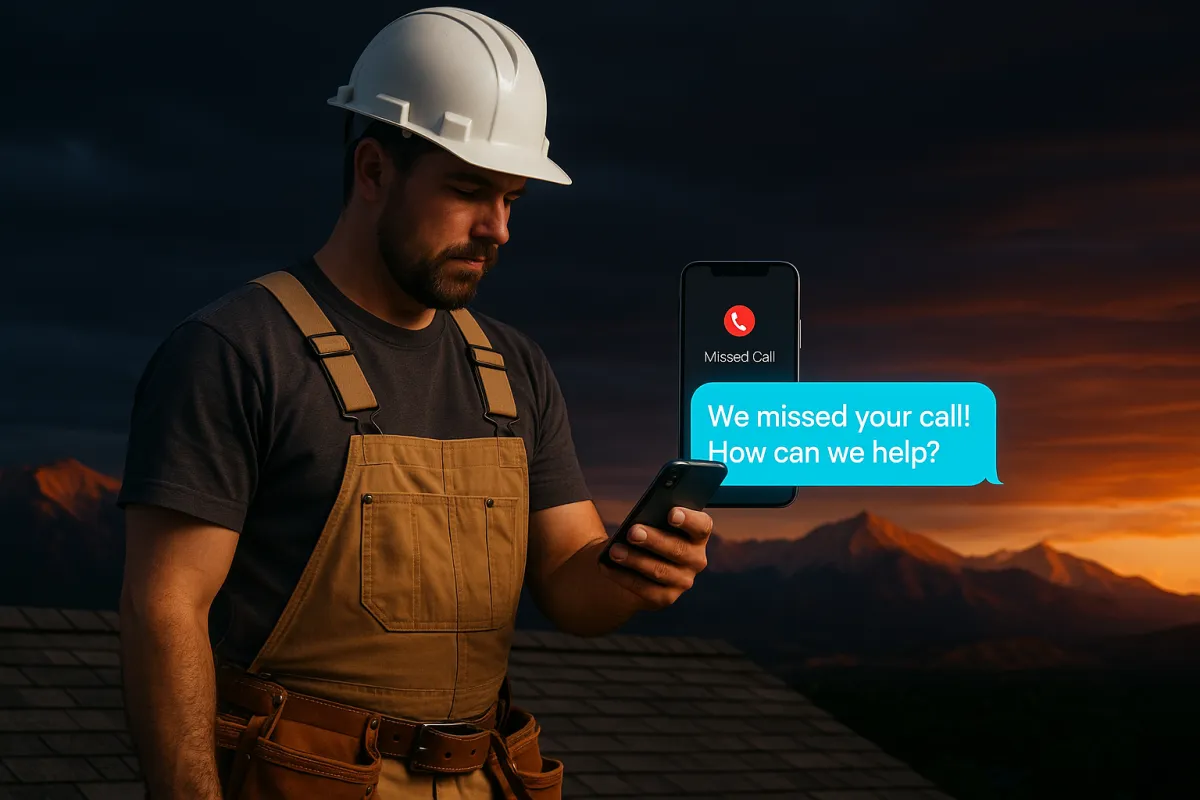
What Is Missed Call Text Back? The Complete Contractor Guide
What Is Missed Call Text Back? The Complete Guide for Colorado Contractors
If you have been hearing the term "missed call text back" and wondering exactly what it means, how it works, and whether your contracting business actually needs it, this guide covers all of it — clearly, completely, and honestly.
Missed call text back is an automated system that sends a personalized text message to anyone who calls your business and does not get an answer. The message is delivered within 30 to 60 seconds of the missed call, acknowledges the attempt to reach you, and invites the caller to continue the conversation via text. At its simplest, that is the full definition. But the implications for Colorado home service contractors — especially in competitive markets from the Denver Front Range to Colorado Springs to Fort Collins — are far more significant than the definition suggests.
Why Missed Calls Are Such a Critical Problem for Contractors
To understand why missed call text back matters so much, it helps to look at the actual scope of the missed call problem in contractor businesses.
Contractors are among the hardest-working, most phone-inaccessible professionals in any local market. HVAC technicians are inside attics or mechanical rooms. Plumbers are under sinks or in crawl spaces. Roofers are on rooftops during hail season inspections. Electricians are inside panels. Landscapers are operating loud equipment. These are not desk jobs where someone can answer a call between tasks. They are physical, focused, hands-on trades where answering a phone is often physically impossible for large portions of every working day.
The data reflects that reality clearly. Home service businesses miss between 27 and 62% of all inbound calls because technicians are on job sites. A contractor receiving 15 to 25 calls per day can expect to miss 4 to 7 calls under normal conditions, and more during surge windows like Colorado's hail season or a January cold snap when HVAC demand spikes overnight.
Here is what happens when those calls go unanswered. Less than 3% of callers leave a voicemail, according to Invoca platform data. That is not a rounding error. The other 97% hang up immediately. And 85% of callers who do not reach a live answer will not call back. They have moved on to the next contractor in their search results.
For a typical Colorado contractor, this translates to $45,000 to $120,000 in lost annual revenue from leads who called, got nothing, and gave their job to a competitor. We covered the full financial breakdown in our post on the real cost of missed calls for Colorado contractors.
Missed call text back does not eliminate the missed call. What it does is prevent the lead from being lost when the call goes unanswered.
How Missed Call Text Back Works: Step by Step
Here is exactly what happens under the hood of a missed call text back system:
A prospective customer calls your business phone number
The call goes unanswered because you are on a job, on another call, or unavailable
Your phone system recognizes the missed call and triggers an automated workflow
Within 30 to 60 seconds, the caller's number receives an automated text message from your business
The message acknowledges the missed call, identifies your business, and invites the caller to respond with their question, request, or preferred callback time
The conversation continues via two-way text messaging, captured in your CRM for your team to manage
From the caller's perspective, this experience is remarkably effective. They called a contractor, expected voicemail, and instead received an immediate personalized text response. They feel heard. They feel like your business is responsive. And critically, they do not call your competitor next, because you have already opened a conversation.
This timing matters more than most contractors realize. 78% of customers hire the first contractor to respond. A Harvard Business Review study found that responding within 5 minutes makes a business 100 times more likely to connect with a lead compared to waiting 30 minutes. After 5 minutes, the odds of qualifying a lead drop by 80%. A missed call text back message arriving within 60 seconds keeps you in that winning window even when you cannot physically pick up the phone.
For a deeper look at why first response wins the job, our post on speed to lead and how Colorado contractors are booking 3x more jobs covers the full data.
What an Effective Missed Call Text Back Message Actually Says
The content of your automated message is critical. A generic, corporate, or overly formal message underperforms. The right message converts the majority of missed calls into active text conversations.
An effective missed call text back message:
Arrives within 60 secondswhile the caller is still on their phone and has not yet dialed a competitor
Uses a warm, personal tone:"Sorry I missed your call" consistently outperforms "Thank you for contacting us" because it sounds like a real person wrote it
Clearly identifies your businessso the caller knows immediately who they are hearing from
Invites a specific next stepwith a low-friction, open-ended question
References the service areawhen possible to reinforce local credibility
Example of an effective missed call text back message for a Colorado HVAC contractor:
"Hey — sorry I missed your call. This is [Name] with [Business Name]. We help homeowners in the [City] area with HVAC repairs and installations. What can I help you with? Just text me back and I will get right to you!"
Notice what that message does not do. It does not list credentials. It does not pitch services. It does not feel automated. It sounds like someone grabbed their phone between jobs and sent a quick reply. That human quality is exactly what drives response.
Missed Call Text Back vs. Voicemail: Why Text Wins Every Time
Voicemail has been the default missed call solution for decades. But voicemail has a fundamental structural problem in 2026: almost nobody uses it.
The numbers make this clear. Less than 3% of callers leave a voicemail when they reach one. Of those who do leave a message, the average business callback takes hours. By then, 85% of those callers have already hired someone else. Text messaging eliminates every one of those failure points.
Text is asynchronous. Each party responds when convenient, without the pressure of a live call. It creates a written record of the conversation. It allows contractors to respond between tasks without committing to a full phone call at an inopportune moment. And it meets homeowners exactly where they already communicate.
98% of text messages are opened. The average response time to an SMS is 90 seconds, compared to 90 minutes for email. 77% of SMS messages receive a response within 10 minutes. Text messaging can reduce voicemail dependency by 84% for businesses that adopt it consistently.
In practical terms: a missed call to voicemail has roughly a 3% chance of generating any follow-up at all. A missed call with a text back response within 60 seconds has a 30 to 40% chance of converting into an active conversation and booked job. That difference, applied across every missed call your business receives over a full year, is the revenue gap we are talking about.
If you are weighing missed call text back against a live answering service or a hired receptionist, our post on AI vs. answering service vs. hiring a receptionist for Colorado contractors breaks down the full cost comparison.
Trade-Specific Applications: Why It Matters by Contractor Type
HVAC Contractors in Colorado
Peak summer AC calls and peak winter heating calls come in concentrated bursts. During a heat wave on the Front Range, an HVAC contractor can receive five to ten calls per hour while every technician is dispatched. A missed call text back captures every one of those inquiries in real time, allowing the office to manage a text-based queue even when live call volume is impossible to keep up with.
Average HVAC job values range from $800 to $3,500 for service calls, with emergency repairs and full system replacements reaching significantly higher. At those values, every missed call during a weather event is a meaningful revenue loss. Our post on how Colorado HVAC contractors stop losing leads during peak season covers the seasonal dimension of this problem in detail.
Roofing Contractors
Colorado hail season creates emergency demand surges where speed of response is the entire competitive advantage. A missed call text back that reaches a homeowner within 60 seconds of their call, while they are still in the moment of urgency about their damaged roof, locks in the conversation before they can dial the next roofing company. Average roofing job values range from $5,000 to $15,000 or more for storm damage work. One recovered missed call often covers months of automation costs.
Plumbers
Plumbing calls are among the most urgent in home services. A homeowner with a burst pipe or a sewage backup is not going to wait patiently for a callback. They are calling every plumber they can find until someone responds. Missed call text back immediately re-engages that caller with a real-time response, moving the conversation to text where it can be managed even while the plumber is mid-job. Average plumbing job values range from $500 to $2,500, with burst pipe emergencies frequently exceeding $1,200.
Electricians
Electricians have among the highest call miss rates of any trade because it is physically impossible to answer calls while working inside panels, in attics, or in crawl spaces. Every unanswered call during working hours is a potential job lost. Electrician average job values of $350 to $2,500 and above mean that consistent missed call recovery through text back generates compounding revenue impact week over week.
Landscapers and Lawn Care
During Colorado's spring season, lawn care and landscaping businesses receive the majority of their new customer inquiries while operators are on equipment in the field. Missed call text back captures those spring inquiries in the exact season when a recurring lawn care customer is worth $1,500 to $3,000 or more over the lifetime of the relationship. Failing to respond in the spring means losing that recurring revenue entirely.
Missed Call Text Back as Part of a Complete Lead Recovery System
Missed call text back is powerful on its own. It is most powerful as the first layer of a complete lead recovery system that handles every channel through which leads arrive.
A contractor with missed call text back covering their phone, combined with automated follow-up for Facebook Lead Ads, Google Lead Form submissions, and website contact forms, has a unified system where no lead falls through the cracks regardless of how or when they reached out. One dashboard. Every conversation. Every lead at every stage visible in one place.
Our post on automating the full contractor lead journey from ad click to five-star review shows how missed call text back fits into the complete picture. And our post on the step-by-step system for automating your ad lead follow-up covers how to build out the rest of that system alongside your missed call response.
How Much Is Missed Call Text Back Worth to Your Business?
The ROI calculation for missed call text back is straightforward. Start with three numbers:
How many calls does your business miss per week? (Most active Colorado contractors miss 5 to 20 or more during peak working hours)
What percentage of those callers would have become customers if they received an immediate response? (Industry estimates: 25 to 40%)
What is your average job value?
Example calculation for a Colorado roofing contractor:
12 missed calls per week × 30% estimated conversion with immediate response × $7,500 average job value = $27,000 in recoverable weekly revenue opportunity
Even capturing a fraction of that, say 3 additional booked jobs per week rather than 6, represents a transformative annual impact. For a tool that runs automatically 24 hours a day, seven days a week, with no staffing cost attached, missed call text back may be the single highest-ROI investment available to a Colorado home service contractor in 2026.
Frequently Asked Questions: Missed Call Text Back for Contractors
What is missed call text back?
Missed call text back is an automated system that sends a personalized text message to anyone who calls your business and does not reach a live person. The message is delivered within 30 to 60 seconds of the missed call, acknowledges the attempt to reach you, and invites the caller to continue the conversation via text rather than waiting for a callback.
How fast does a missed call text back message arrive?
An effective system delivers the automated message within 30 to 60 seconds of the missed call, while the caller is still actively on their phone and has not yet decided to call a competitor. Speed is everything. After 5 minutes, the odds of converting that lead drop by 80%.
Does missed call text back work for all contractor trades?
Yes. It is particularly high-value for any trade where physical work makes answering calls impractical during working hours. HVAC, plumbing, roofing, electrical, landscaping, painting, and general contracting all benefit. The higher your call miss rate and the higher your average job value, the greater the ROI.
What should a missed call text back message say?
The most effective messages are warm and conversational, clearly identify your business, acknowledge the missed call, and invite the caller to respond with their question or request. The message should sound like a real person wrote it, not like a system generated it. Personalization improves response rates meaningfully.
Is missed call text back the same as a live answering service?
No. An answering service uses live operators to answer calls on your behalf. Missed call text back is an automated system that responds via text when a call goes unanswered. Missed call text back is significantly less expensive than a live answering service, operates 24 hours a day with no staffing costs, and often achieves better lead capture rates because of the immediacy and accessibility of text over a third-party live operator.
How do I set up missed call text back for my contracting business?
Missed call text back is available through CRM and automation platforms that integrate with your existing business phone number. Setup typically takes less than a day and requires no changes to your phone hardware. Once configured, the system runs automatically every time a call is missed with no ongoing manual management required.
How many missed calls do Colorado contractors typically miss per week?
A contractor receiving 15 to 25 inbound calls per day can expect to miss 4 to 7 calls under normal conditions, based on an industry average miss rate of 27%. During surge windows like Colorado hail season, winter freeze events, or summer heat waves, that number climbs significantly as call volume overwhelms available team capacity.
Stop Letting Missed Calls Become Lost Jobs
Every missed call from a Colorado homeowner is a person who needed exactly the service you provide. In most cases, they are not lost because they chose someone better. They are lost because the timing of their call did not align with your availability, and no system existed to bridge that gap.
Missed call text back bridges that gap. It is not complex. It does not require new hardware or extra staff. And the revenue it recovers is real, measurable, and compounding.
At Instant Business Pro, we help Colorado home service contractors implement missed call text back as part of a complete lead recovery system that works across every channel. If you are ready to stop losing the leads you are already earning, reach out today for a free setup consultation.
