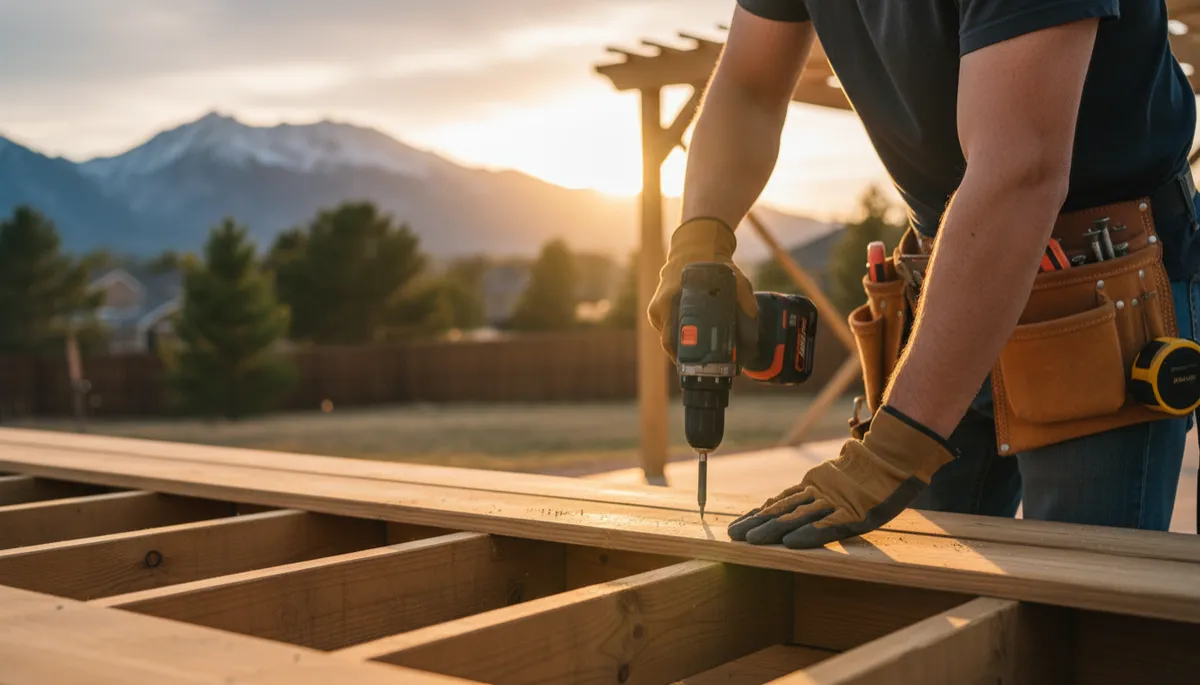
How Colorado Deck Builders Book Winter Interior Projects and Pre-Sell Spring Builds in November
AI for contractors, deck builders, lead automation
Colorado Deck Builders: How AI Automation Stops You From Losing Estimate Requests
Colorado deck builders stop losing estimate requests when they let AI answer every call, capture every lead, and follow up automatically while they keep building. No receptionist required. No extra hours in the office. Just software that turns missed calls and late-night web forms into booked estimate appointments.
1. The direct answer: how to stop losing deck estimates
If you build decks anywhere along the Front Range, you stop losing estimate requests by doing three simple things with AI for deck builders customized for Colorado:
Turn every missed call into a missed-call text-back conversation within seconds.
Have AI ask the same questions you ask on the phone and log everything in one place, so pricing is fast when you get off the tools.
Drop every lead into an automatic follow-up sequence so homeowners planning a deck for summer still remember you when they’re ready to sign in May or June.
This is what lead automation for Colorado deck contractors looks like in real life. You keep building in Parker or Colorado Springs. The AI handles the office work you never have time for, and over time you can even point homeowners to real-world results in your case studies when they ask what kind of outcomes to expect.
2. The deck builder problem: short season, long sales cycle, big contract values
Deck work in Colorado isn’t like small maintenance jobs. You have a tight window from March through October. Homeowners in the Denver suburbs, Boulder, and the Springs start planning in late winter. Many of your projects land in the fifteen- to forty-thousand-dollar range, especially composite, multi-level decks with pergolas and lighting.
At the same time, homeowners rarely call just one contractor. They open Google and search for “deck builder near me” or “Denver deck builder” then call three or four numbers in a row. Whoever answers first or follows up first usually gets the site visit. Whoever drags their feet gets ignored. To see how this same logic applies to fences, you can check out the Colorado fencing contractor guide to AI estimate requests.
As a senior software engineer, I see this as a workflow problem. Your crew capacity is fixed. Lead volume spikes when the sun comes out. Your phone is the bottleneck. Every time you’re on the saw or framing a second-story deck, you can’t answer that new incoming call. That’s exactly where AI for Colorado deck builders makes sense. It removes the bottleneck without adding payroll.
3. What really happens when an estimate request goes unanswered
Picture a homeowner in Highlands Ranch on a Saturday morning. They want a new composite deck before the Fourth of July. They search on their phone. They tap the first three numbers that look legit. Here’s what happens if you don’t answer.
They tap your number. The phone rings with no answer. Maybe they leave a voicemail, maybe they hang up.
They tap the next contractor on Google. That person answers or texts back immediately.
That contractor books a site visit for Tuesday. By the time you call back Sunday night, the homeowner already feels committed to them.
On paper, all that happened is you missed a call. In reality, you watched a twenty-thousand-dollar project move to the next name in the Google results. When this repeats all spring, your calendar feels busy, but your schedule is full of small repairs instead of the big outdoor living projects you actually want.
📌 Key takeaway: In a bid-heavy business like decks, the first contractor to respond with real answers usually wins. Speed-to-lead isn’t a luxury — it’s direct money. You can go deeper on the “speed to lead” principle in the five-minute rule for contractors article, and see how that plays out in real projects inside the case studies library.
4. How AI captures and qualifies deck leads while you keep building
Here’s what lead automation for Colorado deck contractors looks like today when you set it up through a platform like Instant Business Pro. I’ll explain it the way I design the system as an engineer, but in plain language.
Step 1: Turn missed calls into instant text conversations
Any time a call comes into your deck business line and you don’t answer within a few rings, the system fires a trigger. That trigger sends a friendly text in your voice, like: “Hey, this is Jake from Front Range Decks. Sorry I missed your call. Are you looking for a new deck or a repair? Send me a few details and I’ll lock in a time for an estimate.”
The AI watches their reply and keeps the conversation going. It’s like a smart office person in your pocket who never sleeps. If you want the technical details, there’s a full guide to setting up AI lead automation written for contractors.
Step 2: Have AI ask the same qualifying questions you ask
When I build this kind of flow, I treat it like a checklist. The AI has a list of questions it needs before you can price the job. For a typical Colorado deck builder, that list looks like this:
Address and city so you know if they’re in Denver metro, Colorado Springs, or near Boulder.
New build or tear-out and rebuild.
Approximate size and height off the ground.
Preferred material type — wood, composite, or other options.
Target budget range and target month for the build.
If you want to see how AI can qualify contractor leads in other home services niches using the same logic, there’s a full guide just for that.
Step 3: Automatically book estimate windows
Once the AI knows the lead is inside your service area and the budget is realistic, it can offer estimate windows you’ve already approved — for example, Tuesday and Thursday evenings or Saturday mornings. It reads your live calendar and only shows open times. When the homeowner picks a slot, the system sends a confirmation text and calendar invite to both of you.
5. The long follow-up game: staying top-of-mind for months
Deck projects in Colorado rarely close in a single day. Homeowners in places like Erie, Castle Rock, and Monument collect two or three bids and sit on them for weeks. They think about fire codes, composite upgrades, and whether to add a pergola or an outdoor kitchen. If you send one estimate email and never follow up, you quietly lose to whoever keeps in touch.
AI solves this with nurture sequences. Every qualified lead drops into a timeline. Over the next thirty, sixty, or ninety days, they get helpful texts and emails that sound like they’re from you, not spam. For example:
A quick note about how composite performs in Colorado freeze–thaw cycles.
Photos of a deck you just finished in their city with real numbers on cost and timeline.
A reminder before your schedule fills up for prime summer weeks.
Again, you’re not writing Python to make this happen. A tool like Instant Business Pro gives you buttons and ready-made templates. I’m just explaining the logic. The idea is simple — while you’re framing a second-story deck in Arvada, the system is quietly following up with ten homeowners you met last month. When one of them is ready, they’ll reply to that message, not dig through their inbox for someone else’s buried quote.
💡 Pro Tip: Even one extra signed deck in a season thanks to smart follow-up often covers your automation bill for the entire year. If you want to see what that looks like in a dedicated deck builder marketing automation service, you can check out the service page built just for that, then skim through related case studies to see how other contractors turn follow-up into booked work.
6. Costs and ROI for Colorado deck crews
Most small deck crews worry that AI means big software bills. In reality, the math is simple. If the average composite deck in Denver or Boulder runs around twenty thousand dollars, losing one project because of the missed-call problem hurts far more than a year of software. You can see a breakdown of what AI automation actually costs contractors, but the rule of thumb is: if AI saves or closes one extra project, you’re ahead.
As an engineer, I like predictable systems. AI lead handling is a predictable system. You know every call will get a response, every form will get a follow-up, and every estimate will get reminders. Humans simply can’t match that level of consistency through a busy Colorado summer.
7. FAQs for Colorado deck and outdoor living contractors
Will AI make me sound like a robot to Colorado homeowners
No. Good AI for Colorado deck builders is trained on your style and real conversations. During setup, you feed it your go-to answers about composite brands, fire codes, Denver permits, and your process. Then the system replies in the same tone. Think of it as a sharp office assistant who knows decks and your market — not a canned script.
Can AI handle detailed deck estimates, or does it just collect basic info
Today, AI is best at gathering and organizing the details you need. It will ask about size, height, materials, access, and timing. It can even tag leads as “composite” or “wood” and flag who’s in high fire-risk areas. You still control the final pricing because you know your crew and costs. The difference is that when you sit down to price jobs at night in Colorado Springs or Thornton, you have a clean client sheet instead of a messy voicemail.
Is AI really worth it if I only build fifteen to twenty decks a year
Yes, because your contract values are big. If you build fifteen decks a year and your average project is twenty thousand dollars, losing one composite deck in the Denver area means leaving twenty thousand dollars on the table. If automation helps you save even one of those projects, you’re ahead. For many Colorado builders, they end up adding two or three projects a season simply because they stop letting leads die in voicemail.
8. Next step: see AI working inside your deck business
If you build decks anywhere from Fort Collins down to Pueblo, the biggest risk in your business isn’t bad workmanship — it’s silent losses. Calls you never heard about. Forms you never had time to answer. Estimates you never followed up on. AI won’t swing the hammer for you, but it will make sure every homeowner who reaches out gets a fast, helpful reply and a clear path to book with you instead of the next contractor on Google.
To see what this looks like with your business name and service area, visit https://instantbusinesspro.ai. You’ll see how missed-call texts, AI lead capture, and automatic follow-up can run in the background while you stay on-site building the kind of Colorado decks you actually want to build. And when you’re ready to talk through your specific numbers or ask about reviews and reputation, you can always reach out directly via the contact page.
Ready to turn deck estimate requests into confirmed appointments?
If you want a practical system that combines AI, automated follow-up, and fast lead response in your deck business, start with our deck services page. You’ll find real-world examples, plug-and-play templates, and clear implementation steps tailored to Colorado deck builders.
Head over now to AI automation for deck builders to see how AI automation can increase your number of profitable projects in a single season — without adding office staff or extra late-night admin hours. When you’re ready to put it in motion or ask about how reviews and local reputation fit into the picture, you can book a quick conversation through the contact page or explore related case studies for more proof.
