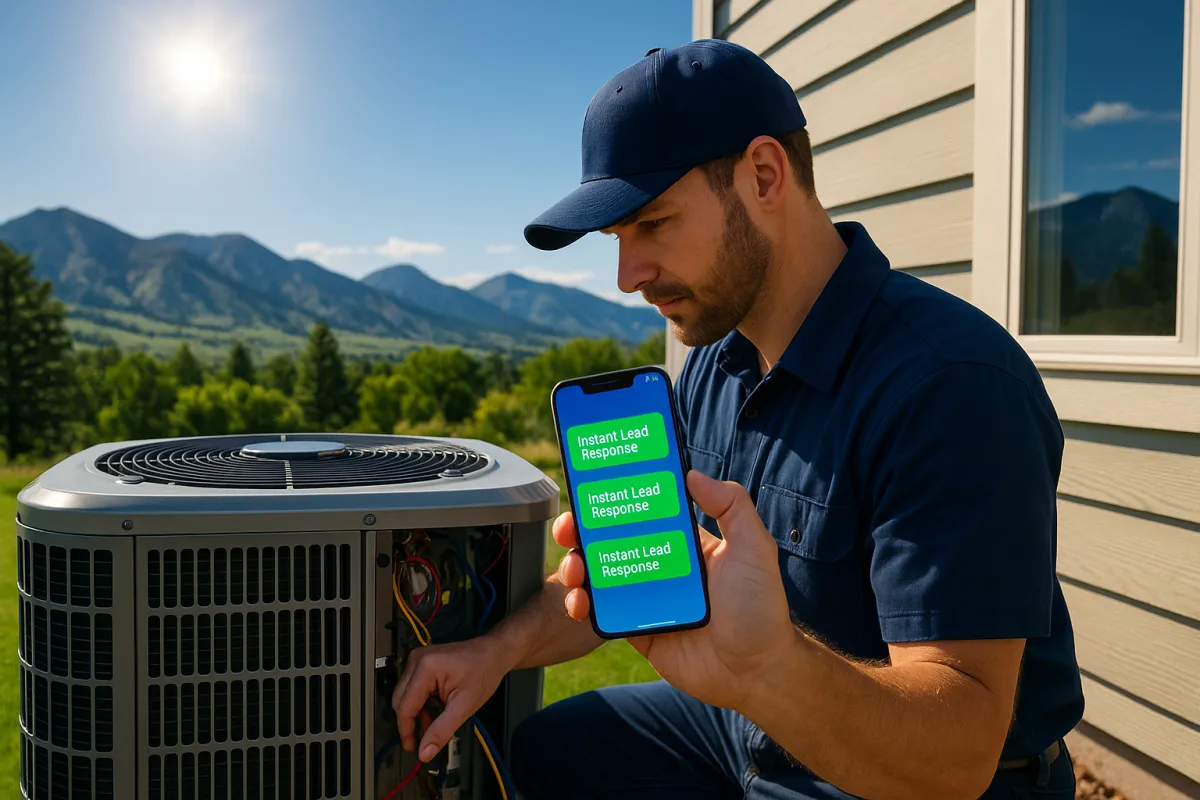
The HVAC Contractor's Playbook: How to Never Miss an AC Repair Call During Peak Season
How Colorado HVAC Contractors Stop Losing Leads During Peak Season
Ask any HVAC contractor in Colorado what the first week of June feels like and you will get a variation of the same answer. Controlled chaos. Temperatures spike. Calls spike. The schedule fills overnight. Somewhere in the middle of all of it, the phone keeps ringing when both hands are occupied, when you are chest-deep in a mechanical room, or when you are already three jobs behind schedule.
Peak season is the best problem an HVAC business can have. It is also, paradoxically, when most Colorado HVAC contractors lose more leads than at any other point in the year.
This post is about fixing that. When the heat arrives and Colorado homeowners and businesses start calling in volume, your system should capture every single one of them.
What Is Speed to Lead in HVAC? (And Why It Determines Who Wins the Job)
Speed to lead is the time between a new customer inquiry and your first response. In the HVAC industry, this single number determines whether you win the job or whether the homeowner books with the contractor who responded while your phone was still ringing.
Industry data from contractor lead platforms confirms that 78% of HVAC jobs go to the first contractor who responds, regardless of price or reviews. Not the most experienced company. Not the one with the most five-star ratings. The first one to reply.
Companies that respond within 5 minutes are 8 times more likely to win the job compared to those that respond after 30 minutes. After 30 minutes, recovery rates drop below 10% because the customer has already booked with someone else.
We cover the full data behind this in our post on speed to lead and how Colorado contractors are booking 3x more jobs with instant response.
The Peak Season Paradox: More Calls, More Leads Lost
There is a cruel irony built into seasonal contracting businesses. The busier you get, the harder it becomes to capture new business.
When your schedule is open in February, you answer every call on the first ring. When it is 97 degrees in Denver in July and you have six service calls to complete before 5pm, the phone goes to voicemail more often than you would like to admit.
Here is where the data gets uncomfortable.
The typical HVAC contractor misses approximately 22 to 25% of all incoming calls under normal conditions. During peak summer and winter seasons, that miss rate spikes to 35% or higher as call volume overwhelms existing staff. When technicians are in the field with no office coverage, the number can climb as high as 62%.
At the same time, HVAC contractors experience call volume increases of 340% or more during peak summer months compared to milder spring periods. The first heat wave of the season triggers the sharpest single-day spike. Spring staffing levels are structurally underprepared for what July demands, and no amount of effort closes that gap without a system behind it.
The result is that you end up missing the highest percentage of calls during the exact time of year when each call is worth the most money. July and January are when HVAC businesses in Colorado make or break their year. They are also when they miss the most calls.
The financial picture is concrete. Industry data shows HVAC contractors lose between $88,400 and $176,800 per year from missed calls and slow follow-up. A single missed system replacement call during peak season can represent $8,000 to $15,000 in lost revenue. For a company missing just 5 calls per week during peak season, annual losses can range from $47,000 to $312,000.
What Happens in the Minutes After a Missed HVAC Call
Without a recovery system, roughly 85% of callers who reach voicemail will never call back. They move to the next contractor in their search results.
Homeowners calling about a broken AC on a hot afternoon are not browsing casually. Their system is down. It is 85 degrees inside. They may have children, elderly parents, or pets in the house. They are motivated, they are ready to book, and they will call as many companies as it takes until someone responds.
Here is how the timeline actually plays out after a missed call:
Homeowner calls your number and reaches voicemail
Homeowner hangs up (85% do not leave a message)
Homeowner calls the next HVAC company on the list
That company responds first and books the job
Your missed call sits in your voicemail, already a lost lead
The recovery window is narrow. Companies that text back within 60 seconds consistently recover 35 to 40% of missed calls. Those waiting 5 to 15 minutes typically see 20 to 25% recovery. After 30 minutes, recovery drops below 10%.
The after-hours window makes this worse. Calls between 5pm and 9am account for roughly 35 to 40% of all missed calls for HVAC businesses. Weekends represent an equally significant gap, with Saturday and Sunday calls making up about 20 to 25% of weekly call volume while most HVAC companies have zero live coverage. 31% of all emergency HVAC calls come in after business hours. That is nearly one third of your highest-urgency revenue arriving when no one is there to answer.
For contractors spending money on Google Ads or Local Service Ads, slow follow-up multiplies the waste. We break this down specifically in our post on why contractor ads are not booking the jobs they should.
What Colorado HVAC Leads Need the Moment They Reach Out
Not every HVAC inquiry carries the same urgency, and a well-built lead capture system accounts for each type.
Emergency repair calls — no AC on a 95-degree Colorado afternoon, no heat during a cold snap — need immediate acknowledgment. The customer needs to know someone is helping them and needs a realistic timeline. Without confirmation within minutes, they call the next contractor on their list.
System replacement inquiries come from customers in a different mindset. More research-oriented, less panicked, evaluating options over a slightly longer window. But they still expect a professional and timely response. The contractor who replies quickly, asks the right questions, and sets a clear next step earns trust before any in-person visit happens.
Maintenance and tune-up requests carry lower urgency but are still time-sensitive because these customers are also calling other companies. The first contractor to engage helpfully is usually the one who gets booked.
The specific mechanics of this urgency window are covered in our post on the 5-minute rule for HVAC and contractor leads. A well-configured AI follow-up system accounts for all three inquiry types, matches the response tone to the situation, and ensures every lead is captured and organized regardless of time of day or how busy the crew is.
How to Build Your HVAC Lead Overflow System
One of the most common questions Colorado HVAC contractors ask is whether automation replaces the need for office support or works alongside it. The answer depends on the business.
For smaller HVAC operations without a dedicated dispatcher or admin:
Automation serves as the first line of response. It handles every inbound inquiry instantly, collects the customer's basic information, and organizes leads so the owner or lead technician can triage from a clean list rather than sorting through missed calls and voicemails at the end of a 10-hour day.
For larger HVAC businesses with existing office staff:
Automation handles overflow. The calls that come in when the admin is already on the phone, during lunch, after hours, and on weekends. Even well-staffed operations miss 27% of calls under normal conditions. Automation closes those gaps and ensures every customer receives an immediate acknowledgment regardless of when they call.
If you are working through the cost comparison between AI automation, a traditional answering service, and hiring an additional receptionist, we put the full numbers side by side in our post on AI vs. answering service vs. hiring a receptionist for Colorado contractors in 2026.
For contractors still weighing whether automation fits their business model, the honest answers to the most common concerns are in our post on questions Colorado contractors ask before trying AI automation.
Setting Up Before the Rush: Why April and May Are the Window
The HVAC contractors who capture the most peak-season leads do one thing differently from those who scramble. They set their system up before peak season, not during it.
April and early May are the optimal window for Colorado HVAC contractors to configure, test, and refine an automated lead follow-up system. Call volume is still manageable, the team has time to review how the system handles different inquiry types, and adjustments can be made without pressure. By the time the first serious heat wave arrives, the system is running correctly and attention stays where it belongs — on delivering quality work.
We built a full seasonal prep checklist for contractors in our post on getting your contracting business ready for the busiest lead season of the year.
The most important thing to know: a well-configured automation system is not a lengthy or complex undertaking. Most HVAC contractors are fully operational within one to two days of initial setup.
Year-Round Value: Beyond Summer Peak Season
A well-built HVAC lead capture system earns its value in every season, not just summer.
Fall furnace tune-up season generates consistent lead volume from Colorado homeowners preparing before temperatures drop. Winter heating emergencies produce the year's highest-urgency calls, often at the least convenient hours. Spring system inspections and AC startups round out the annual cycle with steady, schedulable demand.
Contractors who build their lead capture system once and let it run year-round build more consistent revenue across all four seasons. Every missed call gets a response. Every inquiry gets acknowledged. Every potential customer feels like they reached a professional operation that takes their business seriously.
That reputation compounds. Customers who were impressed by your instant response tell their neighbors. Online reviews mention your responsiveness. Referrals arrive already trusting your brand before you have spoken to the new prospect. That kind of credibility is not something a bigger ad budget can replicate.
Frequently Asked Questions: HVAC Peak Season Lead Capture
How many calls does a Colorado HVAC contractor miss during peak season?
The typical HVAC contractor misses approximately 22 to 25% of all incoming calls under normal conditions. During peak summer and winter seasons, that miss rate spikes to 35% or higher as call volume overwhelms existing staff. When technicians are in the field with no office coverage, the miss rate can climb to 62%.
What is speed to lead in HVAC and why does it matter?
Speed to lead is the time between a customer inquiry and your first response. In HVAC, 78% of jobs go to the first contractor who responds. Companies that reply within 5 minutes are 8 times more likely to win the job than those who wait 30 minutes or longer.
How much revenue do Colorado HVAC contractors lose from missed calls?
Industry data shows HVAC contractors lose between $88,400 and $176,800 per year from missed calls and slow follow-up. A single missed system replacement call during peak season can represent $8,000 to $15,000 in lost revenue.
When should an HVAC contractor set up their lead automation system?
April and early May are the ideal window for Colorado HVAC contractors to set up and test before peak summer season. Most contractors are fully operational within one to two days of initial setup.
What percentage of emergency HVAC calls come in after business hours?
31% of emergency HVAC calls come in after business hours. After-hours calls between 5pm and 9am account for 35 to 40% of all missed calls across the HVAC industry.
Does AI automation work for small HVAC businesses without office staff?
Yes. For small operations without dedicated office staff, AI automation serves as the first line of response. It handles every inbound inquiry instantly, collects basic customer information, and organizes leads so the owner or lead technician can triage efficiently.
How much does HVAC call volume increase during peak summer in Colorado?
HVAC contractors experience call volume increases of 340% or more during peak summer months compared to spring. The first serious heat wave of the season typically triggers the most dramatic spike, often overwhelming spring staffing levels within a single day.
Ready to Build Your Peak Season Lead System?
At Instant Business Pro, we help Colorado HVAC contractors build automation systems that perform at their best when peak season demand is at its highest. If you want to walk into summer knowing you will not lose a single lead to an unanswered call, the time to build is now, before the heat arrives.
Reach out today and let us get your HVAC business ready for its best summer yet.
