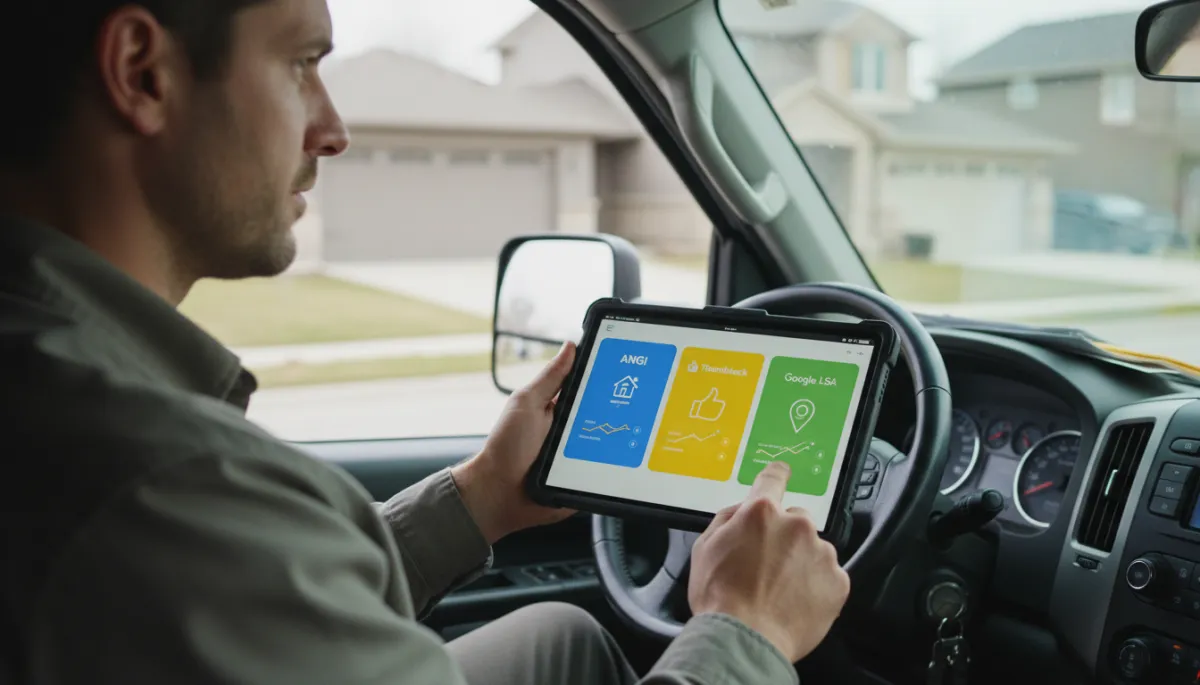
Google Local Services Ads for Colorado Contractors: Is the 'Google Guaranteed' Badge Actually Worth It in 2026?
Lead Recovery, Revenue Growth, Contractor Resources — Angi vs Thumbtack vs Google LSA for contractors
Angi vs. Thumbtack vs. Google LSA: The Truth for Home Service Contractors in 2026
If you run an HVAC, plumbing, electrical, roofing, or landscaping business, you’ve probably asked yourself: which is the best lead platform for home service contractors in 2026 — Angi, Thumbtack, or Google Local Services Ads — and is any of them actually worth what you’re spending?
The real problem: you’re renting leads, not building an asset
Across the U.S. — from Denver and Colorado Springs to Atlanta and Phoenix — contractors are dropping $2,000–$20,000 per month on Angi, Thumbtack, and Google Local Services Ads for contractors. On paper, the math looks simple: pay for leads, close a percentage, grow revenue. In reality, the system is stacked so you stay dependent on the platforms, not the other way around.
Angi and Thumbtack both sell the same homeowner inquiry to multiple contractors at once. You’re often one of 3–8 pros paying for the same “opportunity.” Even when the top-line cost-per-lead looks decent — say $40 — the real cost per booked job balloons because you’re fighting in a mini bidding war every time your phone buzzes. Google LSA is better on exclusivity, but competition and pricing still climb as more contractors pile in.
The deeper problem: every review, every message thread, and most of the customer data live on someone else’s platform. You’re renting access to demand instead of building a pipeline you own. When the algorithm, pricing, or category rules change, your schedule and cash flow change with them — whether you like it or not.
The hidden cost of depending on third-party lead platforms
Let’s call out the real costs — not just the line item on your AmEx statement, but the strategic cost to your business.
Shared leads and race-to-the-bottom pricing: Angi and Thumbtack routinely send the same request to 3–5 contractors. Some markets report 8. That means you’re paying for a chance to win — not a booked job — and the “winner” is usually whoever responds first and discounts hardest.
Rising cost-per-lead over time: In 2026, Angi leads often run $30–$120+, Thumbtack $25–$75 for most trades, and Google LSA averages around $53 nationally with many categories higher. As more contractors join, the platforms raise prices — you have no say in that curve.
Trapped reviews and reputation: That 4.8-star profile with 250 reviews is powerful — but it’s locked inside someone else’s ecosystem. If they suspend your account or change their visibility rules, you lose the social proof you paid to earn.
No real customer data ownership: You rarely get clean, structured data you can feed into your own CRM, automations, and remarketing. The platform controls the relationship. You just get the scraps: a phone number, maybe an email, often buried in an app inbox that your team doesn’t consistently work.
💡 Reality check: when Angi or Thumbtack tweaks pricing or Google LSA tightens verification, your lead flow can drop 30–60% overnight. That’s not a marketing channel — that’s a single point of failure.
Is Angi worth it for home service contractors?
Angi (formerly Angie’s List / HomeAdvisor) still has massive brand recognition with homeowners. For certain trades — especially remodeling, roofing, and higher-ticket projects — it can deliver volume. But the Angi lead quality contractors see in 2026 is mixed at best, and the economics are often misunderstood.
Pricing: contractors report annual memberships around $300 plus per-lead fees from $30–$120+ depending on trade and job size. Contract terms often include 12-month commitments and early cancellation penalties.
Lead model: shared leads — usually 3–5 contractors per request. Close rates in many markets sit around 8–15%. That pushes real cost per booked job into the $135–$500+ range, with some HVAC installs averaging ~$500+ per job.
Strengths: strong homeowner trust, good for filling calendars in slower seasons, and decent for larger project quotes when you have a tight sales process and fast response.
Limitations: shared leads, price-sensitive shoppers, and heavy dependence on Angi’s internal ranking and category rules. You’re building Angi’s marketplace more than your own brand.
Thumbtack for contractors review: when it works — and when it doesn’t
Thumbtack is more flexible. It covers everything from house cleaning to wedding photography to HVAC installs. For contractors, it can be a useful “gap filler” — a way to pick up extra jobs when your schedule has holes. But again, the shared-lead model changes the math.
Pricing: pay-per-response or pay-per-contact. Typical home service leads land in the $25–$75 range, with high-ticket installs hitting $90–$150+ in some markets.
Lead model: leads are commonly shared with 4–5 pros. Many homeowners choose the first person who responds with a reasonable price. Effective close rates often sit between 15–30%, pushing cost per booked job into the $100–$500 range depending on your trade and sales discipline.
Strengths: good for low- to mid-ticket jobs, flexible budget control, and quick testing in new service lines or geographies without long contracts.
Limitations: lead quality varies widely, reviews are platform-bound, and the shared model again pushes you into speed-and-price competition instead of value-based selling.
How does Google LSA compare to Thumbtack for contractors?
Google Local Services Ads for contractors are different in two critical ways: leads are exclusive, and intent is usually higher. When someone searches “emergency plumber near me” and taps your Google Guaranteed ad, they’re not casually browsing — they’re trying to solve a problem right now.
Pricing: national blended average around $53 per lead, with many trades ranging roughly $25–$120. Roofing, water damage, and storm-driven categories can spike higher, especially in dense urban markets.
Lead model: pay-per-qualified-lead, not per click. Leads are not shared — that homeowner is contacting you directly. Booking rates commonly sit in the 38–55% range depending on the trade and your response speed.
Strengths: high-intent traffic, strong trust via the Google Guarantee, and typically the best cost per paying customer among paid channels when managed well.
Limitations: verification requirements, category restrictions, and ranking heavily tied to reviews, responsiveness, and proximity. As more contractors in your market optimize, cost-per-lead rises and visibility becomes harder to maintain.
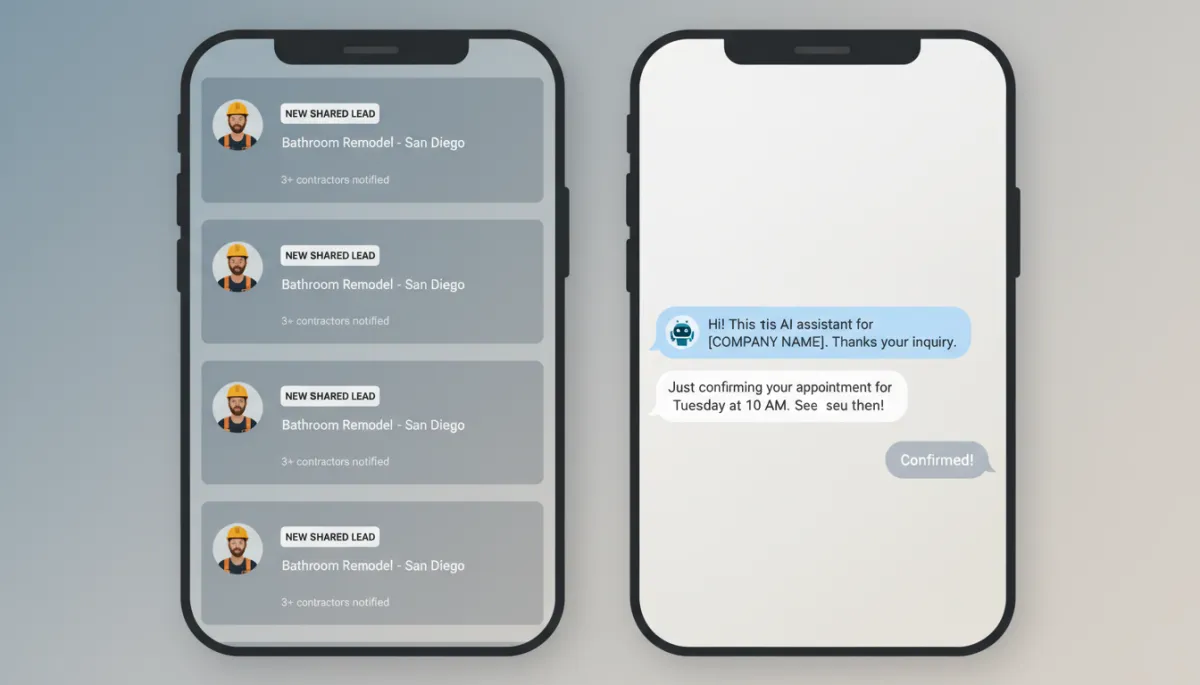
Shared leads fuel price wars — owned leads fuel stable, predictable growth.
ROI comparison: shared platforms vs owned lead capture
Let’s simplify the math. Assume you’re an HVAC contractor and you’re evaluating Angi, Thumbtack, Google LSA, and an owned lead generation for contractors model with AI-powered follow-up.
Angi: $60 average per lead, shared with 3–5 contractors, 10% close rate → effective cost per booked job ≈ $600.
Thumbtack: $45 per lead, shared with 4–5 contractors, 20% close rate → ≈ $225 per booked job.
Google LSA: $70 per exclusive lead, 40% close rate → ≈ $175 per booked job.
Now compare that to an owned lead capture system where leads come from your own website, ads, and local SEO. Suppose your blended cost to drive a lead to your site is $30. Historically, maybe only 20–25% of those web leads book because response is slow and you miss calls. With AI follow-up and missed call automation, that changes.
Cost per lead: ~$30 (from your own ads, SEO, referrals hitting your site).
Conversion rate without automation: ~20% → $150 per booked job.
Conversion rate with AI instant follow-up and missed call text back: 40–50% is realistic → $60–$75 per booked job.
📌 Key takeaway: you can’t control Angi’s pricing curve, but you can control your own conversion rate. When you double conversion on owned leads, you cut your effective cost per job in half — permanently.
The better strategy: own your lead capture, then layer platforms on top
Angi, Thumbtack, and Google LSA are not scams. They’re tools — and in the short term, they can absolutely help you keep trucks rolling. The mistake is treating them as your primary growth strategy instead of what they really are: rented distribution channels that should feed an engine you own.
Owning your lead capture infrastructure means:
Your website, not someone else’s profile, is the main conversion point.
Every call, form, and chat becomes a record in your own system — not a rented inbox.
Automations work across all channels — Google LSA, organic, referrals, even Angi and Thumbtack — because everything flows into one AI-powered follow-up engine.
How Ad Form Instant Follow-Up and Missed Call Text Back fit in
As a software engineer, I look at this like system design: platforms are external APIs — powerful but outside your control. Your job is to build an internal service that captures every request, responds instantly, and owns the data end-to-end. That’s where tools like IBP’s Ad Form Instant Follow-Up and Missed Call Text Back matter.
Start with Ad Form Instant Follow-Up. It plugs into your website and landing pages so that when a homeowner fills out a form — from Google LSA, SEO, or even a link on your Angi profile — an AI assistant texts them back in seconds, qualifies the job, and moves toward booking. No more 20-minute delays while your dispatcher juggles three calls.
Pair that with Missed Call Text Back. Every missed call — from any source — triggers an automatic text: “Sorry we missed you, how can we help?” For home service contractors, that’s often the difference between losing the job to a competitor and recovering a $1,500+ ticket.
Under the hood, the logic is simple. Conceptually, it looks like this:
def handle_new_lead(lead):
    save_to_crm(lead)
    if lead.source in ["web_form", "lsa_form", "angi_profile"]:
        send_instant_text(
            to=lead.phone,
            message="Hey {name}, got your request about {job}. When works for a quick call?"
        )
    elif lead.source == "missed_call":
        send_instant_text(
            to=lead.phone,
            message="Sorry we missed your call. Can you text a bit about the issue?"
        )
    start_follow_up_sequence(lead_id=lead.id)
IBP’s Growth Engine tier (https://instantbusinesspro.ai) effectively gives you this behavior without writing code — centralizing leads from multiple sources, automating outreach, and feeding everything into a pipeline you control. If you want to layer deeper CRM and nurturing on top, their guidance on contractor CRMs and email follow-up is worth a look: https://instantbusinesspro.ai/blog/contractor-crm-software-for-home-service-businesses and https://instantbusinesspro.ai/blog/email-marketing-for-contractors.
Should contractors own their lead generation?
If your goal is a business you can scale, sell, or step back from, the answer is yes. The best lead platform for home service contractors in 2026 is not a single marketplace — it’s a hybrid strategy where you:
Use Angi and Thumbtack tactically to smooth out seasonality and test new services.
Lean on Google LSA for high-intent, exclusive leads while it remains cost-effective in your market.
Invest steadily in your own website, SEO, branded search, and local reputation — and run all of that through an AI-powered lead capture and follow-up system you own.
The outcome: a pipeline that outlives any platform
Contractors who combine platform lead generation with owned AI-powered lead capture stop playing defense. When Angi raises prices or Thumbtack changes categories, it’s an annoyance — not a crisis. When Google LSA tightens verification rules, you adjust, but your phones don’t go silent because your website, brand, and automations are doing the heavy lifting.
If you’re already spending thousands a month on Angi, Thumbtack, or Google LSA, you don’t need to abandon them overnight. You do need to make sure every dollar you spend — on any platform — ultimately feeds a system you control: your own lead capture, your own follow-up, your own customer database.
💡 Next step: if you’re ready to turn rented attention into owned demand, explore IBP’s Growth Engine tier and its Ad Form Instant Follow-Up and Missed Call Text Back tools. Use Angi, Thumbtack, and Google LSA — but build a pipeline that doesn’t depend on any of them.
Meta description: Angi vs Thumbtack vs Google LSA for contractors — honest 2026 breakdown, real ROI math, and why owning your lead capture beats renting shared leads long term.
Author: Austin Baughman (ID: 698cb47a0d64325109a8e111) — Categories: Lead Recovery (698cb2259a3413bb92c472b2), Revenue Growth (6994965ea6d17fd7d3fa88f3), Contractor Resources (69a232fa5160810f9b8b3824)
