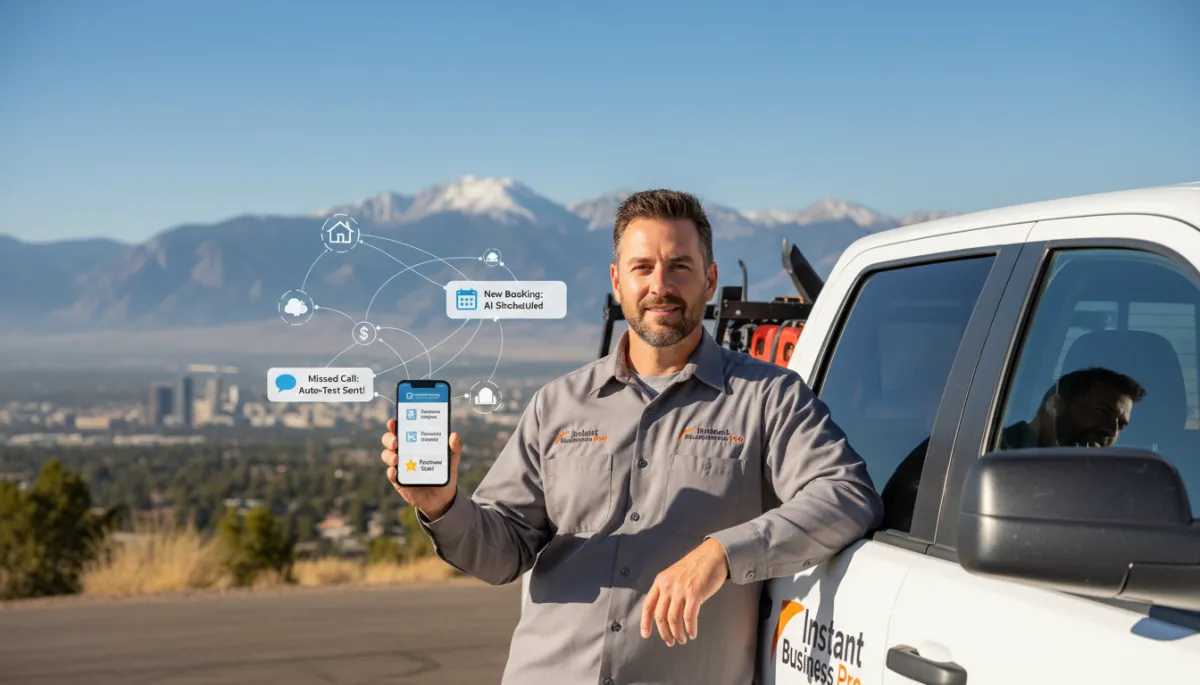
Complete Guide to AI Automation for Colorado Home Service Contractors
Home Services, AI Automation, Colorado Contractors
Complete Guide to AI Automation for Colorado Home Service Contractors
A practical, numbers-driven playbook on using AI automation for Colorado home service contractors to capture more calls, book more jobs, and grow profitably in markets like Denver, Colorado Springs, Fort Collins, and Elizabeth.

If you own an HVAC, plumbing, roofing, electrical, painting, landscaping, or general contracting business in Colorado, you already know the pattern: the phones blow up during peak season, crews are in the field, and calls roll to voicemail. Industry studies show that 30–60% of calls are missed at peak times, and about 85% of those callers never leave a message. They simply dial the next contractor on Google.
That is a serious profit leak. Across home services, each missed call is typically worth somewhere between $350 and $1,200 in potential revenue, depending on your trade and average ticket size. At the same time, 78% of jobs go to the first contractor who responds. When you connect those dots, the opportunity becomes obvious: whoever responds fastest, wins the work and the cash flow. Platforms like Instant Business Pro, based in Elizabeth, Colorado, are built specifically to help local contractors plug this gap with practical AI automation that fits right into your current phones and calendars.
What Is AI Automation for Contractors?
AI automation for Colorado home service contractors simply means using software “assistants” to handle routine communication and scheduling tasks that usually fall through the cracks when you are in the field. Instead of hiring another office person or paying a call center that does not understand your business, you delegate the repetitive work to systems that run 24/7 and never get tired or distracted.
In practice, that usually covers seven core workflows:
Missed call text-back, so every unanswered call gets an instant text reply and a chance to book.
Voice AI, which can answer calls, ask screening questions, and book appointments when humans cannot pick up.
Automated lead follow-up sequences by text and email that nurture estimates, second opinions, and “thinking about it” quotes until they say yes or no.
Google review automation, turning happy customers into steady 5-star reviews that push you up the map pack in Denver, Colorado Springs, Fort Collins, and beyond.
AI scheduling and booking that syncs with your calendar, dispatch software, or routing tools to keep techs busy without double-booking or back-and-forth phone tag.
Lead reactivation campaigns that wake up old estimates, unsold quotes, and past customers with timely offers and reminders.
Reporting and dashboards that show where leads come from, which channels convert, and how quickly your team responds.
The goal is not to replace your office manager or dispatcher. The goal is to remove the low-value, repetitive steps so your people can focus on higher-value work: closing deals, managing crews, and delivering a great customer experience on every job. For many Colorado contractors, that translates into booking roughly three times more jobs from the same lead flow, simply by responding instantly and following up consistently. For a deeper dive into this impact, see the case studies in this article on contractors booking 3x more jobs.
How Does Missed Call Text-Back Automation Work for Contractors?
Missed call text-back is usually the fastest win for most contractors in Denver, Colorado Springs, Fort Collins, Parker, Castle Rock, Loveland, Pueblo, and Elizabeth. The concept is simple: whenever your business number rings and is not answered within a set time (for example, 20–30 seconds), an automated system sends the caller a personalized text message within a few seconds. No app switching, no extra phone number for you to manage, and no waiting until after dinner to start returning calls.
Because 78% of jobs go to the first contractor who responds, this alone can change your booking rate overnight. Studies show that contractors who respond within five minutes are up to 21 times more likely to qualify and win the job compared to those who wait 30 minutes or longer. Yet many small shops still respond four to eight hours later, or even the next day. During busy HVAC season or after a hailstorm, that delay can easily cost $350 to $1,200 per missed call in lost revenue, depending on job size, according to multiple industry benchmarks on missed-call costs and average ticket values.
A well-designed missed call text-back system will typically:
Detect the missed call in real time on your existing business number.
Send a friendly, branded text within seconds, acknowledging the call and asking how it can help (for example, “Are you looking for repair, replacement, or an estimate?”).
Capture the caller’s name, address, and service need through a short text conversation if they reply.
Offer available appointment windows or connect them to your team when someone is free to talk live.
Tools like Instant Business Pro are designed so this can be turned on without new hardware, new phone numbers, or complex configuration. You keep your existing number, and the automation runs in the background. If you want a step-by-step walkthrough of how this works in a contracting environment, review the detailed guide on how to set up missed call text-back for your contracting business.
For a step-by-step breakdown of the missed call recovery system specifically — including the exact 3-part sequence Colorado contractors use to recover leads from unanswered calls — read: How to Never Miss a Contractor Lead: The 3-Part Missed Call Recovery System for Colorado Home Services.
What Is Voice AI for Contractors and How Does It Answer Calls?
Voice AI is essentially a smart answering system that can talk with your callers in natural language, 24/7. Instead of a basic voicemail greeting or a generic call center, voice AI answers the phone, asks the right questions, and either books the appointment or routes the call to the right person on your team. From the caller’s perspective, it feels like talking to a calm, organized office coordinator who never rushes and never forgets to capture details.
For Colorado HVAC, plumbing, roofing, electrical, and landscaping contractors, voice AI can be configured to follow your exact playbook. It can ask whether the issue is emergency or non-emergency, confirm if there is active water damage or a gas smell, check service areas by ZIP code, and provide rough availability windows. The AI does not make up prices or diagnose problems; it focuses on qualification and booking so your licensed techs can do the real work on-site. This is especially powerful in markets like Denver and Colorado Springs where call volume spikes during weather extremes and after storms.
A typical voice AI workflow looks like this:
Caller phones your main number. If your team is available, they can still answer live. If not, the AI picks up automatically after a short ring.
The AI greets the caller with your business name and a friendly script (for example, “Thanks for calling ABC Heating in Denver, how can we help today?”).
It listens to the caller, asks clarifying questions, and fills in the intake form: name, phone, address, service type, urgency, and any notes your techs need before rolling a truck.
If appropriate, it offers appointment windows based on your calendar rules, then sends the caller a confirmation text and email with the details.
This is not science fiction. Contractors across the country are already using voice AI to capture more after-hours and overflow calls without adding headcount. For a contractor-focused breakdown of how this technology works and what it costs in 2026, see this guide on voice AI for contractors. Instant Business Pro and similar platforms are intentionally built so that you do not need to be technical to deploy these capabilities; you define your business rules, and the system handles the rest behind the scenes.
How Do Automated Lead Follow-Up Sequences Work?
In every Colorado market, from Denver to Pueblo, there is a long tail of “almost” jobs: estimates sent but never approved, roof inspections that did not convert, furnace quotes where the homeowner wanted to “think about it.” Most contractors mean to follow up, but field work, staffing, and emergencies push those calls and texts further down the list. Over a year, that can easily add up to tens or hundreds of thousands of dollars in unrealized revenue, especially when each job is worth $350 to $1,200 or more.
Automated lead follow-up sequences solve this by putting your best salesperson on autopilot. Once a lead is created—whether from a web form, phone call, or manual entry—the system automatically starts a series of messages designed to move that person toward a decision. These sequences are typically customized by lead type, such as emergency repair, non-urgent maintenance, replacement quotes, or seasonal promotions like pre-winter furnace tune-ups in Fort Collins or pre-monsoon roof inspections in Castle Rock and Parker.
Day 0: Immediate text and email acknowledging the inquiry, summarizing what was discussed, and confirming next steps or appointment details.
Day 1–2: A follow-up message asking if they have any questions and offering to answer concerns about price, timing, or scope of work.
Day 3–7: A gentle reminder that their quote is still valid, possibly with a limited-time incentive or scheduling prompt for slower periods.
Day 14–30: A final touchpoint to close the loop, either moving them to a long-term nurture list or confirming they went another direction so you can improve your process.
Because these sequences run automatically, every lead gets the same timely, professional experience, whether it is your slowest Monday in January or your busiest week in July. Contractors consistently report that simply adding structured follow-up can generate up to three times more booked jobs from the same number of leads, especially when combined with instant response from missed call text-back and voice AI. For HVAC-specific ideas, you can review strategies outlined in this HVAC lead generation guide for 2026, many of which are powered by automation behind the scenes.
How Does AI Automate Google Review Requests for Contractors?
When homeowners in Denver, Colorado Springs, Fort Collins, Loveland, or Parker search for “HVAC repair near me” or “roofing contractor,” they usually choose from the top few listings in the Google map pack. Those spots are heavily influenced by review volume, star rating, and how recently you have received reviews. Yet most home service owners rely on technicians to remember to ask for reviews at the end of the job, and then hope the customer follows through later. In reality, only a small fraction ever do without a structured system in place.
AI-driven review automation turns this into a repeatable process. After a job is completed and marked as such in your CRM, scheduling tool, or simple calendar, the system automatically sends the customer a personalized text and email with a direct link to your Google review page. If they do not respond, it follows up politely a few days later, adjusting the message based on whether they clicked the link or interacted with previous messages. Over time, this builds a steady stream of fresh, positive reviews without nagging your techs or office staff to remember each step manually.
Consistent review requests after every completed job, not just the ones your team remembers to ask for.
Smart timing, such as sending the request within an hour of job completion, when the positive experience is fresh in the customer’s mind.
Clear, simple instructions and one-click links, reducing friction and making it easy for customers to leave a review on their phone in less than a minute.
The business impact is significant. More reviews mean higher visibility, stronger trust, and better conversion rates for every marketing dollar you spend. When combined with faster response times and professional follow-up, your overall close rate improves across the board, making your advertising in Denver, Colorado Springs, or Pueblo far more efficient. Instant Business Pro includes these review workflows as part of its broader automation toolkit, so you do not need multiple tools to manage calls, texts, and reputation in separate silos.
How Does AI Scheduling and Booking Work for Home Service Contractors?
Scheduling is where many small contractors feel the most day-to-day friction. You are juggling technician availability, drive times across the Front Range, emergency calls, warranty work, and weather delays. Meanwhile, customers just want a clear time window and a confirmation that someone will actually show up. AI scheduling and booking tools sit in the middle of that chaos and help enforce rules without you needing to manually approve every appointment request that comes in via phone, text, or web form.
At a basic level, AI scheduling systems connect to whatever calendar or dispatch tool you already use. You define your service areas, time windows, and capacity (for example, how many installs and how many service calls your team can handle per day in Denver versus Colorado Springs). Then, when a lead responds to a missed call text-back, speaks with your voice AI, or fills out a form on your website, the system can offer real appointment options that fit your rules. This reduces the back-and-forth that typically happens when a homeowner calls during the day, leaves a message, and then plays phone tag with your office manager for two or three days before anything is booked.
Real-time availability: The system knows when your team is already booked in Fort Collins and when a tech is available in Loveland or Parker, so it does not promise time slots you cannot honor.
Smart routing: Rules can prioritize grouping jobs by geography to reduce windshield time, which is especially valuable when driving between Denver, Castle Rock, and Colorado Springs on the same day.
Automated confirmations and reminders: Once a slot is booked, the customer receives confirmations and reminders via text and email, reducing no-shows and last-minute cancellations.
The result is a smoother schedule, fewer gaps in your day, and better utilization of your field team. Contractors often find that with AI scheduling, they can handle more jobs per day without feeling more rushed, simply because the system avoids inefficient routing and double-booking. Combined with lead follow-up automation, this is a key reason many service businesses are seeing up to three times more booked jobs from the same number of leads and marketing spend.

Centralized dashboards help Colorado contractors see every lead, call, and booking in one place.
What Are Lead Reactivation Campaigns and How Do Contractors Use Them?
Lead reactivation campaigns target the “gold mine” hiding in most contractor databases: past customers, unsold estimates, and cold leads that never turned into booked work. Over the years, you have likely built a list of hundreds or thousands of contacts across Denver, Colorado Springs, Fort Collins, Pueblo, and surrounding areas. Many of those homeowners still need ongoing maintenance, upgrades, or new projects, but they are not actively thinking about you when the need arises. A well-structured reactivation campaign brings your brand back to the top of their mind at the right time, with the right offer.
AI-powered reactivation sequences typically segment your list based on factors like last service date, job type, and location. For example, you might send one campaign to homeowners in Castle Rock and Parker who had furnace installs three years ago, reminding them about maintenance and safety checks before winter. Another campaign might target roof inspections completed after a previous hailstorm in Loveland and Fort Collins, offering a follow-up inspection before the next storm season. The system can automatically personalize messages with the customer’s name, past service details, and relevant timing cues.
Identify target segments, such as “customers not serviced in 18+ months” or “estimates sent but not approved in the last 90 days.”
Design a short sequence of texts and emails offering a check-in, seasonal tune-up, or limited-time discount to encourage action.
Launch the campaign and let the AI handle responses, appointment booking, and reminders based on who engages.
Because these campaigns tap into people who already know, like, and trust your business, they often produce some of the highest return on investment of any marketing activity. You are not paying for new clicks or leads; you are simply reactivating relationships you have already earned. Platforms like Instant Business Pro include reactivation templates so you can launch these campaigns quickly without writing everything from scratch or learning complex marketing software.
How Much Does AI Automation Cost for Colorado Contractors?
Pricing for AI automation in home services has become much more accessible by 2026. Instead of six-figure custom projects, most Colorado HVAC, plumbing, roofing, electrical, painting, landscaping, and general contracting companies can get started on a monthly subscription model. Entry-level packages typically begin around the $197 per month range for core features such as missed call text-back, basic lead capture, and simple follow-up sequences. More advanced plans that include voice AI call handling, deeper CRM integration, and multi-location support may range from a few hundred to low four figures per month, depending on scale and feature set.
The right way to think about cost is not as a new expense, but as a reallocation of dollars you are already losing through missed calls and slow response times. Remember that industry benchmarks put the value of a missed call between roughly $350 and $1,200 in potential revenue, depending on your trade and job mix. If your business misses even 10–20 calls per month, that is a theoretical loss of $3,500 to $24,000 every month. With 30–60% of calls commonly going unanswered at peak times, this is not an abstract risk; it is an everyday reality in busy Colorado markets.
When you stack that against the cost of AI automation, the math becomes compelling. Recovering just one or two missed jobs per month can typically cover the entire cost of a platform like Instant Business Pro, leaving the rest of the recovered revenue as pure profit. In addition, AI automation can reduce the need for after-hours answering services or additional office staff, and it can make your advertising more efficient by improving conversion rates from lead to booked job. If you are comparing AI tools with traditional answering services or hiring additional staff, this article on AI vs answering service vs hiring for Colorado contractors provides a useful side-by-side business analysis.
As with any investment, the key is to start with your biggest bottleneck. For many Colorado contractors, that is missed calls and slow response times. Implementing missed call text-back, basic follow-up automation, and review requests is often enough to demonstrate clear return on investment within the first 30–60 days. From there, you can layer on voice AI, more sophisticated scheduling, and reactivation campaigns as your comfort and results grow.
FAQ: AI Automation for Colorado Home Service Contractors
Is AI automation only for large contractor companies?
No. In fact, small and mid-sized Colorado contractors often see the fastest gains, because they feel every missed call and scheduling gap. Modern tools like Instant Business Pro connect to your existing phone number and calendar, so you can deploy automation without an IT department or custom development project.
Will AI replace my office manager or dispatcher?
No. Think of AI as an assistant for your office team, not a replacement. It handles repetitive tasks like missed call responses, appointment reminders, and review requests. Your people still make judgment calls, handle complex customer situations, and oversee the schedule. The goal is to free them from low-value busywork so they can focus on higher-impact responsibilities.
How quickly can I see results from AI automation?
Most contractors notice a difference within the first few weeks, especially when enabling missed call text-back and basic follow-up. Because 78% of jobs go to the first responder, simply replying instantly instead of hours later can significantly boost booked jobs. Over 60–90 days, you will also see compounding gains from better reviews, reactivation, and more efficient scheduling.
Do I need technical skills to use AI automation tools?
No. Platforms designed for contractors, such as Instant Business Pro in Elizabeth, Colorado, provide prebuilt workflows, templates, and onboarding support. You will configure settings like service areas, hours, and message tone, but you do not need to write code or manage servers. The vendor’s technical team handles the underlying integrations and maintenance for you.
What if a customer wants to talk to a real person, not an AI?
Good systems always provide an easy handoff to a human. Voice AI can route calls to your team when available, and text automations can offer a “talk to a person” option. The objective is not to trap customers in automation, but to ensure they are acknowledged immediately and then connected to the right person as soon as possible.
How does AI automation fit with my existing CRM or job management software?
Most modern AI platforms integrate with popular CRMs, scheduling tools, and field service management systems. They can push new leads, booked jobs, and status updates into your existing workflow rather than forcing you to replace it. In many cases, you can start with light integration and deepen it over time as you see results and get comfortable with the technology.
Where should I start if I am new to AI automation?
Begin with your biggest leak: missed calls and slow response times. Turn on missed call text-back, basic lead capture, and simple follow-up sequences. Once you see more consistent bookings and better conversion rates, consider layering in voice AI, scheduling automation, and lead reactivation. Resources like this overview of contractors booking 3x more jobs can help you prioritize next steps.
AI automation for Colorado home service contractors is no longer a futuristic concept. It is a practical toolkit that helps you answer more calls, respond faster than competitors, follow up on every lead, and keep your crews booked with profitable work. Whether you are running a two-truck operation in Elizabeth or a multi-crew company across Denver, Colorado Springs, and Fort Collins, the combination of missed call text-back, voice AI, review automation, scheduling, and reactivation can unlock significant, measurable growth. Platforms like Instant Business Pro are built to make that transition straightforward, so you can focus on what you do best: delivering excellent service on every job.
Ready to see what this is costing your business?
IBP builds the complete AI lead response system for Colorado contractors — missed call recovery, automated follow-up, and review requests — in 14–21 days, fully managed. The IBP Revenue Calculator shows your exact opportunity in 60 seconds. Free, no sign-up needed.
