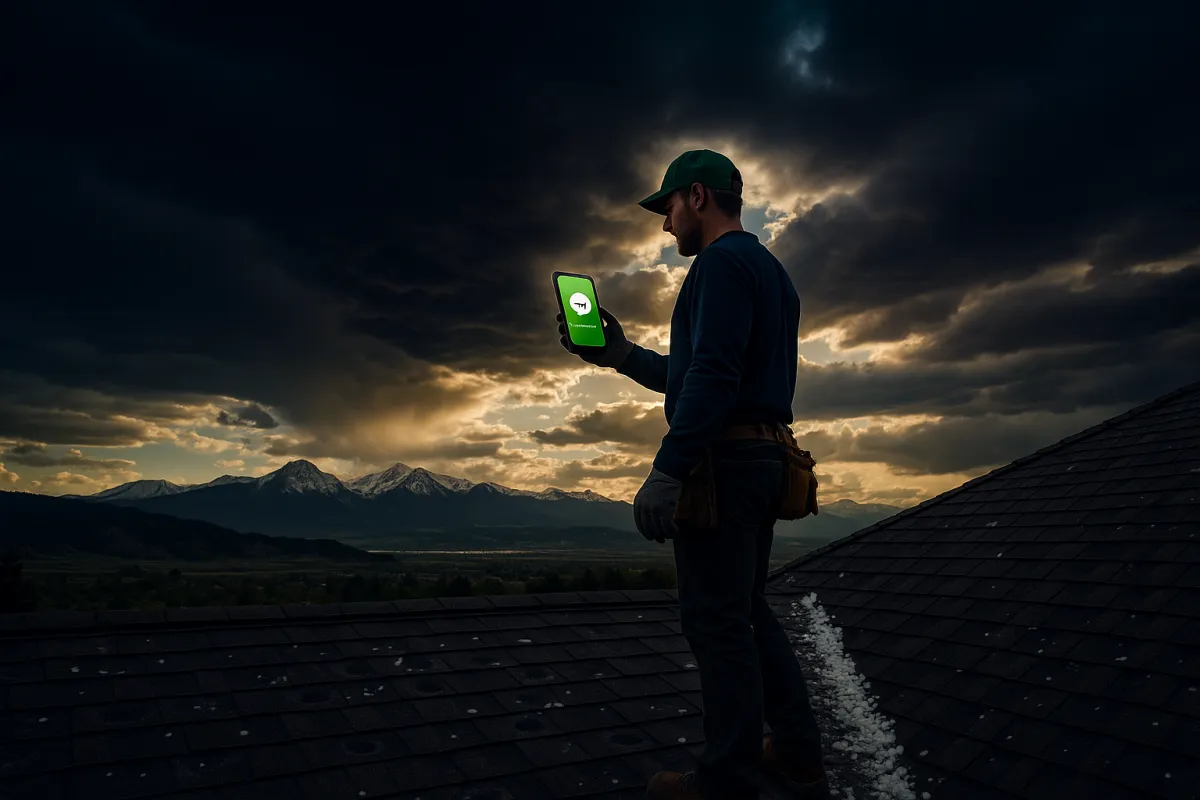
How Colorado Roofers Win More Hail Storm Leads in 2026
How Colorado Roofers Win More Hail Storm Leads in 2026
If you run a roofing business in Colorado, you already know what the sky looks like right before everything changes. The clouds stack up fast along the Front Range, the temperature drops ten degrees in twenty minutes, and somewhere between Castle Rock and Fort Collins, hailstones the size of golf balls are about to hit a neighborhood full of homeowners who are about to reach for their phones.
Colorado is one of the most hail-prone states in the country. According to data compiled by local roofing contractors and weather research, Colorado experiences approximately 94 hail events per year, generating around $151 million in annual property losses and ranking second nationwide for per-capita hail damage. In 2023 alone, reports of baseball-sized hail in Colorado nearly tripled compared to 2019, according to the National Weather Service in Denver. The storms are getting bigger. The season is getting busier. And the competition is getting faster.
Storm season in Colorado is the roofing industry's single biggest revenue opportunity of the year. A single hailstorm can generate 10,000 to 50,000 roofing claims in a metropolitan area within days. In that same window, roofers who are prepared to capture those leads immediately and roofers who are not will have completely different springs.
This post is about making sure you are in the first group.
The Storm Opportunity and the Trap
Here is the paradox every Colorado roofer faces during storm season. The moment demand surges, your capacity to respond to it shrinks.
You are out on inspections. You are on rooftops. You are dealing with insurance adjusters, material suppliers, and a crew that needs direction every hour. Your phone is ringing constantly and you literally cannot answer every call while you are working. The leads are piling up but so are the missed calls, the unreturned voicemails, and the potential customers who got tired of waiting and called someone else.
This is not a failure of effort. It is a structural problem. Your lead capture system was built for normal volume and storm season is not normal.
The roofing companies that win the most storm business are not necessarily the ones with the best crews or the most competitive pricing. They are the ones who respond fastest. According to industry data from Contractor Clarity, over 40% of roofing leads go to the first contractor to respond. A homeowner who calls three roofing companies after a storm is going to schedule an inspection with the first one who gets back to them. The other two calls were wasted effort on their part and lost revenue on yours.
You can read the full revenue picture on what missed calls cost Colorado contractors in our post on The Real Cost of Missed Calls for Contractors in 2026, including what a missed roofing lead specifically costs during hail season.
Why Roofing Leads Are Different
Not all contractor leads behave the same way, and roofing leads after a storm have a unique psychology worth understanding.
First, there is urgency. A homeowner who just watched hailstones punch through their roof is not comparison shopping the way they would for a deck addition or a kitchen renovation. They want someone to come look at it. They want reassurance that it is going to be handled. That emotional window when they are most motivated to act is often just a few hours wide.
Second, there is competition. In markets like Denver, Colorado Springs, and Fort Collins, a major storm event triggers an immediate influx of roofing companies, including out-of-state storm chasers who follow severe weather systems across the country specifically because Colorado's Front Range is one of the most consistently active hail corridors in the United States. These companies arrive with aggressive follow-up systems and crews ready to mobilize instantly. They compete directly with your local reputation and often beat local contractors on response speed alone.
Third, there is the insurance timeline. Homeowners filing hail damage claims are frequently working within specific insurance windows and adjuster availability. A roofer who engages them quickly can help guide that process and establish themselves as the trusted professional before a competitor even returns a call. Nearly 50% of all homeowners insurance claims in the US are related to wind and hail damage, according to the Insurance Information Institute. In Colorado, that ratio is even higher given the state's storm frequency.
Speed is not everything in roofing. Quality, reputation, and licensing absolutely matter. But speed gets you in the door. And in storm season, if you are not in the door, you do not get to show off the rest of it.
The Missed Call Problem, Amplified
We have written about the real cost of missed calls for contractors broadly, but during storm season the math becomes even more significant.
In 2026, Colorado homeowners typically invest between $9,500 and $24,000 for a residential roof replacement, according to data from Red Diamond Roofing and other Colorado-based contractors. The average asphalt shingle replacement for a home in the $10,000 to $18,000 range is the most common storm-driven job. Storm damage claims specifically tend to land in the $8,000 to $12,000 range after insurance, according to Invoca's 2025 home services data. A storm that significantly damages roofs across a single neighborhood can represent hundreds of thousands of dollars in total contract value, split among however many roofing companies respond quickly enough to get in front of homeowners first.
If your phone rings 30 times during the 48 hours after a storm and you are only reaching or returning 12 of those calls, you are not just missing calls. You are potentially leaving significant revenue on the table during your single most important window of the year. According to Invoca research, the average missed call costs a home services business $1,200 in lost revenue. In roofing, where storm jobs regularly exceed $10,000 in contract value, that cost per missed call climbs considerably higher.
And unlike a missed plumbing inquiry or an unanswered HVAC lead, a missed roofing call after a storm almost never comes back. The homeowner moves on, signs with someone else, and you never get a second chance at that job.
How AI-Powered Follow-Up Changes Storm Season
The answer to the storm season capacity problem is not hiring a temp receptionist in March and hoping for the best. It is building a system that responds to every single lead the moment they reach out, automatically, professionally, and in your business's voice, whether you are on a roof, in a meeting with an adjuster, or finishing your last inspection of the day.
Here is how it works in practice for a roofing contractor using Instant Business Pro's AI automation. A homeowner calls at 2:17pm on a Tuesday afternoon. You are on a roof three miles away. The call goes unanswered. Within seconds, they receive a text message from your company, a professional acknowledgment that you received their inquiry and a simple question to help them start sharing what they need.
They respond. The conversation is logged. When you get off that roof at 4pm and check your phone, you do not see a missed call. You see a qualified lead with contact information, a damage description, and their availability, ready for you to schedule an inspection with a single reply.
Meanwhile, the three other roofers that homeowner called before giving up? They got voicemails. You got the lead.
Multiply that sequence across every call you miss during storm season and you start to see the real difference between an average storm season and an exceptional one. Our post on Speed to Lead in 2026 covers exactly how this response gap plays out in bookings and revenue for Colorado contractors across all trades.
If you have been on the fence about whether AI follow-up actually feels professional and trustworthy to customers, we addressed that directly in The Human Side of AI: How Colorado Contractors Are Using Automation to Build Trust and Book More Jobs. The data on how customers respond to fast automated replies is worth reading before storm season starts.
Setting Up Your System Before the First Storm Hits
The worst time to build your lead capture system is after a storm has already hit. By then you are already overwhelmed, and any setup time you spend on systems is time you are not spending on inspections and estimates.
The contractors who win storm season set up their follow-up systems in February and March, before the first significant hail event of the year. Colorado's active hail season runs from April through September, with May through July typically delivering the most concentrated damage along the Front Range. That gives you a real window right now to get ahead of it.
Setting up before the season means defining your messaging, testing your responses, connecting your phone numbers, and walking into storm season knowing that every call is being captured, every lead is being engaged, and no revenue is being left on the table because you were too busy to pick up the phone.
Our Spring Contractor Lead System Checklist walks through exactly how to prep your lead capture before busy season starts, and it applies directly to roofing contractors heading into hail season.
For a broader look at how AI automation fits into a complete business growth system, The Complete 2026 Guide to Contractor Marketing Automation is worth reading alongside this one.
At Instant Business Pro, we specialize in helping Colorado roofing contractors do exactly this. Fast setup, simple management, and a system that performs hardest when your workload does. We understand the Colorado roofing market, the seasonal dynamics, and what it takes to compete when the sky opens up and the leads start pouring in.
Do not let another storm season pass without a system that works as hard as you do. Reach out today and let us get your lead capture ready before the hail hits.
Frequently Asked Questions
When is hail season in Colorado?
Colorado's hail season runs from April through September, with May through July typically delivering the most concentrated and damaging storms along the Front Range and I-25 corridor. Colorado averages approximately 94 hail events per year and ranks second in the nation for per-capita hail damage. Roofing contractors should have their lead capture and follow-up systems in place before April to avoid missing the early-season surge.
How do I get more roofing leads after a hail storm in Colorado?
The most important factor is response speed. Over 40% of roofing leads go to the first contractor who responds, according to industry data. The homeowners calling after a storm are contacting multiple companies simultaneously. Automated follow-up systems that respond within 60 seconds of a missed call significantly increase the number of leads that convert to scheduled inspections, especially during high-volume storm windows when manual follow-up cannot keep up with call volume. For a deeper dive into proven hail damage lead capture for Colorado roofers, explore our dedicated guide.
How fast should a roofing contractor respond to storm leads?
Research from Harvard Business Review and the Lead Response Management Study shows that responding within five minutes makes a contractor 21 times more likely to qualify a lead compared to waiting 30 minutes. In roofing, where homeowners are often calling multiple contractors at the same time, the first company to respond in a professional and reassuring way typically wins the inspection appointment.
What is the average cost of a roof replacement in Colorado in 2026?
According to current 2026 data from Colorado-based roofing contractors and industry pricing tools, Colorado homeowners typically invest between $9,500 and $24,000 for a residential roof replacement. The most common asphalt shingle replacement for an average Colorado home runs between $10,000 and $18,000 depending on size, pitch, and materials. Storm damage claims specifically tend to land in the $8,000 to $12,000 range after insurance.
How do out-of-state storm chasers affect local Colorado roofers?
Out-of-state storm chasing companies follow severe weather systems across the country and deploy sales teams and marketing resources immediately after major hail events. They often have aggressive automated follow-up systems and crews staged for rapid mobilization. Local Colorado roofers compete against them primarily on reputation, local licensing, and warranty reliability, but often lose jobs purely on response speed during the critical first 24 to 48 hours after a storm. Having an automated lead capture system narrows that response speed gap significantly.
What is the best way for Colorado roofers to capture storm leads without missing calls during busy season?
The most effective approach is AI-powered automated follow-up integrated with your existing business phone number. When a call goes unanswered during storm season, the system immediately sends a personalized text from your company to the homeowner, starts gathering information about their damage, and notifies you when they respond so you can step in to a warm conversation. This eliminates the window where homeowners call competitors while waiting for a callback that never comes.
