How Much Does an Answering Service Actually Cost Colorado Contractors in 2026?
Contractors, AI answering vs live answering service for contractors
AI Answering vs. Live Answering Service: What's the Real Difference for Contractors?
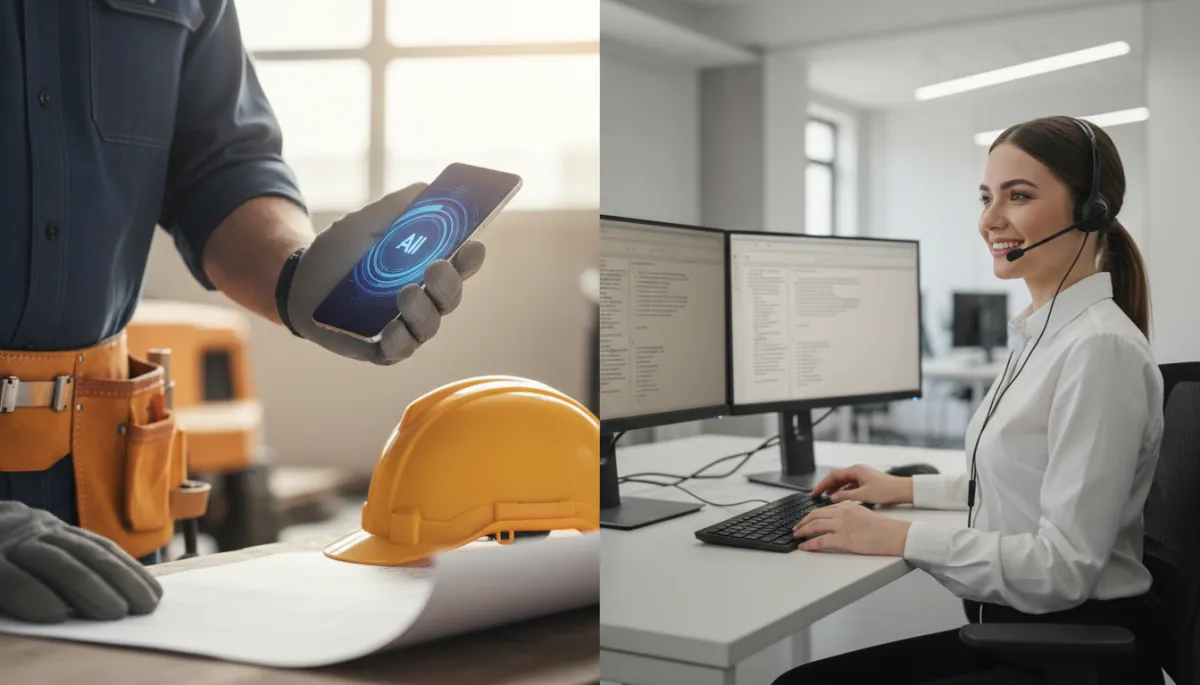
Most contractors are familiar with live answering services. They have been around for decades and many shops in Colorado still rely on them when the office is closed or the phone is ringing off the hook. AI answering is newer, but real companies across Colorado and the country already use it to handle calls that used to roll to voicemail. This post gives an honest, side by side look at AI answering vs live answering service for contractors so you can see what each option actually does and where each one fits.
What does a live answering service actually do for contractors?
A traditional live answering service routes your business line to a pool of human operators. When a homeowner calls, a person answers with your company name, follows a basic script, collects contact details, and writes up a message. Some services can also transfer calls during business hours or for emergencies, but most of the work is message taking and simple triage for your team to handle later.
For contractors, this can be helpful if you have no internal office staff or you want to avoid pure voicemail. The tradeoff is that operators usually do not know your trade, your pricing, or your scheduling rules. They work from a generic script, so they rarely qualify leads in depth, book jobs directly into your calendar, or run a proper contractor answering service comparison that fits your exact workflow. Quality also varies by operator and by shift.
How is AI answering different from a live service?
AI answering uses conversational software to pick up the phone, hold a natural back and forth, and follow structured logic every single time. With platforms like Instant Business Pro, the system can recognize common contractor scenarios, such as new estimate requests, existing job questions, or after hours emergencies, and then follow the rules you define. It can book appointments, capture photos via text, and trigger a missed call text-back sequence automatically when you cannot answer in real time.
The key difference in AI vs answering service contractor workflows is consistency and integration. AI ties into your calendar and CRM, so every call becomes structured data instead of a loose note. That means cleaner reports on lead sources, booking rates, and response times. If you want a deeper dive into the technology, Instant Business Pro has a full guide on voice AI for contractors, including how it works behind the scenes and what it costs in 2026.
Which one costs less over a full year?
Most live answering services bill per minute or per call. Industry data in 2026 shows human services often land between 150 and 500 dollars per month for basic plans, with premium or high volume plans easily passing 1,000 dollars per month. Per minute rates in the 0.75 to 2.00 dollar range, plus after hours, holiday, and overage fees, make busy seasons noticeably more expensive. When you annualize that, many contractors spend several thousand dollars per year just to keep calls away from voicemail.
AI answering is usually priced as a flat subscription. Current AI offerings for contractors typically run between about 50 and 300 dollars per month, often with 24 or 7 coverage included and no separate after hours surcharge. Since the software can handle multiple callers at once, you are not paying more during spikes. For most small to mid sized contractor shops, AI answering comes in noticeably cheaper than a comparable human service over a full year, while also capturing and following up more leads automatically.
When does AI answering make more sense than a live service?
AI answering makes the most sense when your main goal is to convert more inbound calls into booked jobs, without adding office headcount. If most of your calls are routine, such as estimate requests, scheduling, rescheduling, and simple status questions, AI will handle them consistently, capture full lead details, and trigger instant follow up. When you combine AI answering with missed call text-back, you dramatically reduce the number of leads that disappear after one unanswered ring.
There are still cases where a live human is useful, for example, sensitive conversations or high dollar commercial negotiations. Many contractors handle those personally anyway. For everything else, AI answering vs live answering service contractors is less about replacing your judgment and more about replacing generic message taking. If you want to see how AI can stand in for traditional services after hours, Instant Business Pro explains how AI replaces answering services in real contractor workflows.
Frequently Asked Questions
What is the real difference between AI answering and a live answering service?
A live answering service uses human agents in a call center who read a script and take messages on your behalf. AI answering uses a trained voice system that picks up instantly, asks your specific qualification questions, and can book appointments directly into your calendar — 24 hours a day without a per-minute charge. AI is faster to respond, more consistent at scale, and costs a fraction of the price. Live answering offers a human voice but carries unpredictable costs and variable quality depending on who picks up.
Which is better for contractors — AI answering or a live answering service?
For most contractors, AI answering delivers better outcomes at lower cost — especially for after-hours coverage and high-volume seasons. AI answers in under two rings, never has a bad day, and handles multiple calls simultaneously without putting anyone on hold. Live answering is still worth considering for edge cases where empathy and improvisation matter, such as a very distressed homeowner with a serious emergency. The best setup for many contractors is AI as the primary layer with a clear path to a human for situations that need one.
How much does AI answering cost compared to a live answering service for contractors?
Live answering services typically charge per minute, with most contractors spending $200 to $500 per month at moderate call volumes — and significantly more during peak seasons when call volume spikes. AI answering runs as a flat monthly subscription covering unlimited calls for a predictable cost. The gap widens further during storm season, summer peaks, and weekend rushes when a live service bills for every additional minute and AI does not.
Can AI answering handle emergency contractor calls in the middle of the night?
Yes — this is one of the clearest advantages for emergency trades. AI responds in seconds regardless of the hour, can identify urgent situations like active leaks, no heat in winter, or exposed electrical panels, and flag them for priority follow-up. The homeowner gets an immediate response that reassures them someone will help, and your team wakes up to a qualified, organized list of overnight inquiries instead of a pile of voicemails. For HVAC, plumbing, and electrical contractors, this alone often justifies the investment.
Related reading for contractors
What is voice AI for contractors, how it works, and what it costs in 2026
How AI can replace your after hours answering service in 2026
Turning missed calls into booked jobs with automated text-back
If you want to see how this works with your own call volume, crews, and service area, Instant Business Pro can walk you through a live demo using real contractor scenarios. You will see how AI answering, lead follow up, and call handling behave on actual calls, then you can compare that directly against any live service you are considering. Contact the team here to schedule a time that fits your calendar.
