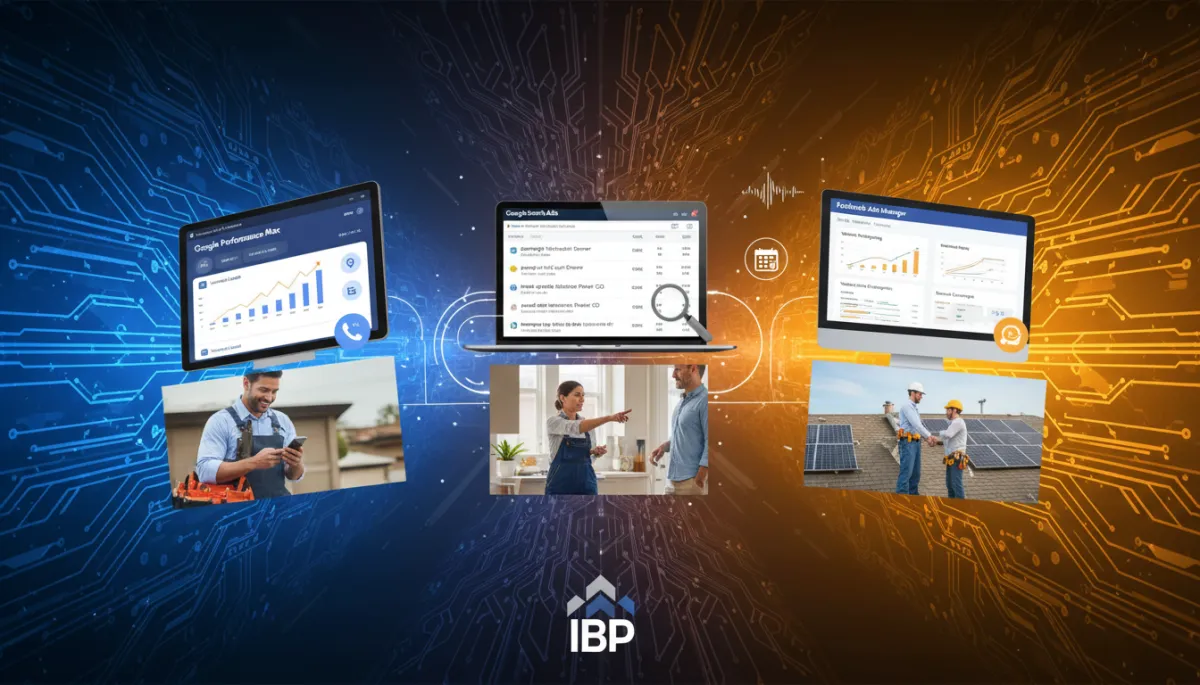
How IBP Runs Ads for Contractors
Contractor Marketing, Google Ads, Facebook Ads, Lead Generation
How AI-Managed Ads Help Colorado Contractors Get $8 Back for Every $1 Spent on Lead Gen
A clear, budget-tiered ad system for HVAC, plumbing, roofing, and electrical contractors who want predictable leads without becoming full-time marketers.
The One-Channel Trap: Why “We Tried Ads, They Don’t Work” Is Usually Wrong
Most contractors in the $700K–$1.5M range follow the same pattern. You pick one ad channel—maybe Google Local Services Ads, maybe regular Google Ads, maybe you boosted a few Facebook posts. You ride it up, leads spike for a bit, then things plateau or get more expensive. Eventually you say, “We tried that. It doesn’t work anymore.” If you’re wondering whether those ads are actually profitable, you can plug your numbers into the IBP ROI Calculator to see your real return.
The problem usually isn’t the channel. The problem is that no single channel covers the whole buyer journey. Homeowners don’t move in a straight line. They see a brand, search for options, compare reviews, click an ad, get distracted, come back later on a different device, and finally call whoever is easiest to reach right now. One isolated campaign can’t reliably follow that path, especially after Google’s August 2026 migration of Local Services Ads into Performance Max pay-per-lead campaigns inside Google Ads (see Google Ads migration details on support.google.com and Google Ads vs Local Service Ads for Contractors: The August 2026 Migration Update).
Instant Business Pro (IBP) solves this by running three channels as one coordinated system: Google Performance Max Pay-Per-Lead (the new version of LSA), Google Search PPC, and Facebook Ads. Each channel has a job. Each channel is turned on at the right budget level. And all of it is backed by Voice AI so leads are answered, qualified, and booked in real time through IBP’s AI-Powered Field Operations system.
Channel 1 — Google Performance Max Pay-Per-Lead: Your Lead Foundation
In August 2026, Google began folding standalone Local Services Ads into a new Performance Max Pay-Per-Lead (PMax PPL) campaign type inside Google Ads. The billing model is the same idea contractors loved about LSA: you pay only for verified leads, not for clicks or impressions (support.google.com, Performance Max pay-per-lead rollout 2026; see also Google Ads vs Local Service Ads for Contractors: The August 2026 Migration Update).
With PMax PPL, Google decides who sees your ad based on your business profile, service areas, and categories. There are no keywords to manage. Your ads can show across Google Search, Maps, and selected placements, but you’re only charged when a real homeowner reaches out—usually via a tracked phone call or message that Google flags as a valid lead. Invalid spam or obvious wrong numbers can be disputed, just like classic LSA.
For contractors without a dedicated marketing person, this is the logical starting point. It’s simple, it’s close to the bottom of the funnel, and it delivers a high volume of leads at the lowest cost-per-lead (CPL) when it’s set up and managed correctly. Across IBP accounts, typical CPL ranges look like this:
HVAC: $40–$80 per verified lead
Plumbing: $40–$80 per verified lead
Roofing: $50–$100 per verified lead
Electrical: $40–$70 per verified lead
That’s why IBP always activates PMax PPL first. It becomes the foundation of your contractor ad management in 2026 and beyond: a predictable flow of pay-per-lead calls that keeps your schedule full at the most efficient CPL the market will bear.
Channel 2 — Google Search PPC: Precision on Top of Volume
Once PMax PPL is doing its job, the next step is traditional Google Search PPC. This is the classic pay-per-click model: you choose keywords, write ads, send traffic to a landing page, and pay every time someone clicks. You get full control over:
Which keywords you show up for (and which you exclude)
The ad copy homeowners see in the search results
The landing pages they land on—tuned for conversion and tracking
Search PPC shines when you want to capture very specific, high-intent searches such as “emergency HVAC repair Denver,” “slab leak plumber near me,” “storm damage roof replacement,” or “panel upgrade electrician Parker CO.” These homeowners are not browsing—they’re hunting for someone to call now, often with higher average ticket values in play. For deep dives into niche campaigns like HVAC tune-ups, see IBP’s guide on AI-Powered HVAC Seasonal Tune-Up Campaigns.
Because competition is higher and you pay per click (not per lead), cost-per-lead benchmarks are higher than PMax PPL:
HVAC: $100–$200 CPL
Plumbing: $93–$150 CPL
Roofing: around $228 CPL
Electrical: around $93 CPL
IBP typically layers Search PPC in when your PMax PPL campaigns hit their volume ceiling—usually once you’re investing about $1,000–$1,500 per month in Google’s pay-per-lead system. At that point, Search PPC and PMax PPL run simultaneously and reinforce each other: homeowners see your PMax PPL listing, then your Search ad, then your reviews, which builds trust and increases your close rate.
When channels work together, contractors see steadier lead flow and clearer ROI per dollar spent. You can quantify that lift using the IBP ROI Calculator before scaling budgets.
Channel 3 — Facebook Ads: Retargeting and Seasonal Amplifier
Facebook is not your primary “emergency leak” lead source. Its real power for contractors is retargeting and awareness. IBP uses Facebook Ads to reach:
Homeowners who visited your website from Google but didn’t call
People who engaged with your content or watched your videos
Past traffic and lookalike audiences during seasonal pushes (AC tune-ups, furnace checks, gutter and roof inspections, panel upgrades before storm season, and so on)
Because these people already know your brand, Facebook retargeting can generate very efficient leads. For many IBP-managed contractors, overall Facebook CPL ranges from $12–$50, with retargeting campaigns dropping as low as $5–$15 per lead and close rates in the 35–50% range. That makes Facebook an excellent way to squeeze more revenue out of the traffic you’re already paying Google to generate, especially for HVAC contractors running tune-up offers like those in Boost HVAC Revenue with Facebook Ads in Colorado.
IBP typically activates Facebook once your total ad spend (Google plus Facebook combined) is around $1,500 per month or higher. At that level, you have enough traffic for retargeting to matter. Facebook becomes the amplifier, not the foundation—a way to stay in front of homeowners until they’re ready to book, particularly for HVAC seasonal campaigns outlined in AI-Powered HVAC Seasonal Tune-Up Campaigns.
The IBP Sequencing Framework: What to Run at Each Budget Level
The biggest mistake confused advertisers make is turning channels on and off at random. IBP uses a budget-tiered activation framework so each dollar goes to the right place at the right time.
Under $1,000/month: PMax Pay-Per-Lead Only
At this level, your goal is simple: maximize verified leads at the lowest CPL. All spend goes into Google PMax PPL. IBP focuses on tightening your service areas, categories, and profile so you’re showing up for the right jobs and disputing invalid leads promptly. For plumbing contractors, pairing this with automation like in AI Lead Automation for Plumbing Contractors can help ensure every paid lead is followed up automatically.
$1,000–$1,500/month: Add Google Search PPC
Once PMax PPL is maxed out for your area, IBP layers in Search PPC for your highest-value, highest-intent keywords. Think “tankless water heater install,” “roof replacement financing,” or “24/7 emergency electrician.” PMax keeps your phone ringing; Search adds precision for the jobs you most want. For after-hours plumbing emergencies, you can model campaigns on the strategies in Plumbing After-Hours Emergency Marketing Tips so those calls don’t get missed.
$1,500–$3,000/month: Add Facebook Retargeting and Seasonal Campaigns
At this stage, you’re generating enough Google traffic that not everyone will convert on the first visit. IBP introduces Facebook retargeting to follow those visitors around with offers, testimonials, and seasonal promotions. This is where many contractors see their overall blended CPL drop, because Facebook converts “near-miss” visitors into booked jobs at a much lower cost. HVAC companies can borrow playbooks from campaigns like Boost HVAC Revenue with Facebook Ads in Colorado to make these seasonal pushes even more effective.
$3,500+/month: Full Stack with Advanced Retargeting and Lookalikes
At higher budgets, IBP runs the full stack: PMax PPL, Search PPC, and Facebook, plus advanced retargeting and lookalike audiences built from your best customers. This is where contractors typically move from “keeping crews busy” to strategically filling the calendar with higher-margin work and smoothing out seasonal dips. For example, roofers can focus this stack on insurance and storm jobs using ideas from AI in Roofing: Boost Claim Success, while electricians can lean into panel upgrades with campaigns like AI-Powered Electrical Panel Upgrade Leads.
Why Voice AI Makes the Whole System Work
None of this matters if nobody answers the phone. Industry data and IBP call audits show that around 89% of HVAC contractors do not respond to new leads within an hour. Calls hit voicemail during jobs, after hours, or when your office manager is buried in paperwork. By the time someone calls back, the homeowner has already booked with a competitor who picked up first. To see how your own response times stack up, you can compare them against the Lead Response Benchmark Tool.
That’s why IBP bundles Voice AI with ad management. When a lead comes in from PMax PPL, Search PPC, or Facebook:
The AI answers immediately—no voicemail, no hold music
It qualifies the job using your rules (service area, job type, urgency, ticket size)
It books the appointment directly onto your calendar or dispatch board
Studies consistently show that responding within five minutes can increase close rates by up to 9x compared to callbacks an hour or more later. You can test the impact of faster follow-up on your pipeline using the Lead Response Benchmark Tool alongside your call logs. When your ad system and your phone system are connected through AI, you stop leaking money on missed calls and slow responses. Every dollar you spend on contractor ad management in 2026 has a much better chance of turning into booked revenue.
What IBP Actually Does for Contractors Day to Day
Most owners in the $700K–$1.5M range don’t want another platform login. You want leads you can trust, at a cost that makes sense, with reporting you can read in five minutes. IBP’s role is to manage the complexity so you don’t have to. Practically, that looks like:
Building and managing your PMax Pay-Per-Lead campaigns inside Google Ads, including disputes and optimization after the August 2026 migration
Running Google Search PPC with targeted keywords, ad copy, and landing pages tuned to your trade, city, and margins
Setting up and optimizing Facebook retargeting and seasonal campaigns that follow your Google traffic and past visitors
Integrating Voice AI call handling so leads are answered, qualified, and booked automatically, tying into IBP’s AI Field Operations system and broader AI-Powered Field Operations services
Providing a simple weekly performance snapshot—how many leads, from which channels, at what cost, and what booked revenue they’re turning into
You’re not logging into three dashboards and guessing which channel is working. IBP manages the strategy, budgets, creative, and optimization from a single integrated system. Your job is to keep your crews running efficiently and deliver great service to the homeowners who are already booked on your calendar.
If You’re Confused by the LSA Migration, Here’s Your Next Step
Google’s move to Performance Max Pay-Per-Lead has left a lot of HVAC, plumbing, roofing, and electrical contractors wondering what to do next. The old Local Services Ads dashboard is going away, reporting is changing, and you’re being pushed into a system that assumes you have a marketing department watching it every day (support.google.com, LSA to PMax migration timeline 2026–2027). For a contractor-focused breakdown of what’s changing, see Google Ads vs Local Service Ads for Contractors: The August 2026 Migration Update.
You don’t need to become a Google Ads expert or a Facebook media buyer. You need a clear, staged digital advertising strategy that:
Starts with PMax Pay-Per-Lead to lock in low-cost verified calls
Layers on Search PPC and Facebook as your budget grows and your goals expand
Uses Voice AI and field operations automation so every lead is answered and tracked through IBP’s AI-Powered Field Operations platform
If you want an expert team to manage your full ad stack—PMax Pay-Per-Lead, Google Search PPC, Facebook Ads, and AI-powered call handling—so you can focus on running your crews, schedule a call with IBP. You’ll walk away with a clear plan for your specific trade, market, and budget, whether you’re at $700K or pushing past $1.5M in annual revenue.
Book a strategy session with Austin here:https://links.instantbusinesspro.ai/widget/bookings/austin-work-calendar . You can also explore how IBP’s AI systems support dispatch, scheduling, and field operations at https://instantbusinesspro.ai/services/ai-powered-field-operations .
